
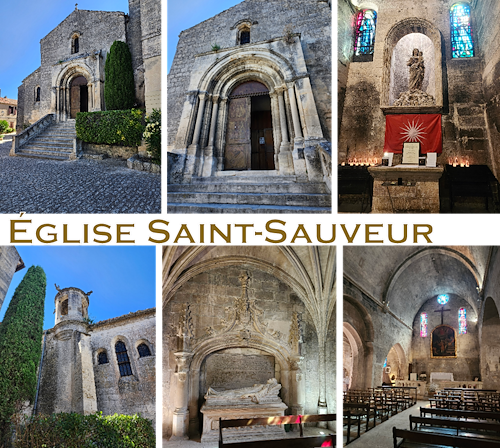
Located on Place Saint-Vincent in the heart of the village of Les Baux‑de‑Provence, Saint-Vincent Church is one of the most unusual monuments of the site. Built between the 12th and 16th centuries, it is partly carved directly into the limestone cliff, giving the building an almost troglodytic character.
Listed as a historic monument since 1886, the church is one of the oldest preserved buildings in the village.
A church dedicated to Saint Vincent
The church is dedicated to Vincent of Saragossa, a Spanish deacon who served Bishop Valerius in the 3rd century. He was martyred during the persecutions of Christians in the early 4th century and later became one of the most venerated saints in Western Christianity.
Saint-Vincent became the parish church of the village in 1481, when the former church of Saint-André, located in the valley below the village, was abandoned.
Originally, the church was linked to a priory belonging to the monastery of Saint‑Paul‑de‑Mausole, near Saint‑Rémy‑de‑Provence.
Architecture shaped by the cliff
The building follows an east-west orientation, in accordance with Christian symbolism. The west façade represents the darkness of the world, while the altar facing east symbolizes the light of Christ.
The church consists of three vaulted naves and several side chapels. The central nave, rising about twelve meters (39ft) high, dates from the 12th century and forms the oldest part of the structure. In 1609, the nave was extended eastward without altering the overall Romanesque harmony.
One of the most striking features of the church is its southern wall carved directly into the rock, a distinctive characteristic of architecture in Les Baux.
The church was restored in the nineteenth century, notably in 1862 by architect Henri Révoil.
Chapels and remarkable details
The church contains six side chapels. The chapel of the de Manville family, built in the 16th century, features a refined Gothic vault with decorative ribs. A neo-Gothic cenotaph made of Carrara marble, added in 1906, commemorates members of the family.
Several baptismal fonts can be seen in the right nave, including one carved directly into the rock that may have been used for immersion baptism.
In the central nave, a tombstone dated October 7, 1467, depicts a kneeling figure in prayer surrounded by a Latin inscription of the Ave Maria.
Some chapels were associated with local guilds, including shepherds and winegrowers, reflecting the pastoral and agricultural life of the region.
Stained glass and the link with Monaco
The church’s modern stained-glass windows were designed in the mid-20th century by French master glassmaker Max Ingrand. They were donated by Rainier III, Prince of Monaco, recalling the historical connection between Monaco and Les Baux, whose title of Marquis des Baux is traditionally borne by the heir to the Monegasque throne.
The Lantern of the Dead
On the southern side of the church stands a small circular turret topped with a domed roof and decorated with gargoyles, known as the Lantern of the Dead.
According to local tradition, a flame was lit there whenever a villager died, inviting passers-by to pray for the soul of the deceased.
Living traditions
Inside the church visitors can also see the small cart used during the Pastrage ceremony, an important Provençal Christmas tradition.
For more than four centuries, the midnight mass celebrated here on Christmas Eve has included the Pastrage, during which shepherds symbolically offer a newborn lamb to the Christ Child. The procession is accompanied by traditional Provençal music and villagers dressed in regional costumes.
 Simple Travel and Recreation