
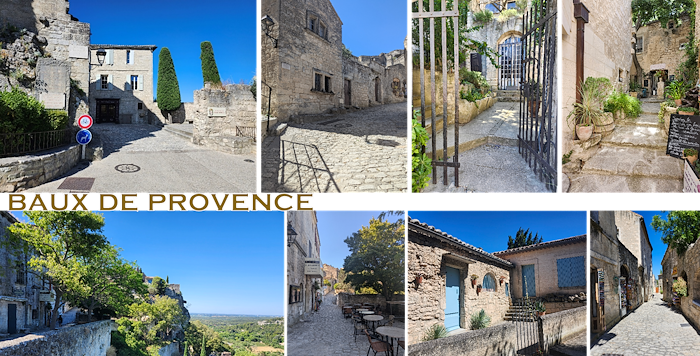
Located in the heart of the Alpilles massif, about 40 kilometers (25 miles) from Marseille, Les Baux-de-Provence rises above the valley from its rocky spur, perched at an altitude of 245 meters (800ft). This remarkable site, inhabited since prehistoric times, reached its peak during the Middle Ages under the authority of the powerful House of Les Baux, who claimed descent from the Magus Balthazar and controlled more than seventy surrounding villages.
The fate of the village changed dramatically in 1666, when the royal troops of Louis XIV suppressed the last local rebellions: the castle was dismantled, the fortifications destroyed, and the village entered a long period of decline. It was not until the 19th century that Les Baux was rediscovered by artists, writers, and travelers, drawn by the austere beauty of its ruins and the magic of its landscape.
Today listed among the “Most Beautiful Villages of France,” the village offers a picture-postcard setting: endless olive groves, dry-stone walls, slim cypress trees, wind-sculpted rocks, and houses with pastel shutters. Every street tells a story, and every viewpoint opens a window onto timeless Provence.
Map : https://www.lesbauxdeprovence.com/wp-content/uploads/2021/02/Plan-Village-FR-VF.pdf
Les Baux-de-Provence offers a unique immersion into a mineral landscape where medieval ruins, Renaissance heritage, and exceptional panoramic views come together.
Overview of Sites to Discover
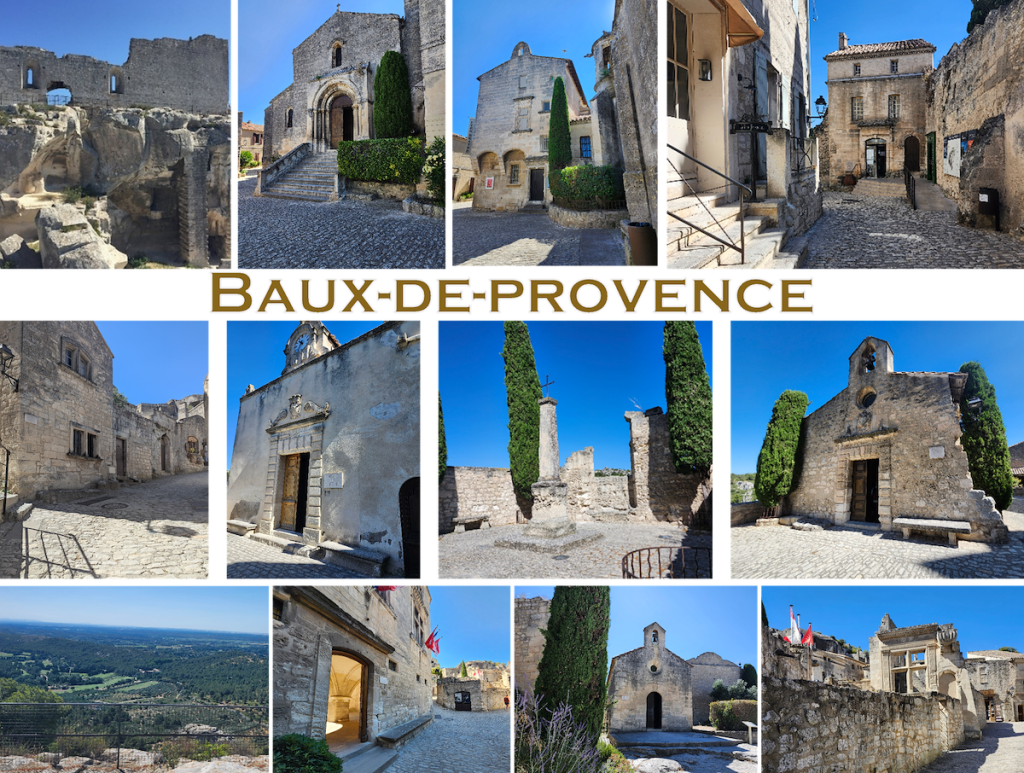
1. The Castle and the Hilltop Plateau
- Château des Baux: An impressive ruined fortress overlooking the valley, reflecting the power of medieval lords.
- Ramparts and towers: Defensive remains that still outline the former citadel.
- Troglodyte rooms: Rock-carved spaces once used for shelter, storage, and daily life.
- Siege machines: Reconstructions of trebuchets and catapults illustrating medieval warfare.
- Panorama: Spectacular views over the Alpilles, the Camargue, and, on clear days, the Mediterranean.
- Esplanade du château : Vaste espace ouvert vue sur le château, aperçu des machines de guerre reconstituées, un ancien moulin, et un panorama spectaculaire sur les Alpilles.
Theme: power, defense, landscape
2. The Religious Heart and Upper Square
- Place Saint-Vincent: A shaded square serving as both a resting spot and a scenic viewpoint.
- Saint-Vincent Church: A Romanesque building partly carved into the rock, emblematic of the village.
- Chapel of the White Penitents: A site linked to religious brotherhoods and local traditions.
- Monumental cross: A religious symbol marking the space and recalling historical practices.
- Saint-Blaise Chapel: A small, discreet chapel located near the castle, associated with local devotional practices and the spiritual life of the plateau.
Theme: spirituality, community life
3. Renaissance and Artistic Heritage
- Hôtel de Porcelet: An elegant Renaissance townhouse now housing the Yves Brayer Museum.
- Cour de Porcelet: A former school courtyard now transformed into a peaceful, well-preserved medieval space.
- Louis Jou Foundation: A workshop-museum dedicated to typography and fine printing.
- Place Louis Jou: A small square named after the artist, located in the heart of the village.
- Place François de Hérain: A small square offering a quiet breathing space within the dense medieval fabric of the village.
- Hôtel de Manville: An elegant Renaissance townhouse reflecting the wealth and influence of Les Baux’s noble families.
- Place Rainier III: A square named in honor of the Prince of Monaco, highlighting the historical ties between Les Baux and the Grimaldi family.
Theme: art, culture, village revival
4. Witnesses of the Reformation and the 16th Century
- Post Tenebras Lux window: A Renaissance remnant bearing a Calvinist motto from 1571.
- Brisson-Peyre House: A former residence likely linked to the local Protestant presence.
- Hôtel de Manville: A major Renaissance building reflecting the village’s prosperity at the time.
Theme: religious history, Protestantism, architecture
5. The Village Entrance and Transition Spaces
- Charles-de-Gaulle Esplanade: A large modern reception area offering a first panoramic view.
- Place Georges Pompidou: A transitional space marking the threshold between the modern world and the medieval village.
- Porte Mage Square / Street: A small area located in front of the former fortified entrance.
- Maison du Roy: A 15th-century judicial building now serving as the tourist office. Look for the Bauxite rock next to it.
- Visible ruins: Remains of old houses clinging to the rock, visible upon arrival.
- Wayside cross: A modern cross serving as a visual landmark at the entrance.
- Porte d’Eyguières: The former main entrance to the village until the 19th century, this fortified gate once controlled access to Les Baux.
Theme: transition between modern and medieval worlds
6. Everyday Life and Village Architecture
- Narrow streets: Typical paved lanes structuring the medieval village.
- Stone houses: Traditional buildings adapted to the rocky terrain.
- Troglodyte dwellings: Homes partly carved into the rock, characteristic of Les Baux.
- Stairways and passageways: Stone paths connecting the different levels of the village.
- Santons Museum: A museum dedicated to traditional Provençal santons—handcrafted figurines depicting local life and trades.
Theme: daily life, medieval organization
7. The Cemetery of Les Baux
- Former garden (1681): A space converted into a cemetery in the late 17th century.
- View over the Val d’Enfer: A striking panorama of a dramatic rocky landscape.
- Graves of notable figures: Burial site of artists and personalities linked to the village.
Theme: memory, cultural heritage
Must-See Sites Around the Château
A visit to the château and medieval village is often the highlight of a day in Les Baux-de-Provence. However, several major sites lie just nearby and are well worth exploring. Often discreet and not clearly signposted, they offer a richer, more complete experience of the region. Since you’re already here, this is the perfect opportunity to discover them.
The Carrières de Lumières
Just a few minutes from the village, the Carrières de Lumières are set within former limestone quarries transformed into an immersive art space. Each year, monumental projections bring great artists’ works to life across vast rock walls.
While the themes change, the site itself is always striking: a vast underground environment where stone, light, and sound interact. The entrance is relatively discreet, making it easy to miss—yet it is one of the most unique cultural experiences in Provence.
Olive groves and mills of the Vallée des Baux
Surrounding the village are olive groves producing the renowned Huile d’olive AOP Vallée des Baux-de-Provence. Several estates welcome visitors, including Domaine Castelas, Moulin du Calanquet, and Domaine de l’Olivette.
These sites offer tastings and insights into traditional production methods, all set within beautiful Provençal landscapes. Often located along small, discreet roads, they are rarely stumbled upon by chance.
Wine estates of Les Baux-de-Provence
The region also produces wines under the AOP Les Baux-de-Provence, known for elegant reds and aromatic rosés. Nearby estates include Mas de la Dame, Domaine de Hauvette, Château d’Estoublon, and Terres Blanches.
These vineyards, often set in preserved natural surroundings, are not immediately visible to passersby. Visiting them offers a deeper understanding of the Alpilles’ terroir and its strong connection to local winemaking traditions.
Conclusion
Les Baux-de-Provence is best experienced as a journey through time, where each site—whether monumental or discreet—contributes to telling the story of a village shaped by stone, light, and human presence.
Note : Etymology
The name of the village comes from the Provençal word “Baou,” meaning a rocky outcrop, steep cliff, or natural promontory. Les Baux-de-Provence thus owes its name directly to its geography: a series of rocky heights overlooking the valley, shaped by wind and time. The plural form is no coincidence, but rather a direct reflection of the dramatic landscape on which the village developed. This etymology reminds us that the site is above all a place of stone and elevation—a mineral stronghold that has naturally attracted human settlement since prehistoric times.
The name of the powerful House of Les Baux derives directly from this territory. As the village is built upon several baous, the lords naturally adopted the name of the land they dominated. In this way, the landscape gave its name to the village, and in turn to the lineage that shaped its history for centuries.
 Simple Travel and Recreation