
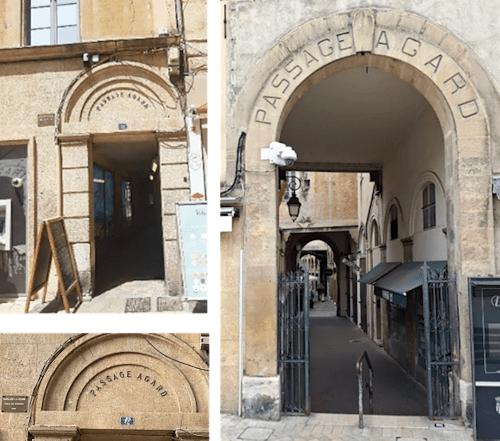
55 cours Mirabeau
The Passage Agard was created in 1846 by Félicien Agard, a prominent citizen of Aix-en-Provence and a major landowner. The passage was opened across part of the former grounds of the Convent of the Great Carmelites, a religious complex founded in the Middle Ages outside the city walls.
The convent originally included a church, cloister, monastic buildings, and a cemetery. During the French Revolution, the complex was confiscated and declared national property. Over time, the buildings were partially demolished or repurposed. In the 19th century, Agard acquired a portion of the site and transformed it to serve the evolving needs of the city.
Rather than preserving the original monastic layout, Agard chose to create a direct pedestrian route through the property, reflecting the spirit of urban modernization characteristic of the period.
A 19th-century urban planning solution
The Passage Agard represents a practical and elegant response to circulation needs in the historic center. It connects the Cours Mirabeau (No. 55) directly to the Place du Palais de Justice, forming the shortest and most frequently used pedestrian link between these two major urban spaces.
While it shares certain characteristics with the commercial passages that appeared in many French cities during the 19th century, Passage Agard differs from the classic Parisian model: it is not a fully enclosed shopping arcade but rather a semi-open urban passage.
A straight yet constrained layout
The passage follows a nearly straight line measuring approximately 90 meters and can be crossed in one to two minutes. Its southern entrance, however, narrows noticeably.
This unusual configuration may reflect an unresolved property negotiation: Félicien Agard was unable to acquire the neighboring property at No. 57 Cours Mirabeau. As a result, the entrance retains a visible bottleneck that creates the distinctive funnel-shaped approach still seen today.
A partially covered, light-filled passage
Unlike the grand glazed arcades of Paris, the Passage Agard is only partially covered. Certain sections are sheltered by built structures, while other parts remain open to natural light, creating the impression of a space halfway between an interior gallery and an outdoor street.
This semi-open character contributes to the passage’s distinctive atmosphere and reinforces its role as a transitional space within the urban fabric.
At night, iron gates close the passage at both ends, emphasizing its status as a semi-private thoroughfare integrated into the surrounding buildings.
Architecture shaped by the remains of the convent
One of the passage’s most remarkable features lies in the architectural traces of the former Carmelite convent that remain visible within several shops. Although the passage itself dates from the 19th century, Agard incorporated and reused parts of earlier structures, particularly in the northern section.
Observant visitors may notice:
- vaulted ceilings reminiscent of former religious spaces
- ancient arcades integrated into the walls
- sections of older masonry identifiable by irregular stonework
These elements correspond to areas once occupied by the convent buildings and the Church of La Madeleine, creating a rare dialogue between medieval religious architecture and contemporary commercial use.
A discreet but rewarding heritage site
For visitors, the Passage Agard offers a subtle but rewarding historical experience that can easily be overlooked at first glance. Behind modern shopfronts lies a layered architectural history in which monastic heritage, 19th-century urban development, and present-day commercial life coexist.
Located just steps from the Palais de Justice, the Cours Mirabeau, and many of the city’s historic landmarks, the passage naturally forms part of walking itineraries through the historic center. Its quieter atmosphere and intimate scale offer a welcome contrast to the busier streets nearby.
Cézanne and the hat maker’s shop
At the entrance to the Passage Agard, at 55 Cours Mirabeau, stood in the 19th century the hat-making shop of Louis-Auguste Cézanne, father of the painter Paul Cézanne. The shop, strategically located at the entrance to the passage and along the prestigious Cours Mirabeau, was a successful business.
Louis-Auguste Cézanne later left the hat-making trade and became a banker, eventually founding the Cézanne & Cabassol bank, which brought the family considerable financial stability. Paul Cézanne spent part of his youth in this immediate environment, growing up in the heart of Aix’s commercial and social life.
Today the building is occupied by a bank, but it still marks the symbolic entrance to the passage and forms a tangible link between the city’s urban history and the life of one of the founders of modern painting.
Contemporary ownership and restoration
The Passage Agard is currently owned by a private real-estate company that acquired the property in 2020 for approximately €12 million. The purchase initiated a redevelopment and restoration project carried out in collaboration with architects and heritage specialists.
The aim of the project is to preserve the historical character of the site while adapting it to contemporary commercial and urban uses.
A place of transition between past and present
At once the site of a former convent, a 19th-century urban creation, and a lively commercial passage, the Passage Agard embodies a layered urban history.
For many residents it remains simply a convenient shortcut between two important squares. For attentive visitors, however, it reveals itself as a place where centuries of history quietly intersect within the everyday life of Aix-en-Provence.
 Simple Travel and Recreation