
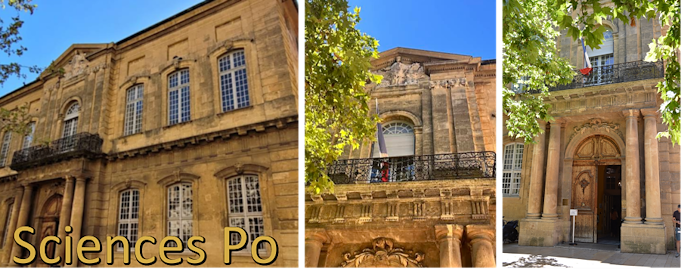
25 Rue Gaston-de-Saporta
Unlike the aristocratic townhouses that characterize much of Aix-en-Provence’s historic center, the building at 25 Rue Gaston-de-Saporta was conceived as an institutional structure dedicated to higher education. For more than five centuries, this site has been associated with legal scholarship and intellectual life in the city.
Origins: A University Founded in 1409
The University of Aix was founded in 1409 by Louis II of Anjou, Count of Provence. From the outset, the Faculty of Law became one of its principal pillars, reflecting the city’s growing importance as a judicial and administrative center, particularly after the establishment of the Parliament of Provence in the 16th century.
The medieval university buildings once occupied this area near what was historically known as the Place de l’Université, in close proximity to the cathedral and the former ecclesiastical and civic centers of power.
Architectural Evolution of the Present Building
The structure visible today largely reflects successive rebuilding and remodeling campaigns carried out during the 17th and 18th centuries. Rather than being entirely reconstructed at a single moment, the complex evolved gradually to accommodate the needs of a growing faculty.
Works undertaken in the 18th century are partly attributed to the Aixois architect Georges Vallon, who was active in several major projects across Aix at the time. These interventions contributed to the building’s current classical character.
Architectural Characteristics
The façade presents a restrained classical composition typical of institutional architecture in Provence:
- Balanced proportions
- Regular window alignment
- Sober decorative vocabulary
- Emphasis on symmetry and clarity
The overall design reflects the dignity and authority appropriate to a faculty of law in an important judicial city.
A significant later addition is the allegorical pediment sculpted in 1883 by Hyppolite Ferrat. This sculptural ensemble symbolizes learning and scholarship and reflects the values of the Third Republic, reinforcing the building’s identity as a temple of knowledge.
A Continuous Academic Tradition
The site has maintained its educational vocation without interruption. Over the centuries, it trained jurists, magistrates, and public officials who played key roles in French political and intellectual life.
Among its most notable students were:
- Jean-Étienne-Marie Portalis, principal architect of the Napoleonic Civil Code
- Adolphe Thiers, President of the French Republic
- Frédéric Mistral, Nobel Prize laureate in Literature
- Paul Cézanne, who enrolled in law on December 16, 1858
Their presence illustrates the central role of the Aix Faculty of Law in shaping figures of national importance across disciplines.
From Faculty of Law to Sciences Po Aix
In the 20th century, the evolution of French higher education led to institutional transformation. Today, the building serves as the headquarters of Sciences Po Aix (Institut d’Études Politiques), continuing a long-standing tradition of legal, political, and administrative training.
While the institution has modernized its curriculum and facilities, the historic building remains a powerful symbol of continuity between medieval university origins and contemporary political science education.
A Living Heritage Site
More than an architectural landmark, the former Faculty of Law building represents one of the oldest continuously active centers of higher education in France. Its sober classical façade, its allegorical pediment, and its enduring academic mission embody the intellectual heritage of Aix-en-Provence — a city shaped not only by aristocratic residences and artistic patronage, but also by scholarship, jurisprudence, and public service.
Note: located in front of the Saint-Sauveur Cathedral
 Simple Travel and Recreation