
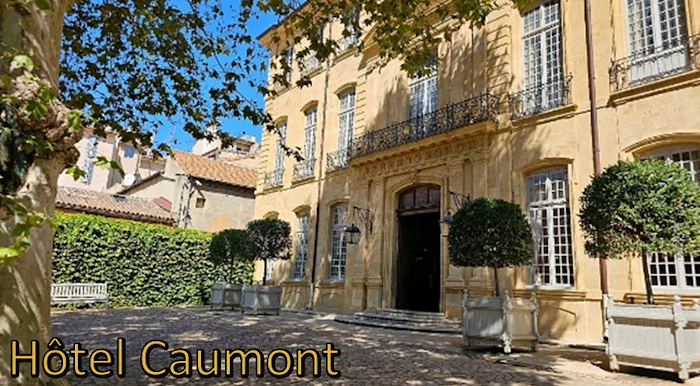
3 Rue Joseph Cabassol
Located in the heart of the Mazarin quarter, the Hôtel de Caumont is one of the most remarkable private mansions in Aix-en-Provence. Built in the 18th century following the classical “courtyard and garden” layout, it reflects the architectural ambition and refinement of the city’s parliamentary elites during the early modern period.
The hôtel is part of the larger urban project of the Mazarin quarter, developed from the mid-17th century to host the city’s administrative and judicial elites. In terms of size, placement, and architectural quality, it stands among the most ambitious constructions of this new district, designed as a showcase of power and prestige in Aix.
Origins and Design of an Exceptional Residence
The Hôtel de Caumont project was initiated in 1715 by François Rolland de Réauville, Marquis de Cabannes, president of the Cour des Comptes, Aides et Finances of Provence. Seeking a residence worthy of his rank, he commissioned Robert de Cotte, First Architect to the King, to provide the initial design of a mansion that would stand out from others in the quarter.
Construction was carried out by the renowned Aixois architect Georges Vallon, beginning on April 4, 1715. Although the marquis died shortly after the start of construction, the project continued under the guidance of his descendants and Vallon. The hôtel was completed in the 1740s and represents a fully realized example of classical Aixois architecture, characterized by balanced volumes and high-quality decorative details.
Prestigious Owners at the Heart of Aixois Life
Originally known as Hôtel de Réauville, the building was sold in 1758 to François Bruny de la Tour-d’Aigues, a wealthy shipowner, merchant, and banker from Marseille. Under his ownership, the hôtel became known as Hôtel de Bruny.
At the end of the 18th century, the residence passed to Pauline de Bruny de la Tour-d’Aigues. Her marriage to Amable de Seytres, Marquis de Caumont, gave the hôtel its definitive name: Hôtel de Caumont. Pauline de Caumont remained deeply attached to the house, which symbolized both her youth and her family heritage.
From Decline to Cultural Renewal
In the 19th century, following Pauline de Caumont’s death, the hôtel changed hands several times and gradually lost its original aristocratic function. Like many Aixois mansions, it underwent interior divisions and varied uses that partially altered its original state.
In the 20th century, the city of Aix-en-Provence acquired the building in 1964, and it became the Darius Milhaud Conservatory of Music and Dance, thereby regaining a cultural and artistic function.
Heritage Recognition and Cultural Revival
The Hôtel de Caumont has benefited from progressive heritage protection: its monumental staircase was listed as a historic monument in 1925, before the entire building was officially classified in 1990.
In the early 21st century, the hôtel underwent a comprehensive restoration managed by Culturespaces, respecting its architecture and original décor. The site reopened to the public on May 6, 2015, under the name Caumont – Art Centre. It now hosts major temporary exhibitions, concerts, conferences, and a permanent film about Cézanne and the region of Aix.
The opening of the site as an art center continues Aix-en-Provence’s long-standing artistic tradition. While not directly connected to Paul Cézanne’s work, the Hôtel de Caumont today contributes to the cultural landscape, fostering a dialogue between heritage, contemporary creation, and art history.
Remarkable Architectural and Landscape Heritage
Visitors to the Hôtel de Caumont can explore emblematic spaces of 18th-century aristocratic life, including the ceremonial rooms, the garden, and the interior circulation areas. The French-style garden is one of the hôtel’s most significant features: in a dense urban neighborhood, its size and formal layout assert the social status of the original owner while extending the architectural composition into a space for representation and retreat.
The monumental staircase, whose heritage value was recognized early, can be interpreted as a structuring element of the interior design. The monumental staircase exemplifies the spatial hierarchy characteristic of large 18th-century aristocratic residences.
A Major Witness to Aix’s History
Through its role in the Mazarin quarter’s urban project, the quality of its architecture, the presence of a remarkable garden, and the continuity of its cultural uses, the Hôtel de Caumont stands as a major witness to the urban, artistic, and cultural history of Aix-en-Provence.
As both a legacy of 18th-century aristocratic prestige and a venue for contemporary creation, it embodies today the fruitful dialogue between heritage and cultural life at the heart of the city.
 Simple Travel and Recreation