
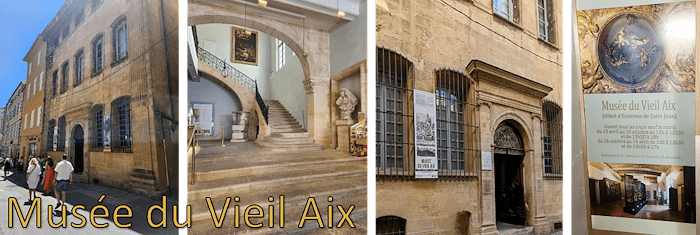
17 rue Gaston-de-Saporta
Housed in the former Hôtel d’Estienne de Saint-Jean at 17 rue Gaston-de-Saporta, the Musée du Vieil Aix is one of the main sites devoted to the history, traditions, and identity of Aix-en-Provence. Established in the early 1930s, the museum aims to preserve, study, and share the city’s memory, from its medieval origins to the 19th century, through rich and varied collections.
The Hôtel d’Estienne de Saint-Jean
Architecture and history of an Aix-en-Provence townhouse
The museum is housed in an Aixois townhouse dating from the second half of the 17th century. Developed for the Estienne de Saint-Jean family—members of the parliamentary nobility closely connected to the city’s judicial and municipal institutions—the residence was subsequently modified over time.
Located in the Saint-Sauveur district, in the heart of the old town, the hôtel is part of a dense urban fabric, close to the Saint-Sauveur Cathedral and the city’s former religious and judicial centers.
A residence born from the merging of medieval houses
The Hôtel d’Estienne de Saint-Jean was not constructed from scratch. It resulted from the gradual merging of several medieval houses between the 17th and early 18th centuries, forming a residence befitting the social status of its owners.
This practice was common in Aix-en-Provence, where urban elites preferred to adapt and unify existing buildings rather than rebuild entirely. Despite the unification, the hôtel retains in its volumes, circulation patterns, and certain irregularities, traces of this diverse origin that are still perceptible today.
Architectural description
The hôtel features sober and elegant architecture, characteristic of Provençal classicism. The façade, made of local stone, is arranged around regular openings, reflecting measured taste and restrained decoration.
The interior is organized around a central courtyard, ensuring light, ventilation, and the distribution of spaces. The staircases, salons, and reception rooms have still reflects the hierarchical distribution typical of 17th- and 18th-century aristocratic residences.
The birth of the Musée du Vieil Aix
In the early 20th century, amid growing awareness of heritage preservation, the municipality of Aix-en-Provence sought to create a space dedicated to the city’s historical and cultural memory.
The Hôtel d’Estienne de Saint-Jean was chosen for its heritage value and central location.
The museum opened to the public in the early 1930s, under municipal initiative, with the mission of safeguarding objects, images, and testimonies threatened by urban transformations and societal modernization. The townhouse thus became a place of preservation and transmission, maintaining continuity with its residential history while being reinterpreted for cultural purposes.
The collections: history, traditions, and lifestyle
The Musée du Vieil Aix collections trace the city’s development through:
- Domestic and artisanal objects
- Antique furniture and costumes
- Paintings, engravings, and drawings
- Urban plans and models
- Documents related to festivals, brotherhoods, and Provençal traditions
Particular attention is given to municipal life, the role of the Parliament of Provence, and the organization of neighborhoods, offering a nuanced understanding of Aix-en-Provence’s social, political, and cultural construction.
A discreet yet essential heritage landmark
Less well-known than the city’s major art museums, the Musée du Vieil Aix plays an important role in preserving collective memory. It reminds us that Aix-en-Provence is above all a city shaped by the daily life of its inhabitants, their traditions, and their history.
Through its location in a remarkable townhouse and the richness of its collections, the museum provides a valuable link between past and present, offering a sensitive and in-depth understanding of Aixois identity.
 Simple Travel and Recreation