
Three Distinct Mansions, One Aristocratic Name
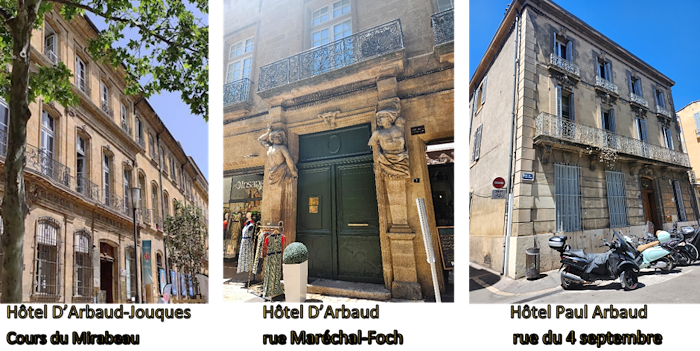
In Aix-en-Provence, the name Arbaud refers not to a single residence but to three distinct hôtels particuliers located within the historic center. Belonging to different branches of a prominent family of the parliamentary nobility of Provence, these residences reflect successive expressions of wealth, prestige, and social ambition from the 17th to the 19th centuries.
Although architecturally independent, they collectively illustrate the role of magistrate families in shaping the urban and cultural identity of Aix.
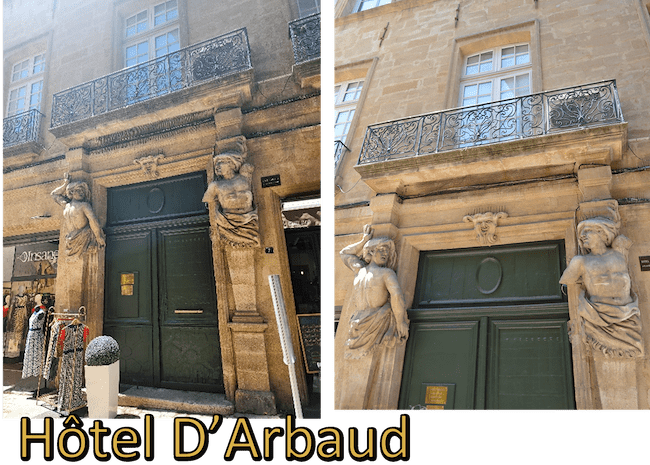
1. Hôtel d’Arbaud
7 Rue Maréchal-Foch — Arbaud de Jouques Branch
Located near Place Richelme, the Hôtel d’Arbaud is a 17th-century townhouse, built around 1670 for the Arbaud de Jouques branch of the family.
Architecture and Sculpture
The façade, made of Bibémus stone, is symmetrically organized across three levels. A monumental portal, attributed to Aix sculptor Jean-Claude Rambot, dominates the building.
The portal is delimited by sculpted male atlantes supporting a wrought-iron balcony, an expressive example of Provençal Baroque ornamentation.
History and Status
Built for a member of the Arbaud de Jouques family, active in the Parliament of Provence, , the hôtel reflects a generation marked by symbols of power and martial prestige.
It is not individually listed as a Historic Monument but forms part of the protected historic center of Aix-en-Provence
2. Hôtel d’Arbaud-Jouques
19 Cours Mirabeau
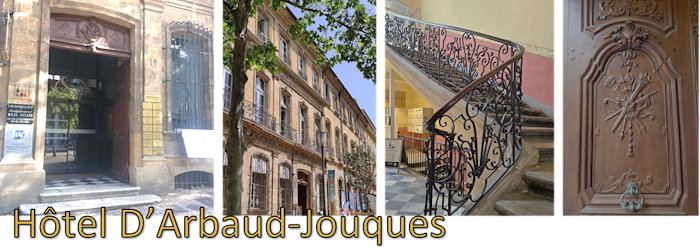
The Hôtel d’Arbaud-Jouques, located on the Cours Mirabeau, is the largest and most prestigious of the three. Built in the early 18th century (c. 1700–1720) for Elzéar d’Arbaud de Jouques, president of the Parliament of Provence, it is attributed to architect Jean-Baptiste Franque.
Monumental yet Refined Façade
The façade spans eight bays and follows a hierarchical classical composition, with increasingly refined orders on the upper levels:
- Doric on the ground floor
- Ionic on the first floor
- Giant pilasters unify the composition
Despite its size, the hôtel blends discreetly into the avenue. The portal is adorned with military trophies, while wrought-iron balconies bear the monogram “AJ” and the presidential mortar, symbolizing high judicial office.
Interiors and History
Interiors reflecting successive Louis XV and Louis XVI decorative campaigns. In 1812, it hosted Charles IV of Spain during his exile.
Listed as a Historic Monument, it remains a private residence, visible only from the street.
3. Hôtel Paul Arbaud
2 and 2A Rue du Quatre-Septembre — Historic Townhouse and Academic Museum
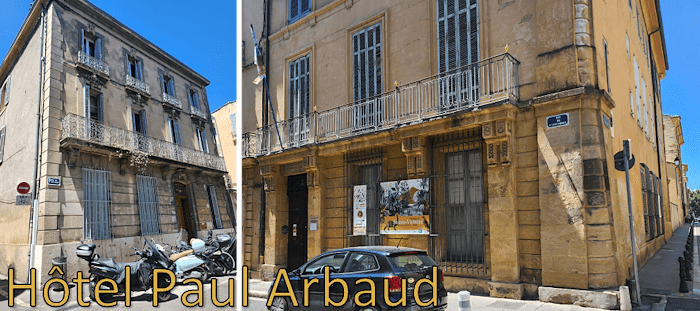
At the entrance to the Mazarin district, the Hôtel Paul Arbaud is a 17th-century townhouse distinguished by a restrained, classicizing style. Unlike the other Arbaud hôtels, it is closely linked to Aix’s intellectual and cultural life.
Architecture
The n° 2 façade features three regular levels articulated by sober classical pilasters. A rounded-arch portal surmounted by a central early 18th-century wrought-iron balcony in the French Régence style.
Paul Arbaud and His Legacy
The hôtel is named after Paul Arbaud (1832–1901), a scholar, bibliophile, and philanthropist. He transformed the family home into a cabinet of curiosities, housing rare books, manuscripts, paintings, faiences, and objets d’art.
In 1901, he bequeathed his collections to the Académie des sciences, agriculture, arts et belles-lettres d’Aix, ensuring their preservation and integrity.
Two Buildings, One Heritage
- Hôtel Paul Arbaud (n° 2) is the historic private residence inscribed as a Historic Monument (includes: façades, staircase, and garden).
- The Musée-Bibliothèque Paul Arbaud (n° 2A), located across Rue Mazarine, houses the collections in a separate building. This structure was later adapted to preserve Arbaud’s legacy and was not originally part of his private residence.
These two sites, physically separate but historically connected, form a unique cultural ensemble in Aix-en-Provence.
Current Status
The Musée-Bibliothèque Paul Arbaud (2A) operates as a private museum and library, open by appointment. Since 2014, it is no longer a municipal museum.
Conclusion
The hôtels d’Arbaud, d’Arbaud-Jouques, and Paul Arbaud illustrate different expressions of power, taste, and ambition within Aix’s parliamentary nobility.
While not architecturally unified, together they form a symbolic ensemble, revealing the decisive role of noble magistrates in Aix’s urban, cultural, and artistic development.
These residences demonstrate that behind a shared name can lie distinct histories, styles, and purposes, each leaving a lasting mark on the cityscape.
 Simple Travel and Recreation