
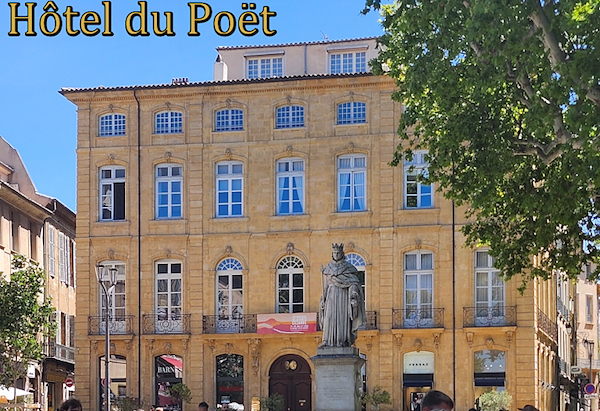
3 Place Forbin
Standing proudly at 3 Place Forbin, where the Cours Mirabeau meets the heart of Aix-en-Provence, the Hôtel du Poët embodies the refinement and ambition of 18th-century Provence. Built in 1730 by architect Georges Vallon and was commissioned by Henri Gautier, later known as Gautier du Poët, Treasurer of the Estates of Provence. it symbolized the rise of a man who gained nobility through the purchase of the lands of Le Poët near Sisteron.
Before the mansion was built, the site is believed to have previously accommodated a mill, reflecting the area’s activity before the urban expansion of the Cours Mirabeau.
An Elegant Baroque Façade
The Hôtel du Poët’s baroque façade remains one of the finest examples of Aixois architecture. Its composition features stone rustication, expressive mascarons (sculpted faces), and a central wrought-iron balcony in Louis XV style, supported by lion-head brackets.
The façade is richly animated with sculpted mascarons—male and female faces, as well as vegetal motifs—distributed across the upper levels. The grand carriage entrance, framed by Doric pilasters, completes this balance of grace and authority, typical of Aix’s noble residences.
A Living House Through the Ages
Over the centuries, the Hôtel du Poët has reinvented itself while remaining central to urban life. In 1777, the Penet and Sure bookstore occupied part of the building, later transformed into a reading room by the Terris family. The commercial court sat there until 1834, and the ground floor successively housed an apothecary, a printer, a carriage rental, and even a taxi office.
In the 19th century, printing activities operated within the building, continuing its association with intellectual and commercial life.
A Protected Symbol of Aix’s Heritage
Since its listing as a Historic Monument in 1987, the Hôtel du Poët has stood as a majestic landmark closing the Cours Mirabeau, directly facing the Fountain of King René. Today, the Hôtel du Poët remains one of the most distinguished 18th-century private mansions in Aix-en-Provence, marking the transition between the medieval town and the planned urban elegance of the Cours Mirabeau.
 Simple Travel and Recreation