
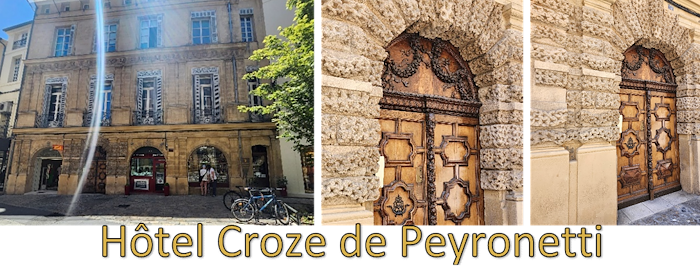
13, rue Aude
A distinctive façade at the heart of Aix-en-Provence’s history
Located near the Mazarin quarter, the Hôtel Croze de Peyronetti occupies a unique place in the architectural landscape of Aix-en-Provence. Unlike many townhouses built during the large-scale development of the Mazarin district in the 17th century, part of its façade predates this urban program. The building thus serves as a living link between the Renaissance city and the classical city that gradually developed around Saint-Sauveur Cathedral.
An ancient façade and its architectural significance
The oldest façade is generally attributed, based on stylistic criteria, to Paul Lombard (c. 1562–1600), a major Aixois architect of the late 16th century. Its design reflects the influence of Italian Mannerism, rare in the city, characterized by freer proportions, a cultivated elegance, and particular attention to sculptural detail. While the exact attribution cannot be confirmed by contemporary documents, this façade remains a valuable testimony to late Renaissance architecture in Aix and illustrates the subtle transition between late Gothic and classical language.
It was precisely this singular façade and its distinctive frieze that caught my attention on site: without this detail, I likely would not have lingered at the Hôtel Croze de Peyronetti or embarked on research to uncover its history. This personal discovery highlights the visual and memorable impact of architecture, capable of sparking curiosity and exploration.
Successive transformations
Around 1620, the building underwent further modifications, probably under the direction of Jean Lombard, with the addition of an upper floor to meet evolving residential needs. This layering of periods remains visible today and enriches the reading of the building. The current portal, dating from the 18th century, is distinguished by its sculpted frame and prominent vermiculated bossing, a rare Mannerist detail in Aix that accentuates the interplay of light and shadow, reinforcing the hotel’s singular character from the very entrance.
A distinctive frieze and Italian influence
One of the most remarkable features of the Hôtel Croze de Peyronetti is its sculpted frieze, rare in Aix’s residential architecture. Both decorative and symbolic, it demonstrates the owners’ desire for distinction and reflects the enduring Italian influence in local architectural culture at the end of the 16th and beginning of the 17th centuries. This attention to detail, visible on the façade and in the proportions, emphasizes the importance of aesthetics and refinement for the affluent families of the time.
A place of memory and intellectual life
The hotel is also linked to Aix’s cultural memory. According to local tradition, it was the birthplace of a notable Aixois figure known as Moillis. While documentary evidence is limited, this tradition places the hôtel within an intellectual and social context where townhouses served as spaces of life, education, and cultural exchange, close to the Parliament of Provence and humanist circles of the city. The Hôtel Croze de Peyronetti thus serves not only as an architectural witness but also as a reflection of Aix’s intellectual and social life in the 16th and 17th centuries.
A precious witness of Aix’s heritage
Discreet yet remarkable, it reminds us that Aix’s heritage is not limited to its grand monuments but can also be read in these refined buildings, carriers of memory and urban identity.
Private property – not open to the public.
 Simple Travel and Recreation