
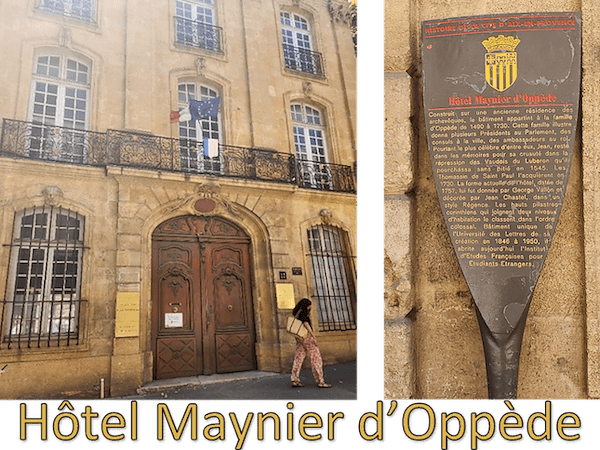
23, rue Gaston de Saporta
A Residence of Parliamentary Power in the Heart of Aix-en-Provence
Located at 23 rue Gaston de Saporta, in close proximity to Saint-Sauveur Cathedral, the Hôtel Maynier d’Oppède is one of the oldest private townhouses in Aix-en-Provence. Set within the historic urban fabric of the city, it bears witness to the continuous aristocratic and institutional occupation of the old town since the late Middle Ages.
A Magistrates’ Residence for Nearly Two and a Half Centuries
For nearly two hundred and forty years, from the late fifteenth century until the first third of the eighteenth century, the Hôtel Maynier d’Oppède was the residence of a single lineage of magistrates: the Maynier d’Oppède family. This exceptional continuity firmly anchors the building in the political and judicial history of Aix-en-Provence, at a time when proximity to the Parliament of Provence strongly shaped the residential geography of the urban elites.
The family’s presence is documented from 1490, when Accurse Maynier d’Oppède, a magistrate and juge-mage of Provence, acquired the house and established his lineage there. His son, Jean Maynier d’Oppède (1495–1558), profoundly marked the history of Provence by becoming First President of the Parliament of Provence in the sixteenth century. A central figure in the institutional life of his time, he embodied the highest level of judicial authority in Aix.
During the seventeenth century, the residence remained closely associated with this same sphere of power through the Forbin-Maynier family, linked by marriage. Vincent-Anne de Forbin-Maynier (1579–1631), followed by Henri de Forbin-Maynier (died 1671), in turn held the highest parliamentary offices. Over several generations, the townhouse thus remained a place closely tied to the exercise of judicial authority, far more than a simple aristocratic residence.
From the Maynier Lineage to the Robe Nobility of the Eighteenth Century
In 1730, the Hôtel Maynier d’Oppède changed ownership and was acquired by the Thomassin de Saint-Paul family, also members of the noblesse de robe. In the mid-eighteenth century, Étienne de Thomassin de Saint-Paul, President of the Parliament of Provence, undertook significant alterations that contributed to shaping part of the building’s present appearance. These transformations reflect changing architectural tastes and residential practices in the early modern period, while maintaining the prestigious and institutional character of the site.
The succession of major parliamentary families illustrates the enduring role of Aix-en-Provence as the judicial capital of Provence until the French Revolution, and gives the Hôtel Maynier d’Oppède a historical significance closely linked to the exercise of power.
A Stratified and Evolving Building
The Hôtel Maynier d’Oppède is not a homogeneous structure attributable to a single stylistic period. While its origins lie in an early construction, it underwent successive transformations, particularly in the eighteenth century. The façade and several architectural elements visible today date from these phases, characteristic of Provençal classicism.
The internal layout, organised around a courtyard, corresponds to the model of Aix townhouses integrated into the dense medieval fabric. The architecture thus reflects a gradual adaptation to evolving uses and functions rather than a pursuit of monumentality.
From Parliamentary Residence to Cultural Venue
Following the end of the Ancien Régime, the townhouse gradually lost its aristocratic residential function. During the nineteenth and twentieth centuries, it notably housed academic uses, extending—under different forms—the intellectual and institutional vocation associated with the site since its origins.
Listed as a historic monument, the Hôtel Maynier d’Oppède is today devoted to cultural uses. Its courtyard and interior spaces regularly host lectures, exhibitions and cultural events, particularly during the Aix-en-Provence Festival.
A Major Witness to Aix’s History
Through the exceptional duration of its occupation by leading parliamentary families, the stratification of its architecture, and the continuity of its intellectual and cultural functions, the Hôtel Maynier d’Oppède constitutes a major witness to the urban, judicial and cultural history of Aix-en-Provence.
Less spectacular than some other private townhouses, it nonetheless remains one of the sites most closely associated with the exercise of power and knowledge in the city, from the late Middle Ages to the present day.
 Simple Travel and Recreation