
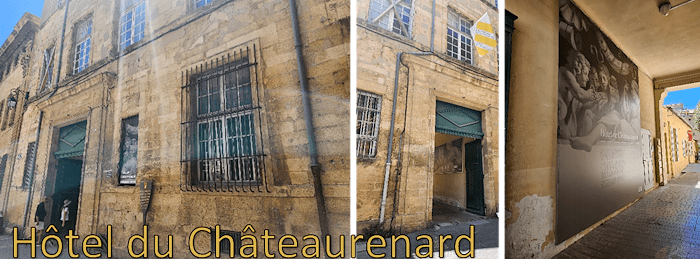
19 rue Gaston-de-Saporta
Baroque Art and Aristocratic Prestige in Aix-en-Provence
Located at 19 rue Gaston-de-Saporta, in the Saint-Sauveur district, the Hôtel de Châteaurenard is one of the most remarkable 17th-century private mansions in Aix-en-Provence. Built around 1650 and listed as a Historic Monument since 1990, it reflects the social and cultural power of Aix’s parliamentary nobility during the era of the Parlement of Provence.
An Ambitious Aristocratic Commission
The mansion was commissioned by Jean-François d’Aymar d’Albi, Baron of Châteaurenard and councillor to the Parlement of Aix. Eager to assert his status, he entrusted the architectural design to Pierre Pavillon, a leading figure of early Baroque architecture in Aix, and the painted decoration to Jean Daret, a Flemish-born artist established in the city.
This choice illustrates the patron’s desire to surround himself with the finest talents of his time, creating a residence that was both prestigious and innovative.
Jean Daret’s Trompe-l’Œil Staircase
Executed around 1654, the painted decoration of the staircase is considered one of the masterpieces of Baroque trompe-l’œil in Provence. Jean Daret unfolds a monumental fictive architecture featuring Doric colonnades, painted balustrades, sculpted niches, illusionistic antique statues, and deep perspectives opening onto imaginary gardens.
The walls and vault are entirely painted, while natural light from the courtyard enhances the spatial illusion.
Louis XIV’s Visit in 1660
In 1660, during his inspection tour of Provence, the young Louis XIV stayed at the Hôtel de Châteaurenard. He was deeply impressed by the staircase décor, which he saw almost exactly as it can still be admired today.
Captivated by Jean Daret’s talent, the king distinguished him by appointing him Painter to His Majesty, thus launching the artist’s official career and securing him numerous commissions.
An Exceptionally Well-Preserved Décor
Inspired by Italian Baroque art, particularly the illusionistic experiments developed in Bologna, the staircase decoration is remarkably well preserved. It stands as a rare surviving example of monumental 17th-century painted décor still in its original setting.
The Latin motto painted on the ceiling, “Virtus Immortalis” (“Virtue is Immortal”), proclaims the triumph of virtue and intellect over time.
Current Use and Visiting Information
Today, the Hôtel de Châteaurenard houses the Department of Museums and Heritage as well as the Heritage Workshop of the City of Aix-en-Provence.
The interior, and especially the staircase, can only be visited through guided tours by reservation, in small groups, helping to preserve this exceptional decorative ensemble.
 Simple Travel and Recreation