
6, rue Espariat
A Grand Baroque Private Mansion in Aix-en-Provence
Located at 6 rue Espariat, close to the Palais de Justice and the Mazarin district, the Hôtel de Boyer d’Éguilles is one of the largest and most representative 17th-century private mansions in Aix-en-Provence. It bears witness to the prestige of Aix’s noblesse de robe at a time when the city was asserting itself as a major political, judicial, and cultural center in Provence.
Baroque Architecture with Parisian Influence
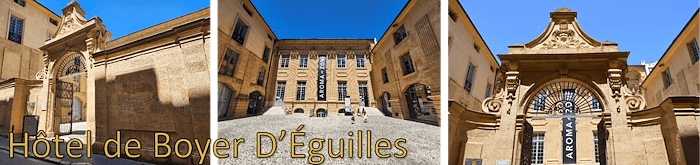
Built between 1672 and 1675 by the architect Jaubert, the mansion stands out for an architectural layout that was rare in Aix and directly inspired by major Parisian models. Set back from the street, it opens onto a forecourt accessed through a carriage gateway, added or remodeled in 1715, which solemnly marks the entrance to the residence.
The façade features a colossal order spread over three levels, combining Doric, Ionic, and Corinthian pilasters. This monumental composition, concealed behind the entrance courtyard, gives the ensemble a sense of controlled power. Inside, a monumental staircase structures the internal layout, while the presence of an inner courtyard and gardens underscores the high status of its patrons.
An Aristocratic and Scholarly Residence
The mansion was commissioned by the Boyer d’Éguilles family, members of the Provençal parliamentary nobility. Among its most notable figures, Pierre-Jean de Boyer d’Éguilles (1700–1783) embodies the spirit of the Enlightenment in Aix: a magistrate, engraver, collector, and patron, he played an important role in the dissemination of arts and knowledge in the city.
The residence served both as a prestigious home and as a place for preserving and displaying art collections. It also housed an engraving workshop, making the mansion a center of artistic creation and intellectual exchange connected to the learned and artistic circles of the 18th century.
From the Revolution to the Contemporary Era
After the French Revolution, the Hôtel de Boyer d’Éguilles underwent several changes of ownership and use, while retaining its monumental character. In the 20th century, it housed the Aix-en-Provence Natural History Museum from 1953 to 2014, reinforcing its cultural and scientific role.
The building has been listed as a Historic Monument since 1988, a designation that notably protects its façades, courtyards, and roofs. This official recognition highlights its importance within Aix’s architectural heritage.
A Heritage Site Given New Life
Since 2020, the Hôtel de Boyer d’Éguilles has housed an Aroma-Zone boutique-workshop occupying approximately 600 square meters. Partially open to the public, the site now includes retail spaces, workshops, and a bookshop-restaurant, offering a contemporary reinterpretation of this historic building.
Despite this new function, the mansion retains strong heritage value and remains a major architectural landmark in the historic center of Aix-en-Provence.
A Witness to Aix’s Refinement
Through its scale, architecture, and history, the Hôtel de Boyer d’Éguilles illustrates the golden age of Aix’s private mansions. It recalls the central role played by the noblesse de robe in the city’s urban, cultural, and artistic development, and today stands as a valuable testament to the elegance and architectural ambition of the Grand Siècle in Aix-en-Provence.
 Simple Travel and Recreation