
Cathédrale Saint-Sauveur
A sacred site since Antiquity
Located in the heart of the old town of Aix-en-Provence, Saint-Sauveur Cathedral stands on an exceptional site shaped by more than two thousand years of history. It rises on the former Roman forum of Aquae Sextiae and, according to tradition, on the foundations of a temple dedicated to Apollo. The earliest Christian structures date back to the 5th century, making Saint-Sauveur one of the oldest active places of worship in Provence.
Architecture shaped over the centuries
The cathedral is the result of successive phases of construction, destruction, and rebuilding between the 5th and the 18th centuries. This long evolution explains the remarkable coexistence of three major architectural styles: Romanesque, Gothic, and Baroque. The building suffered severe damage during the Saracen invasions of the 8th century and later during the religious conflicts of the 16th century, before being gradually restored and consolidated.
An asymmetrical façade that reveals its history
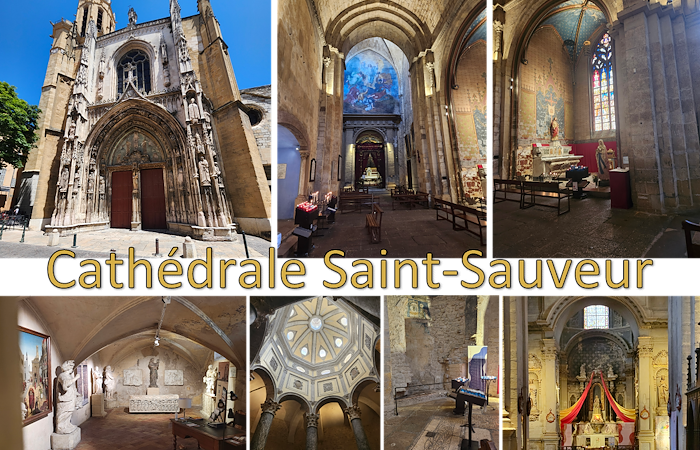
The façade of Saint-Sauveur Cathedral clearly reflects this layered history.
On the south side, to the right of the entrance, stands a 12th-century Romanesque portal, sober and powerful, adjoining a wall of ancient Roman origin.
On the north side, the main entrance is marked by a richly sculpted Gothic portal dating from the 15th–16th centuries, one of the finest examples of late Provençal sculpture.
During the French Revolution, all the statues on the façade were destroyed. Most were replaced in the 19th century, with the notable exceptions of the Virgin on the trumeau and the monumental statue of Saint Michael, which survive in their original form.
The Gothic north portal: a sculptural masterpiece
The north portal is one of the most remarkable sculpted ensembles in Aix-en-Provence. Its walnut doors are adorned with high-relief figures representing sibyls and prophets (Isaiah, Jeremiah, Ezekiel, Daniel, among others), set beneath flamboyant canopies and framed by floral garlands.
These sculptures are mainly attributed to the Bolhit brothers, with high-quality finishing work completed by Jean Guiramand around 1513.
Above the portal stands an exceptional work: Saint Michael slaying the dragon, sculpted in 1507 by Jean Paumier, a Burgundian artist. Rare for its composition and expressiveness, this sculpture gives the cathedral a strong symbolic role as a place of protection.
The Gothic bell tower and exterior sculpture
The cathedral is distinguished by a single Gothic bell tower, unlike the symmetrical twin towers typical of large northern cathedrals. Built between 1323 and 1425 above the north portal, it features an elegant silhouette with an octagonal spire rising to about 64 meters.
Gargoyles decorate the upper sections, combining their practical role in water drainage with symbolic ornamentation. The tower currently houses five bells, still in use today.
An interior of three successive naves
Inside, the cathedral impresses with the juxtaposition of three naves, each corresponding to a different period: Romanesque, Gothic, and Baroque. This rare configuration allows visitors to trace nearly a thousand years of religious architecture within a single building.
Permanent seating is intentionally limited in order to preserve the historic floors and facilitate visitor circulation throughout this heritage space.
The Early Christian baptistery
Among the oldest features is the 6th-century baptistery, one of the most remarkable in France. Octagonal in plan, it is composed of reused Roman columns and a central basin recalling the early Christian practice of baptism by immersion.
Major artistic treasures
The cathedral houses several outstanding works of art, including the famous Triptych of the Burning Bush (c. 1476) by Nicolas Froment, displayed in the Chapel of Saint Lazarus. This masterpiece of 15th-century painting is one of the great treasures of Provençal heritage.
The organ is another highlight: its green-and-gold case, crafted in 1745 by Jean-Esprit Isnard, and the instrumental components added in 1855 by De Ducroquet, are both listed as historic monuments.
A living and protected monument
Listed as a historic monument as early as 1840, Saint-Sauveur Cathedral remains an active place of worship and the seat of the Archdiocese of Aix-en-Provence and Arles. Recent restoration and safety works have ensured its preservation while respecting its authenticity.
Both a spiritual center and a historic and artistic landmark, Saint-Sauveur Cathedral embodies the deep memory of Aix-en-Provence and remains one of the city’s most emblematic monuments.
Also, consider visiting the Saint-Sauveur Cloister, which is accessible from the cathedral.
 Simple Travel and Recreation