
Medieval Origins and Dominican Heritage
Standing proudly on Place des Prêcheurs, the Church of La Madeleine occupies the former site of a Dominican convent founded in 1272. The original chapel was destroyed by fire in 1383 and later damaged by an earthquake. Its complete reconstruction between 1691 and 1703, directed by Jean and Laurent Vallon and master plasterer Esprit Ravanas, gave birth to the grand edifice seen today.
Rebuilding and Later Transformations
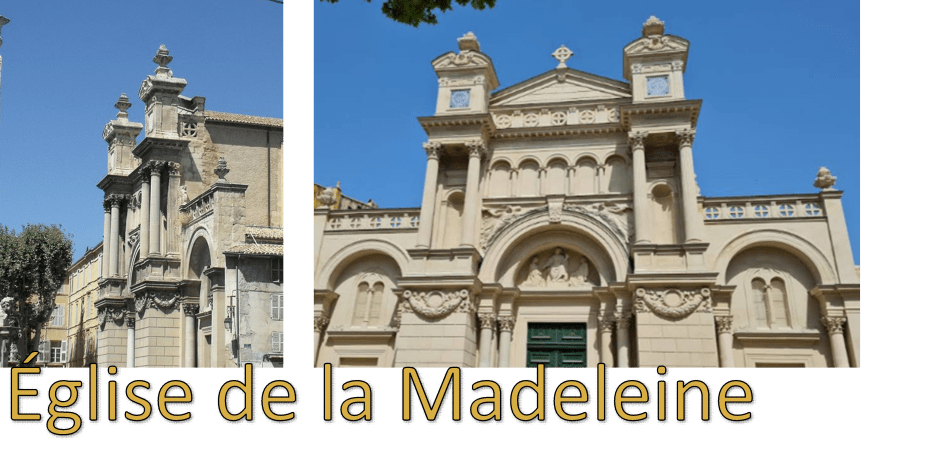
Dedicated to Saint Mary Magdalene, the church embodies the Provençal Baroque style of the late seventeenth century. In the nineteenth century, architect Henri Révoil redesigned the façade (1855–1860), bestowing upon it its neoclassical appearance. The resulting combination of medieval, baroque, and classical elements makes the Madeleine one of the most fascinating examples of Aix-en-Provence’s evolving religious architecture.
Architectural Features
The church’s balanced façade and refined proportions give it a noble simplicity.
Religious and Cultural Significance
La Madeleine holds a special place in the spiritual and artistic life of Aix. Two great names of French culture were baptized here:
- Paul Cézanne, the painter, on February 22, 1839.
- André Campra, the composer, on December 3, 1660.
These connections underline the deep cultural resonance of the site within Aix’s heritage.
Restoration and Renewal
Closed to the public since 2006, the church has been undergoing extensive restoration. Exterior work was completed in 2020, while interior reconstruction continues, with reopening expected around 2028. Once restored, La Madeleine will again serve as both a place of worship and a cultural landmark.
A Living Monument
Listed as a Historic Monument since 1988, Facing the Place des Prêcheurs, once the center of city life under King René, the Church of La Madeleine remains a cornerstone of Aix’s identity — blending faith, art, and architectural grandeur.
 Simple Travel and Recreation