
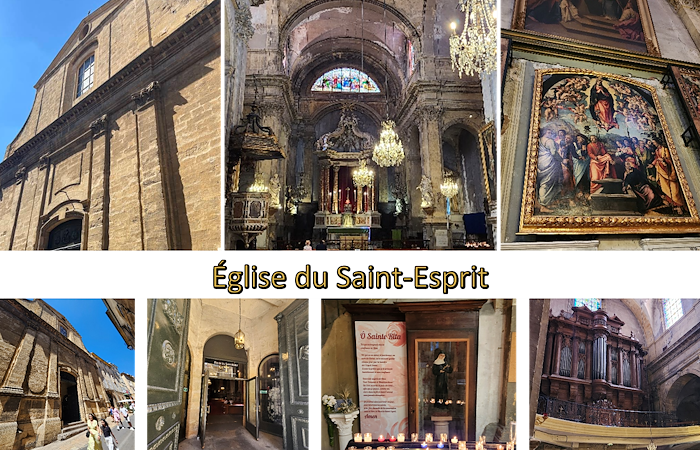
Eglise du Saint-Esprit
40 Rue Espariat
A Baroque Church in the Heart of Aix-en-Provence
Located on Rue Espariat in the historic pedestrian center of Aix-en-Provence, the Église du Saint-Esprit is a major landmark of the city’s religious heritage. Listed as a Historic Monument in 1985, it remains an active place of worship.
Medieval Hospital Origins
The church stands on the site of the former Hôpital du Saint-Esprit, founded in the Middle Ages and associated with the Order of the Holy Spirit, active from the 13th century. The institution cared for abandoned children, the poor, and the sick. A chapel was already documented here in the 15th century.
In the 17th century, the Parliament of Provence decided to establish a new parish independent of La Madeleine, under the influence of Cardinal Jérôme de Grimaldi, Archbishop of Aix.
Construction and Dedication
Construction of the present church was entrusted to the Vallon brothers, Laurent and Georges, and took place between 1706 and 1728. The building was blessed in 1716 under the name Saint Jerome, in honor of Cardinal Grimaldi, but retained the traditional name Église du Saint-Esprit. It was consecrated in 1806 by Archbishop Champion de Cicé.
Architecture: A Restrained Provençal Baroque
The Façade
Facing due south, the façade reflects the sober Baroque style characteristic of the Counter-Reformation in Provence. It is arranged on two levels articulated by six smooth pilasters with Corinthian capitals. A large central window surmounted by a pediment pierced with an oval oculus enlivens the composition while maintaining architectural balance.
The High Altar and Canopy (1726–1728)
The high altar forms the visual and spiritual focal point of the nave and is the only historic church in Aix to have preserved its original altar ensemble. Created in the late 18th century—likely by Jean-Baptiste Casella after designs by Auguste Ramel—it consists of six columns supporting an entablature crowned with volutes.
Above the altar, the dove of the Holy Spirit radiates among angels beneath a canopy. Although initially conceived in Rocaille (Louis XV) style, the completed decoration reflects Louis XVI aesthetics, recognizable in its straight lines and restrained ornamentation, including fluting, laurel garlands, pearls, and acanthus leaves. Its survival during the Revolution is attributed to the intervention of a benefactor, Dame Lantelme.
The Pulpit (1740)
Crafted by Aix sculptor Esprit Routier in 1740, the pulpit was originally entirely wooden. In 1763, it was modified with the addition of a marble cuvette and an openwork iron staircase donated by a parishioner. Decorated with allegories of the theological virtues in high relief, it remains a rare example of 18th-century Provençal preaching furniture preserved in its original setting.
The Organ
One of the church’s most remarkable features is its organ. Its 17th-century case, designed by Jean-Claude Rambot, was transferred from the former Chapel of the Grands Carmes, destroyed during the Revolution. The instrument itself, built by Marseilles organ maker Charles Royer, contains 1,781 pipes, 53 of which are visible in the gilded façade. Renowned for its acoustic quality, it is still used during services.
Other Notable Works
The 16th-Century Altarpiece
A side chapel contains an altarpiece dated 1505, a rare medieval survival from the hospital’s earlier chapel.
Paintings and Sculptures
The church houses numerous works transferred after the destruction of the Comtal Palace and various revolutionary convents. Among them are a triptych of the Assumption of the Virgin, a 17th-century marble statue of the Virgin and Child (Italian school), and several devotional paintings and sculptures.
Contemporary Devotions
At the entrance stands a modern statue of Saint John Paul II, depicted in a gesture of blessing, symbolizing continuity between the church’s historic past and present spiritual life.
A space dedicated to Saint Rita, marked by a statue, candles, and ex-votos, reflects strong popular devotion. Such a dedicated area is relatively uncommon in historic Provençal churches and attracts many faithful seeking the intercession of the “Saint of Lost Causes.”
Side chapels also contain statues of Our Lady of Good Help, Saint Thérèse, Saint Anthony, Saint Joseph, Joan of Arc, and Saint Roch, illustrating the continuity of devotional practices.
A Church Marked by History
The Église du Saint-Esprit has witnessed notable historical events, including the marriage of Mirabeau in 1772. In 1804, Pope Pius VII stopped there on his way to Fontainebleau. Today, candles and ex-votos continue to testify to its living religious tradition.
An Essential Heritage Site
With its harmonious architecture, preserved furnishings, and luminous interior volumes, the Église du Saint-Esprit offers a refined example of 18th-century Provençal Baroque and remains a place of calm and reflection in the heart of Aix-en-Provence.
 Simple Travel and Recreation