
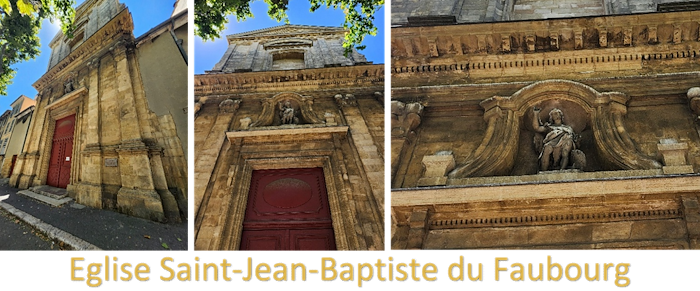
Église Saint-Jean-Baptiste du Faubourg
34 cours Sextius
A Grand Siècle parish on the edge of the Mazarin Quarter
Located south of the historic centre of Aix-en-Provence, at the edge of the Mazarin district, the Church of Saint John the Baptist of the Faubourg stands as an important witness to the city’s urban expansion at the end of the 17th century. It forms part of the development of the former suburbs, made possible after the medieval defensive ditches were filled in.
An evolving urban landscape
During the 17th century, the ditches surrounding Aix’s city walls were gradually filled, allowing the creation of a new major thoroughfare, the Cours Sextius, and encouraging the urbanisation of the southern faubourg, which had previously been only sparsely developed.
As the population of this area increased, Canon Jean-Baptiste du Chaîne, supported by his brother, President of the Parliament of Provence, initiated the creation of a new parish to serve the growing community.
Construction and architectural project
The church was designed by Laurent Vallon, a leading architect in Aix-en-Provence who was also involved in several major projects in the Mazarin quarter.
Construction began in the 1690s and was completed in the early 18th century. However, the original plans were never fully carried out: due to financial and practical constraints, the project was simplified, resulting in the sober appearance the building has today.
A restrained classical façade
The façade reflects a measured Provençal classicism, well suited to its parish function. It is organised over two ordered levels, articulated by pilasters and crowned with a triangular pediment.
Above the main entrance stands a statue of Saint John the Baptist, reinforcing the church’s spiritual identity and serving as a symbolic landmark within the faubourg.
A living place in Aix’s history
Still active today, the Church of Saint John the Baptist of the Faubourg continues to host religious services and sacred music concerts.
It also holds a place in local history as the site of the marriage of Paul Cézanne and Hortense Fiquet in 1886, a discreet yet significant event in the life of the painter.
A parish church of quiet elegance
More modest than the great convent churches of the old town, Saint John the Baptist of the Faubourg perfectly embodies the sobriety and piety of Aix during the Grand Siècle, while bearing witness to the city’s urban and social transformations.
Situated between a once-popular suburb and an aristocratic quarter, it remains an essential landmark for understanding the development of Aix-en-Provence at the turn of the 17th and 18th centuries.
 Simple Travel and Recreation