
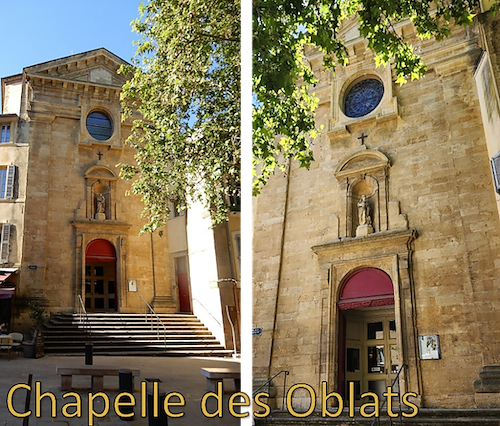
Overlooking the southern end of the Cours Mirabeau on Place Forbin, the Chapelle des Oblats is a religious building that forms an important part of Aix-en-Provence’s heritage. It once occupied part of the former Monastery of the Blessed Sacrament, founded in the 17th century for the Carmelite nuns. Construction of the chapel began in 1695 under the direction of the Aix architect Laurent Vallon and was completed in the early 18th century with the involvement of his son, Georges Vallon.
A measured and balanced architecture
The façade adopts a restrained and well-structured classical style. Reached by a short flight of steps, the central portal is framed by simple pilasters that give the whole composition a strong vertical rhythm.
Above the doorway, a niche houses a statue of the Virgin Mary holding the Child Jesus, serving as the spiritual and artistic focal point of the façade. A triangular pediment crowns the building, topped with a cross that elegantly affirms the sacred character of the site.
Unlike other southern Baroque buildings, the overall design favors balanced proportions and architectural clarity rather than abundant decoration. The building has been listed as a Historic Monument since 1911.
A bright and restrained interior
Inside, the chapel features a Latin cross plan nave surmounted by an elliptical dome, lit by a lantern and oculi. Decoration is deliberately limited: few ornaments, plain walls, and restrained use of marble and gilding. This simplicity enhances the natural light and creates an atmosphere conducive to calm and contemplation.
A place of spirituality still alive
After its construction at the end of the 17th century, the Chapelle des Oblats experienced a history closely linked to political and social upheavals. Like many religious buildings, it was deeply affected by the French Revolution: worship was interrupted, church property was seized, and the building lost its spiritual function. Although it escaped total destruction, the chapel entered a period of neglect and secular use, serving at various times as storage or a utilitarian space. It was only in the 19th century, with the gradual return of religious congregations and the reorganization of worship, that the chapel regained its religious role, while remaining a discreet witness to the breaks and continuities that shaped the history of Aix-en-Provence.
Since the 19th century, the chapel has been entrusted to the Missionary Oblates of Mary Immaculate, a congregation founded by Eugène de Mazenod, a major figure in Provençal religious history who was canonized in 1995. Today, the chapel still hosts services and times of prayer, while remaining open to visitors wishing to discover a quiet and authentic site in the historic center of Aix-en-Provence.
Sobriety as an architectural and spiritual choice
The chapel’s restrained decorative approach reflects a tradition shared by several religious orders, for whom simplicity fosters spiritual focus. It also mirrors the context of 17th-century Aix, marked by a search for balance between dignity, functionality, and available means. Here, architecture does not seek to impress, but to offer a lasting, harmonious, and calming space, faithful to its original vocation.
 Simple Travel and Recreation