
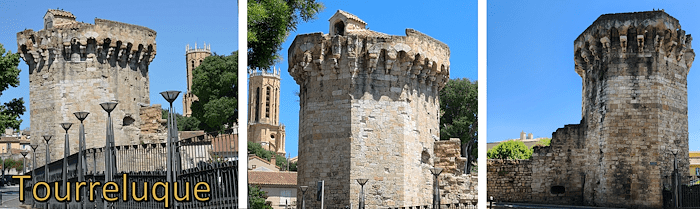
Located on Rue du Bon-Pasteur, the Tourreluque, also known as the Medieval Tower, is one of the few remaining remnants of Aix-en-Provence’s ancient fortifications. Dating from the 14th century, it marked one of the edges of the historic center and was part of the city walls designed to protect Aix, the Saint-Sauveur district, and its suburbs.
A Unique Remnant in the Urban Landscape
Unlike the more common round towers of the 13th century, the Tourreluque is a polygonal corner tower, possibly hexagonal or partially octagonal, optimizing its resistance to assaults and artillery. Built from local stone, it stands out for its massive structure, narrow cross-shaped arrow slits, and machicolations, reflecting the defensive rigor of medieval Provençal fortifications. Its name, derived from the Provençal torreluco, is said to mean “small tower” or “shining watchtower,” referring to its relatively modest size but strategic role.
Historical Context and Defensive Function
Erected around 1360, in the context of the 1348 plague and the instability of the Hundred Years’ War, the Tourreluque was part of a polygonal city wall originally planned to include 39 towers. It is the only surviving corner tower, along with an adjacent curtain wall, following the general demolition of the ramparts in 1848. Its purpose was to protect the city from invasions, banditry, and regional unrest, while overseeing access points and facilitating communication with other defensive structures.
Medieval Architecture within the Modern City
Today, the Tourreluque stands as an isolated vestige in the heart of Aix-en-Provence. Not accessible to the public, it remains visible from the street, illustrating the transformation of Aix from a fortified medieval town to an open, modernized city in the 19th century. Classified as a historical monument, it attracts historians and architecture enthusiasts for its heritage value and its unique testimony to Aix’s medieval past.
 Simple Travel and Recreation