
A Large Religious Complex in the Heart of the Old Town of Aix
Founded at the end of the 13th century by the monks of the Order of Saint Augustine (Augustinian Hermits), the Augustins Convent was originally established outside the medieval city walls of Aix-en-Provence. It quickly became one of the city’s most important religious institutions.
The convent formed a vast complex including a church, a cloister, a refectory, and numerous conventual buildings, extending as far as the area of today’s Cours Mirabeau.
From the 14th century onwards, the Augustins church also played an important civic role, hosting the city council on several occasions, which reflects the political and urban importance of the site. The convent remained active for nearly five centuries and welcomed many notable visitors.
According to local tradition, Martin Luther is said to have stayed at the convent around 1510–1511, during his return journey from Rome. However, this stay remains hypothetical and is not confirmed by written historical sources.
Martin Luther was a German monk and theologian of the 16th century and the initiator of the Protestant Reformation. He challenged the authority of the Catholic Church and promoted a faith based on the Bible and divine grace.
The Augustins Tower
An Iconic 15th-Century Bell Tower
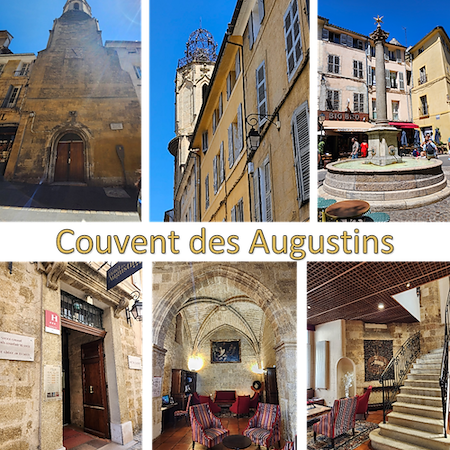
The most striking feature still visible today is the Augustins bell tower, built in 1472 thanks to the financial support of the Aix notable Jean de Guiran. It replaced an earlier tower and stands out for its impressive architecture.
The tower has a massive square base, topped by an octagonal upper level set on a projecting structure. In 1667, a wrought-iron campanile was added to support the bells and to withstand strong winds, especially the mistral. This openwork structure gives the tower its slender and easily recognizable silhouette in the urban landscape.
Listed as a Historic Monument in 1926, the tower can be seen from Place des Augustins and Rue Espariat, although its interior is not open to the public.
Remains of the Convent and Integrated Chapel
Architecture Absorbed by the City
After the French Revolution, the convent and its church were confiscated as national property, sold, and gradually dismantled. The church was demolished in the 19th century, but several elements have survived and are now incorporated into the surrounding buildings.
The former entrance of the church and its narthex, located at 51–53 Rue Espariat, are now occupied by a shop. The original volume and parts of the medieval masonry are still visible. Other walls and structures of the convent can be found integrated into buildings around Place des Augustins.
The chapel next to the tower is now part of the Hôtel des Augustins, created from one wing of the former convent in 1892. The hotel preserves several historic spaces and houses a painting titled Susanna and the Elders, attributed to a Tuscan Italian school close to Orazio Gentileschi.
Place des Augustins
Memory of a Convent District
Place des Augustins takes its name from the former cloister of the convent, once located on Rue de la Masse. It marked one of the former south-western entrances to the city, near the Augustins Gate, also known as the Royal Gate, through which several sovereigns once passed.
Today lined with shops and cafés, the square is still dominated by the medieval tower. Its current layout preserves the memory of a district shaped by the convent between the 13th and 18th centuries, a history that lives on through local place names.
The Augustins Fountain
A Historic Fountain Supplied by Natural Springs
The Augustins Fountain marks the symbolic location of the former convent church. The first fountain is documented as early as 1620, near the convent wall. A second, more monumental fountain was built around 1705 but later disappeared.
The present fountain dates from 1820 and was built according to plans by the architect Beisson. It consists of a circular basin, a cubic pedestal, and an ancient column taken from the former comital palace. At the top stands a twelve-pointed copper star, created by the Aix metalworker Aigueparre. It is one of the few fountains in Aix still supplied by natural springs.
A Fragmented but Readable Site
Heritage and Contemporary Uses
Today, the tower and some of the remaining structures belong to the city of Aix-en-Provence, while the surrounding buildings are privately owned and include shops and the Hôtel des Augustins.
By walking around Place des Augustins, Rue Espariat, and Rue de la Masse, visitors can still trace the history of the convent:
- the distinctive silhouette of the tower and its campanile,
- ancient walls integrated into building façades,
- the fountain and local place names that preserve the memory of the site.
The Augustins Convent remains a striking example of how Aix-en-Provence has absorbed its religious heritage into the urban fabric without erasing its historical presence.
 Simple Travel and Recreation