
History and Origins
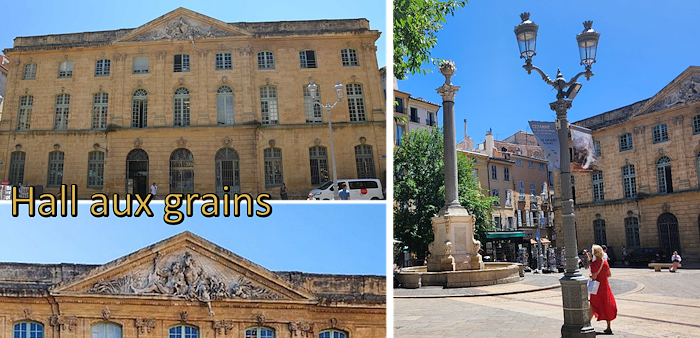
At the crossroads of the lively Place de l’Hôtel-de-Ville and Place Richelme, the Halle aux Grains stands as a symbol of Aix-en-Provence’s commercial ingenuity.
Built in two main phases between 1718 and 1761, the structure was designed to centralize and protect the grain trade — a vital lifeline for the city’s economy.
The project emerged during a broader urban renewal policy launched in the 17th century. In 1709, the City Council decided to clear the old marketplace to create a modern grain exchange. The first warehouse began in 1718 but was halted by the plague of 1720. Work resumed in 1759 under the renowned architect Georges Vallon, giving rise to the monumental building that endures today.
Vallon and Chastel: Classical Harmony and Symbolism
The Halle aux Grains exemplifies the refined Aixois classical style. Vallon designed a structure of perfect symmetry, with clean lines, Ionic pilasters, and a grand triangular pediment.
Sculptor Jean-Pancrace Chastel adorned the façade with an allegorical composition depicting the Rhône and Durance Rivers as deities of abundance, surrounded by sheaves of wheat and emblems of fertility.
This artistic program reflects more than mere decoration — it honors the agricultural wealth of Provence and the life-giving power of its rivers. The building has remained almost unchanged since its completion, preserving the genius of its creators.
From Marketplace to Communications Hub
Over the centuries, the Halle aux Grains has adapted to new social and economic realities. Once the bustling grain market, it became the Bourse du Travail (1896–1922), a labor exchange supporting workers’ rights and solidarity.
In 1923, it was converted into the headquarters of the Post, Telegraph, and Telephone Services (P.T.T.), symbolizing modern communication in the heart of the old town.
These successive transformations reflect the monument’s resilience and its enduring civic role within Aix’s urban fabric.
Heritage Protection and Recognition
Acknowledging its exceptional value, the building was officially listed as a Historic Monument in 1983.
Remarkably, it remains virtually unchanged since the 18th century — a rare example of an intact civic structure that continues to reveal the elegance and functionality of the architecture.
The Halle aux Grains Today
In the 21st century, the Halle aux Grains continues to serve the community while embracing new purposes.
It now houses a branch of the Méjanes Library, a post office, and municipal offices, blending culture, service, and daily life in perfect harmony.
Its classical façade still dominates the heart of Aix. More than a monument, the Halle aux Grains remains a living space — a meeting point between past and present, tradition and modernity.
Nearby things to see: City Hall, Tour de l’horloge
Google map: location of Hall aux grains
 Simple Travel and Recreation