
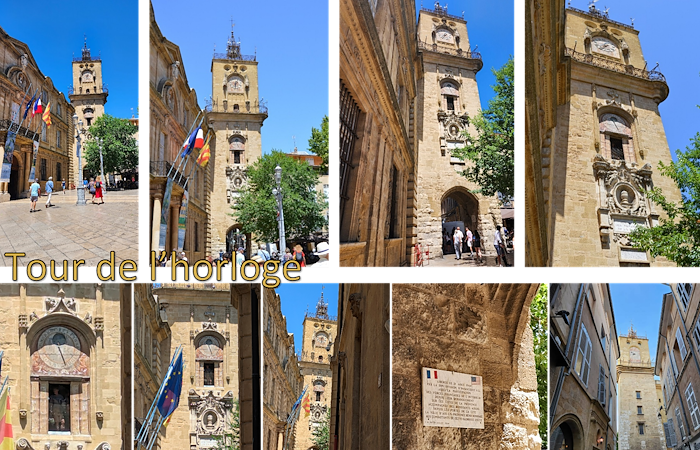
(Tour de l’Horloge)
In the heart of the historic center of Aix-en-Provence, the Tour de l’Horloge d’Aix-en-Provence stands as one of the oldest surviving witnesses of the city’s medieval past. Built in the early 16th century, around 1509–1510, it rises on the remains of the former Saint-Sauveur gate, once integrated into the medieval ramparts. Its strategic location marked the transition between the old fortified town and what would later become the civic and administrative center.
An Architecture of Transition
The tower’s structure is sober and vertical, characteristic of late medieval civic construction. Its solid stone base reflects its original defensive function, with thick walls and limited openings emphasizing security. The lower section clearly preserves this medieval character, while the upper levels reveal the evolution toward a more representative civic architecture.
In the 17th century, the tower was heightened and crowned with an elegant wrought-iron campanile typical of Provençal design. This layering of periods is visually striking: a medieval foundation, Renaissance elevation, and classical crowning element. Together, they illustrate the gradual transformation of a defensive structure into a symbol of municipal authority.
The Astronomical Clock and Its Figures
In 1661, an astronomical clock was installed, reinforcing the tower’s role as a civic landmark. Its dial indicates not only the hour but also astronomical information, reflecting the scientific knowledge and craftsmanship of the period. At the top, four painted wooden automatons represent the seasons. These figures—restored over time—bring movement and rhythm to the façade, symbolically marking the passage of time.
The bell known as the “ban bell,” present from the beginning, once played a crucial role in urban life. It summoned inhabitants to assemblies, announced important decisions, and signaled danger when necessary. Today, it continues to mark the hours, maintaining its historic civic function.
A Landmark of Identity and Memory
More than a simple architectural feature, the Clock Tower is a defining landmark for the people of Aix. It has witnessed periods of prosperity and moments of upheaval, including the French Revolution and the Liberation of Aix in August 1944. Its slender silhouette and openwork campanile rising above the square embody the continuity between the medieval city and the modern urban landscape.
The Clock Tower perfectly illustrates the historical layering of Aix-en-Provence: a medieval defensive base enhanced by Renaissance and classical additions, ultimately becoming the guardian of civic time and collective memory.
Nearby Landmarks: The Civic Ensemble
The tower forms part of a remarkable architectural ensemble centered on the Place de l’Hôtel-de-Ville. Adjacent to it stands the Hôtel de Ville d’Aix-en-Provence, rebuilt in the 17th century and still serving as City Hall. Its classical façade and formal courtyard reflect the political authority and prosperity of the parliamentary city.
The square itself is organized around an 18th-century fountain composed of an ancient Roman column topped with decorative elements, symbolizing both classical heritage and royal prestige. The water flows from sculpted mascarons into a stone basin, reinforcing Aix’s long-standing relationship with water.
Bordering the square is the Halle aux grains, constructed from 1754 onward. Its sculpted façade celebrates agricultural abundance and regional commerce, highlighting the economic vitality that supported the city’s development.
Together, the Clock Tower, City Hall, the square, the fountain, and the grain market create a cohesive civic space where medieval foundations, classical architecture, and public life converge—an enduring expression of Aix-en-Provence’s historical identity.
Google map: link to google map – Tour de l’horloge
 Simple Travel and Recreation