
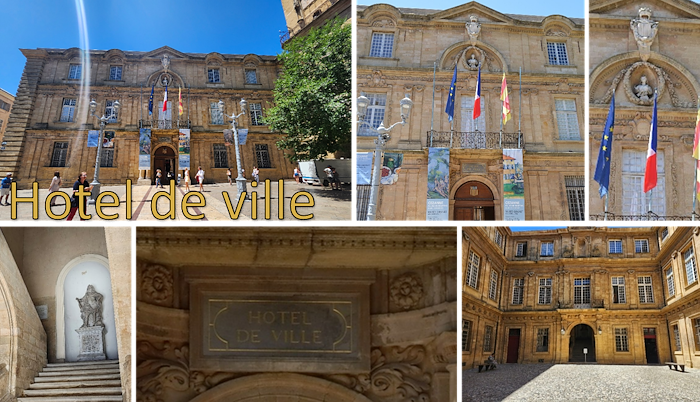
(Hotel de ville)
In the heart of the historic center of Aix-en-Provence, the Hôtel de Ville d’Aix-en-Provence has embodied municipal authority and the political affirmation of the city since the 17th century. Rebuilt between 1655 and 1670 under the direction of architect Pierre Pavillon, and later completed by Georges Vallon, it replaced older medieval structures that no longer reflected the prestige of a prosperous parliamentary city.
Its façade, inspired by Italian classical architecture, conveys a balanced combination of solemnity and elegance. Organized over three levels, it is articulated by paired columns, refined pilasters, and a monumental central portal. The finely crafted wrought-iron balcony adds a decorative touch that reflects local artisanal sophistication. The ensemble illustrates the strength and confidence of Aix’s parliamentary bourgeoisie in the 17th century, when the city served as the seat of the Parliament of Provence.
A Place of Decision and Representation
City Hall is not merely an administrative building; it is also a space of civic representation. Its spacious inner courtyard once accommodated gatherings of notables and citizens during official ceremonies. Inside, the prestigious Salle des États de Provence remains one of the building’s most remarkable rooms. Richly decorated, it preserves portraits of the Counts of Provence and the Kings of France, as well as painted scenes depicting major events in regional history.
However, as City Hall remains an active administrative building rather than a museum, access to this room is strictly limited. It is opened to the public only on rare occasions, during exceptional events or institutional visits. This restricted access enhances its precious character: the Salle des États de Provence stands as a discreet yet emblematic jewel of Aix’s pictorial heritage, whose discovery remains a privilege.
The sculpted medallion on the façade depicts Marianne, the allegorical figure of the French Republic. Originally, it featured a bust of Louis XIV, which was replaced after the Revolution to symbolize the establishment of the new republican regime and the break from monarchy.
In the Background: The Clock Tower and the Square
Adjoining City Hall, the Tour de l’Horloge d’Aix-en-Provence recalls the medieval foundations of the site. Built in the early 16th century on the remains of a former city gate, it houses an astronomical clock installed in 1661 and wooden figures representing the four seasons. Its bell, known as the “ban bell,” once regulated civic life by summoning inhabitants.
The Place de l’Hôtel-de-Ville completes the ensemble. Organized around an 18th-century fountain incorporating an ancient Roman column, it is bordered by the Halle aux grains, a symbol of regional agricultural prosperity. To this day, markets and cultural events continue to animate the square, preserving its public vocation.
An Emblematic Ensemble of Aix Heritage
While the square and the tower enrich the historical panorama, City Hall remains a centerpiece of the ensemble. Through its classical architecture, its enduring institutional role, and the events that have unfolded within its walls, it represents the administrative and political soul of Aix-en-Provence. More than a relic of the past, it stands as a living monument, embodying the city’s ability to unite heritage and modern governance within a single urban space.
Google map: Hotel-de-ville-google-maps
 Simple Travel and Recreation