
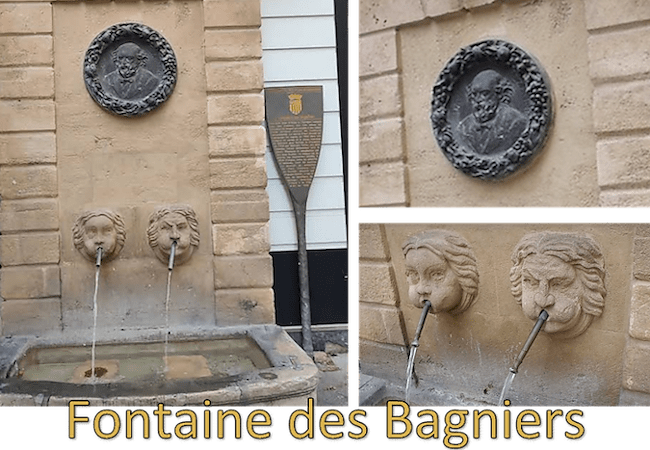
(Fontaine des Bagniers)
Tucked into the heart of Old Aix at the corner of Rue des Chapeliers and Rue des Bagniers, the Bagniers Fountain occupies a unique place in the city’s architectural heritage. Unlike many other fountains in Aix, this small monument preserves a link to the city’s historic water system and the way public water supply was woven into urban life over the centuries.
A 17th‑Century Origin
The Bagniers Fountain was originally constructed in 1685 at the intersection of these two streets in what was then a craftsmen’s district of the old town. At that time, it served as a local water point where residents could draw from an originally hot water source fed by thermal springs in the area.
In 1758–1759, as traffic increased in the narrow streets, the fountain was moved a few meters and set against a wall to free up space. This relocation resulted in the loss of its hot water supply, which was redirected elsewhere in the city, and the fountain was thereafter fed with cold municipal water.
Today, only the elegantly stone basin remains from the original 17th‑century structure. The upper portion of the fountain, including its sculpted mass and pilasters, was rebuilt in the 20th century in homage to the original design.
Artistic Details and the Cézanne Medallion
A particularly charming feature of the fountain is the bronze medallion portraying Paul Cézanne, framed by garlands of flowers and fruit. In 1926, the art dealer Ambroise Vollard—friend and early supporter of Cézanne—had permission to install this tribute based on a drawing by Auguste Renoir. Since then, the fountain has also been affectionately referred to as the Cézanne Fountain.
The decorative mascarons—gargoyle‑like spouts placed at a height designed to avoid splashing passers‑by—add to the structure’s character and reflect a playful yet refined approach to urban ornamentation.
A Living Witness to Everyday Urban Life
Today, the Bagniers Fountain remains quietly integrated into the urban fabric of Aix‑en‑Provence. It retains the traces of successive eras of the city’s hydraulic and urban history, illustrating both the technical evolution of water supply and the civic importance of local fountains in everyday life.
Visible from the street, it enriches the charm of the Vieil‑Aix and recalls the deep connections between water, social practices, and the built environment in the life of the city.
Protected as a historic monument since 1949.
Google map: Google streetview
 Simple Travel and Recreation