
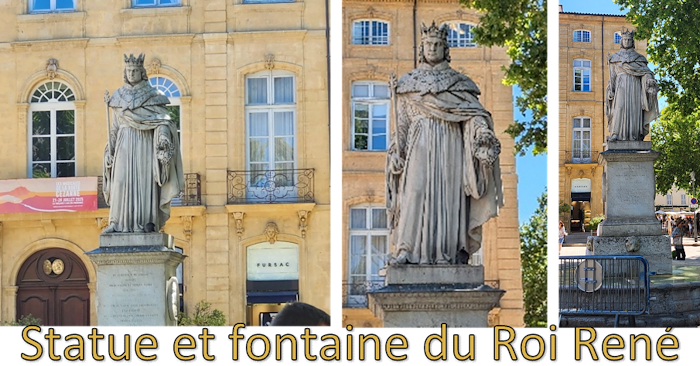
(Roi René)
Erected at the beginning of the 19th century at the eastern end of the Cours Mirabeau in Aix-en-Provence, the fountain surmounted by the statue of King René of Anjou pays tribute to one of Provence’s most emblematic rulers. Designed as a coherent monumental ensemble, it marks the entrance to the historic center and stands as a major landmark in Aix’s urban landscape. Carved in white marble and set along a key thoroughfare, it offers passersby the noble and serene image of a humanist sovereign deeply connected to the city.
A symbolic representation of the Good King René
The statue depicts René I of Anjou, Count of Provence and King of Naples, dressed in a long, ornate cloak and wearing a crown. He holds a scepter in his left hand, symbolizing his authority, and a cluster of Muscat grapes in his right, evoking his attachment to the Provençal land, prosperity, and the local art of living. At his feet, sculpted books recall his love of the arts, poetry, and learning, highlighting the figure of the cultivated prince known as the Good King René.
The statue, carved in white marble, was designed by Pierre Revoil and sculpted by David d’Angers in 1822. The entire monument, weighing approximately 6.6 tons, was produced in Paris before being installed in Aix-en-Provence.
The fountain: composition and architecture
Built on the site of a former pyramid-shaped fountain destroyed during the French Revolution, the present fountain is made of Carrara marble and reflects the Neoclassical style, while retaining a Renaissance spirit through the sobriety of its volumes and the serenity of the royal figure. It is conceived with a vertical and symmetrical composition, combining a large circular basin with a monumental pedestal supporting the statue.
The circular basin, edged with a continuous light-stone coping, is animated by four sculpted lions positioned at the cardinal points, whose mouths serve as water spouts. At the center rises a pedestal composed of several molded tiers, forming a stable and dignified base.
The pedestal has four faces: two are adorned with sculpted medallions depicting Jean Matheron de Salignac, companion and minister of King René, and Palamède de Forbin, Grand Seneschal and Lieutenant General of Provence; the other two bear inscriptions recalling the titles of the sovereign, who died in Aix-en-Provence on July 14, 1480. This strong vertical axis naturally guides the viewer’s gaze from the Cours Mirabeau up to the statue.
The Good King René and Provence
Known as the Good King René, René I of Anjou (1409–1480) has remained in collective memory for his closeness to his subjects, his sense of justice, and his gentle character. A cultivated prince and enlightened patron, he played a key role in the cultural and artistic flourishing of Provence in the 15th century. His refined taste and love of nature and the arts continue to shape the identity of Aix, which he chose as a place of residence.
A symbol of Aix’s identity
More than a simple monument, the Fountain of King René embodies the soul of Aix-en-Provence. It celebrates both the city’s historical heritage and its enduring attachment to culture and the Provençal art of living. To admire this fountain is to immerse oneself in the history of a city that has never ceased to cultivate beauty, elegance, and the memory of its great benefactors.
 Simple Travel and Recreation