
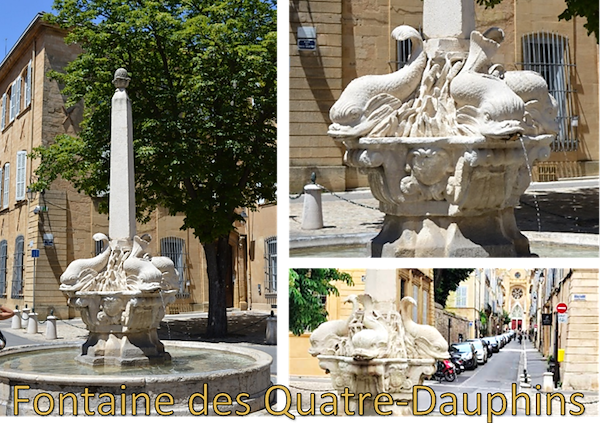
(Quatre-Dauphins)
At the heart of the Mazarin district stands the Fountain of the Four Dolphins, one of the most refined landmarks of 17th-century Aix-en-Provence. Located on the Place des Quatre-Dauphins, this elegant Baroque fountain embodies the harmony and prestige envisioned for the newly planned aristocratic quarter.
A Jewel of the Grand Siècle
The fountain was created in 1667 by the sculptor Jean-Claude Rambot, based on designs by architect Pierre Pavillon, who was also responsible for the urban layout of the Mazarin district. Commissioned by Archbishop Michel Mazarin, brother of Cardinal Mazarin, it crowned a square laid out from 1646 according to a strict grid plan characteristic of Renaissance urbanism.
Originally known as Place Saint-Michel or Place Mazarine, the square was intended to feature a statue of Cardinal Mazarin. The local nobility rejected the idea as overly personal, and the project was replaced by the present fountain. Its success was such that the square eventually adopted the name Place des Quatre-Dauphins, while the intersecting street retained the name Mazarine.
A Baroque Composition in Motion
Carved in Calissanne stone, four stylized dolphins with coiled tails are arranged around a central pedestal, projecting water into a circular basin made of Sainte-Baume stone. Above them rises a slender obelisk, today crowned with a parasol pine motif that adds a distinctly Provençal character.
The circular grouping of the dolphins corresponds to the four streets converging on the square and reflects the Renaissance and Baroque principle of organizing space around cardinal points. Their intertwined forms, resting on sculpted waves, introduce movement and vitality within a composition that remains intimate in scale.
Symbolism and Urban Perspective
Beyond their decorative appeal, the dolphins evoke refinement, prosperity, harmony, and joyful dynamism — qualities associated with the noble district financed by Archbishop Mazarin to attract aristocratic and bourgeois families. Although Aix is not a maritime city, the dolphin motif symbolized fluidity and happiness in classical iconography and subtly alluded to the Dauphin of France, indirectly referencing the reign of Louis XIV without overt royal imagery.
The square also offers a graceful perspective toward the bell tower of Église Saint-Jean-de-Malte, whose Gothic silhouette rises at the end of the axis. This visual connection enhances the sense of depth and elegance within the Mazarin district, linking the intimate scale of the fountain to one of the city’s most significant medieval monuments.
A Timeless and Intimate Square
The Place des Quatre-Dauphins is deliberately simple: an open space centered on the fountain, with direct access and no elaborate landscaping. Located in the middle of the street rather than in a protected plaza, the basin is fully integrated into the circulation of the neighborhood — which makes any visit necessarily brief and somewhat “hazardous,” as one must remain attentive to passing vehicles.
More symbolic than monumental, the fountain is not designed to overwhelm but to punctuate the urban fabric with elegance. Four trees at the corners soften the geometry, while the uniform ochre façades of 17th-century townhouses create a restrained architectural frame. The vertical axis of the obelisk and the circular basin structure the space visually, giving the small square a balanced yet lively character.
Protected as a Historic Monument since 1905, the fountain remains one of the most cherished sites in Aix-en-Provence. Its discreet charm contrasts with the more theatrical fountains of the Cours Mirabeau, offering instead a refined and photogenic pause within the orderly grid of the Mazarin district — intimate, symbolic, and unmistakably Provençal.
 Simple Travel and Recreation