
From the Archbishop’s Square to a Place of Remembrance
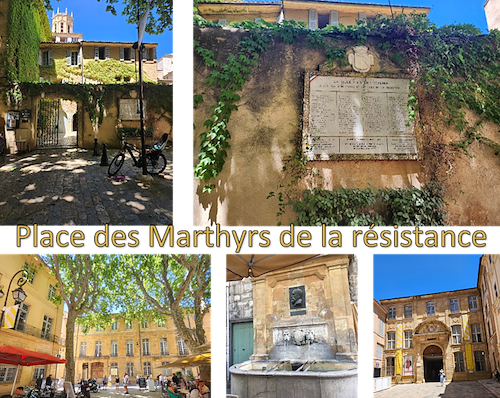
Located on rue Cardinale, facing the monumental façade of the Archbishop’s Palace, Place des Martyrs de la Résistance occupies a symbolic position within the Mazarin district. Until the mid-20th century, it was known as Place de l’Archevêché, reflecting its close ties to ecclesiastical power and the religious organization of the city.
In 1945, in the aftermath of the Second World War, the square was renamed to honor the members of the Resistance from Aix who were executed in 1944. This change of name reflects a deliberate effort to inscribe contemporary history and collective memory into an ancient urban setting, transforming a former place of passage into a space of remembrance.
A human-scale square with a refined atmosphere
Modest in size, the square is distinguished by its elegance and calm. A centuries-old plane tree structures the space and provides welcome shade, while the surrounding cafés and restaurant terraces bring a gentle liveliness to the area. The atmosphere remains peaceful during the day and becomes more animated during major cultural events, particularly the Aix-en-Provence International Festival, when performances and gatherings take place near the Archbishop’s Palace.
The Fountain
The Espéluque Fountain, a discreet witness to the history of water
Hidden, the Espéluque Fountain, a discreet yet historic feature of the site. Created in 1618 for the chapter of the cloister, it was later given to local residents and moved in 1750 against a wall of Roman origin in order to improve circulation within the square.
The fountain takes its name from Espéluque, who was likely the former owner of the water source. The water emerges from a subterranean grotto, one of the rare sources already exploited in Aix as early as the 15th century. The structure consists of a basin made of hard stone from the Bibémus massif, framed by pilasters and topped with a classical entablature, forming a sober and balanced composition.
A bronze medallion, added in 1953, decorates the fountain. It bears the profile of Marcel Provence, historian, writer, and patron of Provençal arts, paying tribute to his major role in preserving and promoting the region’s cultural heritage.
The stele
A place of commemoration
Nearby stands a commemorative stele dedicated to the Martyrs of the Resistance, honoring those from Aix who lost their lives during the Occupation. This memorial element lends the square a solemn dimension, while remaining harmoniously integrated into the overall setting. Together with the fountain, it anchors the place firmly in the city’s collective memory.
The surrounding buildings
Where history, memory, and daily life meet
Surrounded by remarkable buildings—the Archbishop’s Palace, the private mansions of the Mazarin district, and the narrow streets of the old town—Place des Martyrs de la Résistance offers a rare synthesis of long-standing history and modern remembrance.
The Former Archbishop’s Palace
From Episcopal Residence to the Musée des Tapisseries
Overlooking the eastern side of Place des Martyrs de la Résistance, the former Archbishop’s Palace is one of the most significant ecclesiastical buildings in Aix-en-Provence. Constructed mainly during the 17th century on earlier medieval foundations, it served for centuries as the residence of the archbishops of Aix, whose authority extended far beyond religious matters into political and judicial life.
In the 20th century, the building underwent a major change of purpose and now houses the Musée des Tapisseries. This conversion reflects Aix’s broader approach to heritage preservation, where historic monuments are adapted to cultural uses rather than frozen in time. The palace’s vast ceremonial rooms, originally designed for representation and official functions, provide an ideal architectural setting for the display of monumental tapestries and textile works.
Saint-Sauveur Cathedral
The Spiritual Anchor of the Square
Immediately adjacent to the palace stands Saint-Sauveur Cathedral, one of the most historically complex religious buildings in Provence. Developed over many centuries—from Late Antiquity through Romanesque and Gothic periods—it embodies the layered spiritual and architectural history of the city.
Its close proximity to Place des Martyrs de la Résistance reinforces the square’s ecclesiastical identity and explains the former name, Place de l’Archevêché. Together, the cathedral and the archbishop’s residence form a coherent religious ensemble that structured both the urban layout and the institutional life of this part of Aix.
Hôtel Boyer de Fonscolombe
Aristocratic Elegance Facing the Square
Facing the Archbishop’s Palace across the square, the Hôtel Boyer de Fonscolombe is a fine example of an 18th-century Aixois private mansion. Built for a prominent parliamentary family, it reflects the refined architectural language favored by the elite of the Mazarin district.
Its sober classical façade, balanced proportions, and elegant ironwork contrast subtly with the ecclesiastical buildings opposite. This visual dialogue between noble residence and religious authority illustrates the social structure of Aix under the Ancien Régime, where secular and ecclesiastical powers coexisted within a tightly organized urban framework.
An Urban Ensemble Shaped by Power and Memory
Architecture as a Witness to History
The arrangement of these buildings—the cathedral, the former archbishop’s palace turned museum, and the aristocratic townhouse—gives Place des Martyrs de la Résistance its distinctive character. Far from being a simple open space, the square is a meeting point of faith, culture, and history.
Over time, this architectural ensemble has absorbed new meanings, particularly after 1945, when the square became a place of remembrance. Today, the harmony between stone, water, memory, and daily life makes this square one of the most quietly expressive spaces in Aix-en-Provence, where centuries of transformation remain clearly legible in the built environment.
Both a place to pause and a place to remember, it perfectly embodies the spirit of Aix-en-Provence: an urban space where water, stone, shade, and memory coexist in a setting that is at once calm, meaningful, and deeply human.
 Simple Travel and Recreation