
The Civic and Historic Heart of Aix-en-Provence
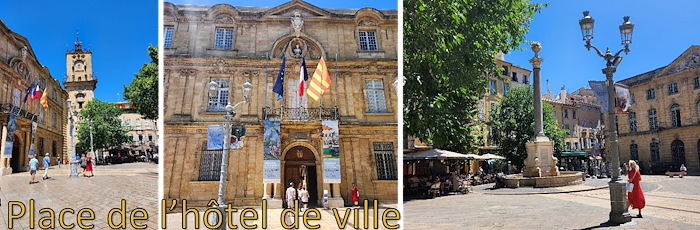
Located in the heart of Aix-en-Provence’s historic center, the Place de l’Hôtel de Ville is one of the city’s most emblematic squares. Since the Middle Ages, it has embodied municipal authority and public life. Framed by the Town Hall, the Clock Tower, the Grain Market Hall, and its beautiful fountain, the square offers a remarkable concentration of history, architecture, and Provençal atmosphere.
A Square Shaped by the Middle Ages
The square took shape in the 14th century at the foot of the Clock Tower, originally part of the city’s medieval fortifications. It quickly became a focal point after the unification of Aix’s districts, notably the Bourg Saint-Sauveur and the comital town. From this period onward, a town hall stood on the site, establishing the square’s enduring administrative and political role.
Over the centuries, the square has remained a key gathering place for public announcements, markets, civic celebrations, and official events, making it a true stage of urban life.
The Town Hall
A Municipal Palace Inspired by Italy
After a fire destroyed the earlier building, the present Town Hall was rebuilt in two major phases between 1655 and 1678 under the direction of architect Pierre Pavillon, a leading figure of Aix’s architectural heritage. His design draws inspiration from Italian Renaissance palaces while fully embracing French classical principles.
The façade, now more restrained following Revolutionary damage, is distinguished by its balanced composition, Doric columns framing the monumental entrance, an elegant wrought-iron balcony, and a triangular pediment. Lion-head door knockers attest to the attention paid to decorative detail.
Inside, the Town Hall is organized around a square courtyard, served by a monumental staircase leading to the prestigious Hall of the Estates of Provence. This ceremonial room houses two remarkable series of paintings: portraits of the Counts of Provence and Kings of France, and large-scale scenes illustrating major events in the region’s history.
The Clock Tower
A Symbolic Urban Landmark
Adjoining the Town Hall, the Clock Tower is one of the square’s oldest monuments. Built in the 14th century on ancient foundations, it was heightened in the early 16th century in a flamboyant Gothic style.
It contains a remarkable astronomical clock installed in 1661, displaying solar and lunar cycles, moon phases, and zodiac signs. The mechanism is animated by symbolic figures, notably the four seasons. Its bell, known as the ban bell, once regulated daily life by announcing the hours, municipal decisions, and major civic events.
The Fountain
Water as a Symbol of Prosperity and Ancient Memory
Erected between 1755 and 1756, the central fountain is the unifying feature of the square. It is crowned by an ancient Roman column taken from the ruins of the former comital palace, recalling the site’s long history of occupation.
At the top, a globe adorned with gilded laurel wreaths celebrates the glory of King Louis XV. Water flows from four sculpted mascarons by Jean-Pancrace Chastel, fed by the Pinchinats spring, and pours into a stone basin.
Four engraved inscriptions refer to municipal authority, provincial administration, royal power, and the legacy of Roman water systems. They also evoke the rebuilding of Aix’s water networks after the devastating plague of 1720, underscoring the deep connection between water, public health, and urban development.
The Grain Market Hall
Architecture and Agricultural Prosperity
Built starting in 1754 by architect Georges Vallon, the Grain Market Hall completes the architectural ensemble of the square. It was originally dedicated to the trade of cereals, a cornerstone of Provence’s agricultural economy.
Its façade features a central projecting section topped by a triangular pediment sculpted by Jean-Pancrace Chastel. The relief depicts allegorical figures of the Rhône and the Durance rivers, represented as a man and a woman surrounded by agricultural abundance made possible by water. The foot of the female figure emerging from the pediment subtly alludes to the Durance’s floods—a poetic yet realistic metaphor.
Today, the Grain Market Hall has been repurposed for cultural and administrative uses while preserving its monumental character.
A Living and Timeless Square
Still vibrant today, the Place de l’Hôtel de Ville remains a favored meeting place. Markets, fairs, cultural events, and occasionally the flower market continue a centuries-old tradition of exchange and conviviality.
Blending medieval heritage, classical architecture, and ancient memory, the square offers visitors a true journey through time. It remains the beating heart of Aix-en-Provence—a civic “open-air salon” where history, architecture, and Provençal art of living come together.
 Simple Travel and Recreation