
Rococo elegance in the heart of Aix-en-Provence
Located in the historic center of Aix-en-Provence, just a short walk from the Town Hall and close to Rue Espariat, Place d’Albertas is one of the city’s most distinctive and photogenic urban spaces. Modest in size yet remarkable for its architectural refinement, it embodies the aesthetic ambitions of the 18th century and the taste of Aix’s elite for symmetry, order, and elegance.
The creation of a prestigious urban setting
The square was created between 1735 and 1746 at the initiative of Jean-Baptiste d’Albertas, son of Henri-Raynaud d’Albertas and heir to the family mansion on Rue Espariat. A prominent parliamentarian and president of the Court of Accounts of Provence, Jean-Baptiste d’Albertas represented the influential elite of 18th-century Aix.
Seeking to enhance both the visibility of his residence and his social standing, he purchased and demolished the medieval houses opposite his hôtel particulier to open a carefully designed square inspired by Parisian royal squares. The project, entrusted to architect Georges Vallon, reflects a deliberate effort to assert prestige through urban design and architectural coherence.
A harmonious Rococo composition
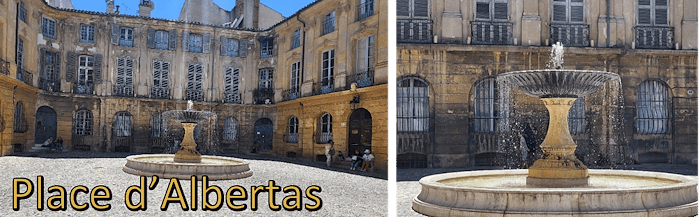
The rectangular square is enclosed by uniform stone façades in warm ochre tones, characteristic of Provencal Rococo architecture. The composition is marked by pilasters, refined sculpted details, and elegant wrought-iron balconies. The façades were designed to create a unified architectural backdrop, with the main Albertas residence facing the center of the square.
Notably, the square has been devoid of vegetation since its creation, reinforcing its mineral character and emphasizing the geometry and balance of the architecture.
The fountain: a later civic addition
Originally conceived as a paved architectural setting without a central feature, the square became a public space only after the addition of a fountain in the 19th century. The fountain was installed in 1860 by the municipality, more than a century after the creation of the square, to enliven the space.
The current cast-iron basin, installed in 1912, was produced by students of the École des Arts et Métiers. Simple and understated, the fountain was designed to complement rather than dominate the surrounding architecture, reinforcing the overall harmony of the square.
Residential character and present-day use
The main Albertas mansion facing the fountain remains a private family residence, while the surrounding buildings are occupied by private apartments, some rented on a long-term or seasonal basis. The square has retained its original residential function, with no cafés or restaurants occupying its perimeter.
A place of passage rather than lingering
Today, Place d’Albertas is more a place for brief contemplation than for extended leisure. With no benches or commercial activity, it does not encourage prolonged stays. Visitors may pause briefly, sometimes sitting on the steps of private residences, while children often run around the fountain, taking advantage of the open space within the dense urban fabric.
For local residents, the square is primarily a familiar architectural landmark, appreciated for its balance and restraint. Tourists, meanwhile, tend to stop mainly to admire the façades and take photos before continuing toward livelier areas of the city. Discreet and unanimated, Place d’Albertas preserves a quiet elegance that reflects its aristocratic origins and residential vocation.
A refined urban landmark
Classified as a historic monument, Place d’Albertas remains one of the most accomplished examples of decorative urban planning in Aix-en-Provence. More than a lively square, it is a carefully composed architectural scene—an enduring testament to 18th-century ambitions, social distinction, and the pursuit of aesthetic harmony in the urban landscape.
 Simple Travel and Recreation