
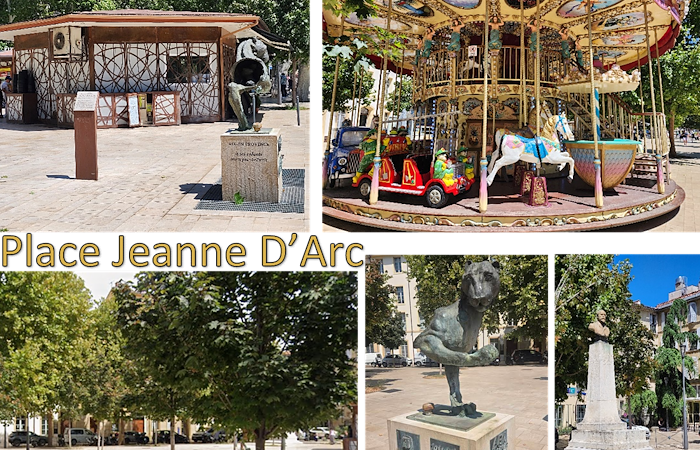
Located just a short walk from the famous Rotonde Fountain, Place Jeanne d’Arc was developed between the late 18th and 19th centuries on the site of the former city rampart. Lined with majestic chestnut trees, it was then known as the evocatively named “Quinconce des Marronniers,” a peaceful place where Aixois would stroll in the shade.
A Past Shaped by Music and Social Life
In 1880, the square became more animated with the installation of a bandstand. It quickly became the beating heart of local cultural life, hosting concerts, celebrations, and public gatherings that reflected the vitality of Aix during the Belle Epoque. Over time, however, the bandstand disappeared—probably between the 1940s and 1950s—and was replaced by a small park featuring a basin. This layout remained until the 1990s, when the square was temporarily converted into a parking area.
It was not until 2012 that Place Jeanne d’Arc regained its role as a place for relaxation and social interaction, following an urban redevelopment that transformed it into the pleasant, modern pedestrian space seen today.
The Monument to Victor Leydet: Tribute to a Man of Action
One of the square’s notable features is the monument dedicated to Victor Leydet, a prominent political figure from Aix in the 19th century. Inaugurated in 1910, the original work by sculptor Auguste Carli included a bust of Leydet accompanied by a symbolic female figure. Melted down during the Second World War, the monument was later replaced by a marble bust, which was transferred to Place Jeanne d’Arc in 1979.
In 2020, on the occasion of the 110th anniversary of the original inauguration, a new bronze bust—cast from Carli’s original mold—was installed. This understated monument recalls Leydet’s republican and social commitment, as well as his defense of civic values and secularism.
The War Memorial: A Symbol of Protection and Remembrance
Facing this testimony to local political history, the square also features a modern war memorial designed by sculptor Jean Lamore and inaugurated on November 11, 2013. Depicting a protective lioness watching over a fallen figure, the monument stands out for its emotional depth and symbolic meaning. Going beyond traditional commemoration, it evokes protection, peace, and collective memory, inviting passersby to contemplation and respect, and making Place Jeanne d’Arc a space of reflection in the heart of the city.
The Carousel in the Square
Place Jeanne d’Arc hosts a carousel that delights children, families, and visitors alike. This merry-go-round contributes to the lively atmosphere of the square and reflects the city’s desire to offer, just steps from the Rotonde, a welcoming and family-friendly space.
Several sources mention the presence of the “Paul Cézanne Carousel,” an emblematic attraction of Aix-en-Provence. Known for its colorful reproductions of Cézanne’s landscapes, this carousel pays tribute to the famous Aix-born painter, creating a joyful and poetic atmosphere. Its carved horses and carefully crafted decorations evoke the spirit of traditional fairgrounds, making it particularly recognizable.
However, during our visit in the summer of 2025, some uncertainty remained regarding the identity of the carousel installed on Place Jeanne d’Arc. While the existence of the iconic Cézanne carousel is unquestioned, the one observed at that time in the square appeared simpler and lacked the distinctive pictorial decorations associated with the painter’s universe. It is therefore likely that the Cézanne carousel is mobile or installed periodically at other locations, and that a different ride was present on the square at that moment.
A Square at the Heart of the City and Aix’s Collective Memory
Today, Place Jeanne d’Arc harmoniously brings together memory, culture, and conviviality. With its commemorative monuments, green pedestrian setting, and charming carousel, it illustrates the urban evolution of Aix-en-Provence and the city’s strong attachment to its history. A place of passage, relaxation, and remembrance, Place Jeanne d’Arc remains a symbol of Aix’s living heritage, where past and present engage in an elegant dialogue.
 Simple Travel and Recreation