
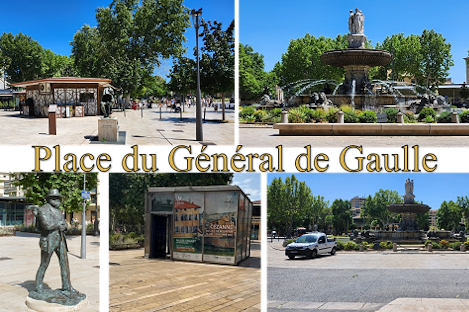
Known to the people of Aix by the familiar name Place de la Rotonde, Place du Général de Gaulle is undoubtedly one of the most emblematic locations in Aix-en-Provence. Situated at the western entrance to the historic center, it marks the transition between the old town and the modern districts, forming a majestic crossroads where several of Aix’s main thoroughfares converge: the Cours Mirabeau, the Cours Gambetta, and the roads leading to the Mazarin district.
Laid out between 1840 and 1850, this vast circular esplanade—nearly 100 meters (328 ft) in diameter—was designed to symbolize Aix’s openness to the outside world while offering a refined urban perspective and a graceful meeting place.
A Monumental Fountain: the Rotonde, Jewel of the Second Empire
The true centerpiece of the square, the Rotonde fountain, inaugurated in 1860 during the Second Empire, dominates the space in all its splendor. Standing 12 meters (39ft) high, it is one of the city’s most recognizable symbols.
Its sumptuous decoration perfectly illustrates the 19th century’s taste for monumentality and ornamentation. Two superimposed basins rise from a richly sculpted base adorned with lions, swans, dolphins, and cherubs.
At the top, three allegorical statues embody the values of Aix and Provence:
- Justice, facing the Cours Mirabeau, by the sculptor Ramus,
- Agriculture, facing Marseille, created by Chabaud,
- Fine Arts, oriented toward Avignon, sculpted by Ferrat.
A Square Steeped in History and Symbolism
Over time, the square has borne several names, reflecting the upheavals of the 20th century. First called Place Maréchal Pétain during the Occupation, it became Place de la Libération after 1944 to celebrate the liberation of Aix, before finally being named Place du Général de Gaulle in tribute to the leader of Free France. However, because of the fountain, it is known as place de la Rotonde.
These successive names reflect the collective memory of a city deeply attached to its history and republican values.
The Modern Face of the Square: A Place for Life and Encounters
Today, Place du Général de Gaulle remains a key point of convergence, where the daily lives of Aix residents mingle with the flow of visitors. Surrounded by cafés, terraces, and landscaped areas, it offers a welcoming setting for relaxation and contemplation. The benches arranged around the fountain allow visitors to admire the sculptures while enjoying the lively urban atmosphere.
An essential place of passage, the square marks the starting point of the famous Cours Mirabeau, a broad avenue lined with plane trees, historic mansions, and cafés. It was laid out on the site of a former city gate, at the intersection of three major avenues: the Cours Mirabeau, Avenue Bonaparte—now Avenue des Belges—and Avenue de la République.
From the Fontaine de la Rotonde, the entrance to the Cours Mirabeau is marked on either side of the avenue by two monumental allegorical statues. Created in 1883 by the sculptor François Truphème, they symbolically frame the access to this emblematic thoroughfare of Aix-en-Provence:
- on the left, the statue representing Arts and Sciences;
- on the right, the one dedicated to Industry and Decorative Arts.
Around the Rotonde: Art, Modernity, and Culture
Place du Général de Gaulle is also bordered by several major sites that enhance its appeal:
- The statue of Paul Cézanne, located on the opposite side of the square, pays tribute to the Aix-born painter. Created in a restrained yet expressive style, it recalls the artist’s deep attachment to his city and to Mount Sainte-Victoire.
- Les Allées Provençales, just nearby, add a contemporary touch with their shops, restaurants, and cultural events, forming a modern extension of the historic center.
- Place Jeanne d’Arc.
Finally, the roads radiating from the square connect the main districts of Aix, making the Rotonde roundabout a central urban hub—both practical and highly symbolic.
 Simple Travel and Recreation