
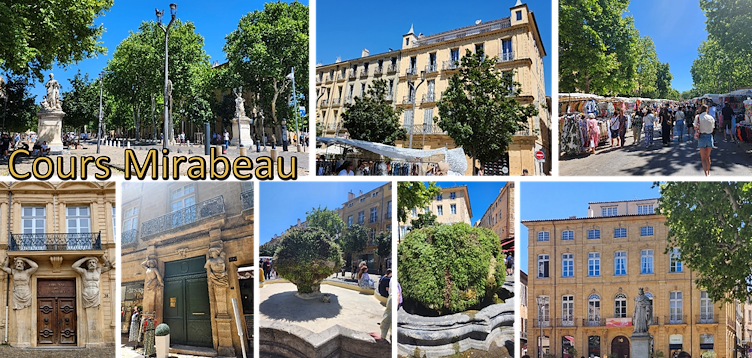
Cours Mirabeau in Aix-en-Provence: Provencal Elegance and Lifestyle
The Cours Mirabeau, a long avenue stretching 440 meters (0.27 mile) and 42 meters (137 ft) wide, is far more than just a street: it is the soul of Aix-en-Provence, where history, urban life, and Provençal charm come together. Lined with centuries-old plane trees, lively café terraces, elegant townhouses, and iconic fountains, it connects the Mazarin district in the south to the bustling old town in the north. Strolling along, visitors admire the noble silhouettes of classical facades, pause in the shade for a coffee, browse the occasional market, and watch the comings and goings of Aixois.
History and Development
The origins of the Cours Mirabeau date back to the 17th century. In 1649, under the initiative of Archbishop Mazarin and the city’s wealthy families, Aix was expanded beyond its old city walls. The walls were demolished, an open space was created between the old and new districts, and what would become the Cours was established. A few decades later, the name “Cours Mirabeau” was officially adopted: carriages strolled here, prestigious residences were built, shops opened, and architectural elegance flourished. Over the centuries, the Cours has accompanied the city’s transformations—modernization, pedestrianization, restoration—while preserving its classical charm. A major renovation in 2002 made it even more enjoyable for pedestrians, while maintaining its original layout.
Markets on the Cours
The Cours Mirabeau regularly hosts a non-food market on Tuesday, Thursday, and Saturday mornings from 8 a.m. to 1 p.m., offering clothing, accessories, local crafts, home textiles, pottery, and decorative objects—a living tradition full of color, encounters, and discoveries. Nearby, Aix also offers food markets on Place Verdun and Place des Precheurs, where local products, fruits, vegetables, cheeses, and Provençal specialties can be tasted.
Iconic Fountains
The Cours Mirabeau owes much of its charm to its historic fountains, which punctuate the promenade with both history and beauty.
Fontaine de la Rotonde: Perhaps the most famous, inaugurated in 1860. Standing 12 meters (39ft) high with a basin approximately 32 meters (105 ft) in diameter, it is surrounded by four groups of lions and three statues representing Justice, Agriculture, and the Fine Arts.
Fontaine des Neuf-Canons: Located midway along the Cours at the intersection of Rue Nazareth and Rue Joseph Cabassol, dating from 1691 – architect attributed: Laurent Vallon. Its name comes from the nine water jets (canons).
Fontaine Moussue: Built around 1666–1667 and remodeled in 1734, it is the first fountain on the Cours and one of Aix’s most unique symbols. Fed by thermal water, it has gradually transformed into a natural sculpture, covered with moss and limestone deposits.
Fontaine du Roi Rene d’Anjou (King Rene d’Anjou): Designed in 1819, the Fontaine du Roi Rene d’Anjou is an integral element of the Cours Mirabeau’s urban landscape. Installed in 1823, the fountain is distinguished by four lions spouting water, symbolizing strength and abundance. At its center rises the statue of King René, which gives the monument its identity and anchors it within the history of Aix-en-Provence.
Ground-level Jets: In addition to the historic fountains, modern fountains embedded in the pavement shoot small jets of water, adding freshness and animation to the avenue, especially in summer, blending discreetly with the boulevard’s charm.
Statues
Statue and Fountain of King Rene: Created in 1822 by sculptor David d’Angers, after a drawing by Pierre Revoil, the statue depicts Rene d’Anjou, the 15th-century Count of Provence and King of Naples. Shown holding a bunch of grapes, he embodies prosperity, generosity, and the Provençal art of living. Facing the avenue, the statue stands as a cultural and symbolic landmark, celebrating a sovereign known as a patron of the arts.
Allegorical Statues near the Rotonde: On either side of the entrance to the Cours Mirabeau stand two allegorical statues by François Truphème (1883). On the north side, Arts and Sciences represents knowledge and culture; on the south side, Industry and Decorative Arts celebrates work and craftsmanship. These statues mark the symbolic threshold of the Cours and complement the monumental figures of the nearby Rotonde fountain.
Statues of the Rotonde: Crowning the Fontaine de la Rotonde, the three allegorical statues represent Justice, Agriculture, and the Fine Arts, reflecting the civic values and prosperity of Aix-en-Provence in the 19th century. Oriented toward the main roads leading into the city, these figures symbolize law, abundance, and culture, affirming the fountain’s role as both an artistic landmark and a gateway to Aix.
Votive Niches: Several votive niches are located at street corners and house statues of saints or the Virgin. Notable intersections include Rue du 4 Septembre, Rue Joseph Cabassol, Rue Frédéric Mistral, and Rue Fabrote, adding historical and spiritual details to the boulevard. It is slightly the eye level.
Hotels (Hotels Particuliers)
The Cours Mirabeau is also lined with magnificent private mansions dating from the 17th and 18th centuries. These residences, built for noble or wealthy families, stand out for their elegant façades, inner courtyards and sometimes gardens, bearing witness to the splendor and refinement of the period.
Hôtel d’Arbaud-Jouques -19 Cours Mirabeau
Built between 1700 and 1732 for Elzear d’Arbaud de Jouques, president of the Parliament of Provence, the Hôtel d’Arbaud-Jouques is one of the largest and most prestigious private mansions on the Cours Mirabeau. Attributed to the architect Jean-Baptiste Franque, it is distinguished by its monumental and refined classical façade, a symbol of judicial power and Aix’s aristocratic prestige.
Hôtel de Forbin – 20 Cours Mirabeau: Distinguished by wrought-iron balconies and mullioned windows. From the street, the delicate ironwork on the balconies is particularly striking.
Hôtel du Poët – 32 Cours Mirabeau: Features an inner courtyard with a fountain and elegant arcades. The sculpted wooden gate visible from the street offers a glimpse of the luxurious interior.
Hôtel Maurel de Ponteves dit d’Espagnet – 38 Cours Mirabeau: Built in the 17th century, notable for its sober yet elegant façade and monumental portal. From the street, the sculpted portal with mascarons immediately catches the eye, hinting at the refined interior.
Hôtel d’Isoard de Vauvenargues – 44 Cours Mirabeau: Recognizable for its ornate portal and refined facades. From outside, the sculpted window lintels reveal the elegance and taste of its original owners.
Hôtel de Gantes – Cafe des deux garçons: 53 Cours Mirabeau : Built in the 17th century, the Hôtel de Gantès reflects the transformation of Aix-en-Provence from aristocratic residence to cultural landmark. Home to the legendary Café des Deux Garçons, the building has welcomed generations of artists and intellectuals, making it a living symbol of the city’s social and artistic heritage.
Other Elements
The discreet stone marker “1651–2002” at the intersection of the Cours Mirabeau and Rue Joseph Cabassol commemorates the creation of the Cours on the site of the old city walls in 1651 and its major redevelopment in 2002. This simple marker is the only official reminder of these key dates.
Chapelle des Oblats – 60 Cours Mirabeau : Built in the late 17th century, this chapel features an elegant baroque façade with a triangular pediment and pilasters. From the Cours Mirabeau, its classical architecture stands out against the bustling boulevard. Originally part of a convent, it remains an active place of worship and a prominent historical landmark.
The Cours Mirabeau as a Whole
Cours Mirabeau is both a lively avenue lined with cafés and plane trees and a walk through urban memory, where each statue, fountain, hotel, or marker tells a part of Aix-en-Provence’s history. Strolling along the boulevard is a delightful experience, especially while enjoying the market. Informational panels installed in front of the main historic sites guide visitors in discovering the history and architectural details of the hotels particuliers, fountains, and other landmarks that make this boulevard so iconic.
 Simple Travel and Recreation