
615 Sainte-Croix Avenue
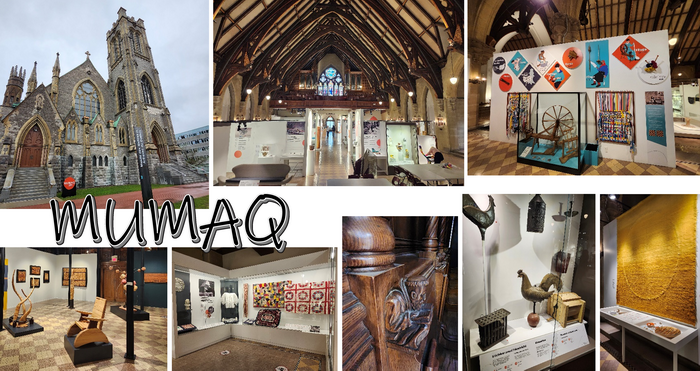
The Musée des métiers d’art du Québec (MUMAQ), located at 615 Sainte-Croix Avenue in Montreal, is a charming cultural stop for anyone wishing to explore the history and richness of Quebec’s artisanal know-how. The museum stands out not only for its collections but also for its unique setting. Inside, the permanent exhibition “Witness Objects: A History of Quebec’s Fine Crafts” tells the story of the evolution of crafts in the province through hundreds of pieces. From everyday objects shaped by the first settlers to contemporary creations in glass, ceramics, textiles, leather, or metal, the exhibit highlights the techniques, materials, and skills of the artisans who helped shape Quebec’s cultural identity. Alongside this, the museum hosts temporary exhibitions, showcasing emerging artists, specialized techniques, or fresh perspectives on today’s craftsmanship.
A church with a singular destiny
Behind the museum lies a building with an equally fascinating story. The structure that now houses the MUMAQ is the former St. Paul’s Presbyterian Church, once located on Dorchester Street (today René-Lévesque Boulevard) in downtown Montreal, on the site of what is now Central Station. Built in the 19th century, the church stood out for its elegant Neo-Gothic architecture, with finely cut stone walls, soaring vaults, and sculpted details that reflected the craftsmanship of its era.
The building, carefully reconstructed in Saint-Laurent, reveals the richness of its Neo-Gothic style:
The main façade:
The grand pointed-arch doorway, crowned by a vast Gothic tracery window, opens onto the nave and bathes it in light. Beneath it, a row of steeply pointed dormers recalls the side chapels of medieval churches. The whole structure is punctuated by prominent buttresses, heightening the impression of verticality and strength.
Towers and spires:
On the left, slender turrets and secondary spires animate the silhouette. Some are richly adorned with ornate pinnacles, almost fantastical in form, emphasizing the upward thrust toward the sky. On the right, the massive square bell tower dominates the ensemble. Pierced with tall twin lancet windows and crowned with crenellations, it combines the solidity of a fortified keep with the spiritual elevation of a sacred monument.
Materials:
The façade combines local grey stone with lighter trim, creating a subtle contrast that highlights its architectural lines. Roofs and dormers are edged with copper, now patinated green, a signature element of 19th-century Montreal religious architecture.
Sculptural details:
Above the side entrance, a statue stands within a Gothic niche. Elsewhere, carved motifs of stylized foliage, floral designs, and chimera figures enrich the stonework. Inspired by English and French cathedrals, these details reflect the builders’ ambition to recreate, in Montreal, the atmosphere of Europe’s great Gothic churches.
This building perfectly embodies the Victorian reinterpretation of Gothic style: faithful to its medieval models, yet adapted to the needs of a 19th-century Presbyterian parish in Montreal.
When the parish was dissolved and the church risked being demolished under real-estate pressures, a remarkable operation was undertaken: the entire structure was dismantled stone by stone, each element carefully numbered and inventoried. Blocks, columns, and even decorative details were transported to Saint-Laurent, where the church was reconstructed on Sainte-Croix Avenue, near Collège de Saint-Laurent and Vanier.
Its location, far from downtown, places it in a quieter, residential neighborhood, less frequented by tourists. But this is precisely what makes it special: stepping through its doors, visitors discover a museum of remarkable richness, one that brilliantly showcases Quebec’s heritage through fine crafts. At once a haven of tranquility and a vibrant cultural hub, the MUMAQ is well worth the visit for anyone wishing to explore a different side of Montreal—more intimate, and deeply tied to its heritage.
A living and participatory space
MUMAQ is more than a contemplative visit: it also offers workshops and educational activities accessible to all, allowing visitors to better understand creative processes and even try their hand at various crafts. Whether you are a heritage enthusiast, a design lover, or simply curious, the experience is immersive, with tradition and modernity constantly in dialogue.
A reflection of Montreal’s identity
As both a center of memory and a living space, this museum perfectly embodies the spirit of Montreal: a city where historic buildings are given new purpose and where craftsmanship continues to hold a central place in culture and everyday life.
 Simple Travel and Recreation