
3800 Queen-Mary Road (Côte-des-Neiges Metro)
Perched on the slopes of Mount Royal, Saint Joseph’s Oratory is far more than a sanctuary: it is a place of pilgrimage, an architectural masterpiece, and one of Montréal’s most remarkable viewpoints. Each year, it attracts millions of visitors from around the world, whether believers or simply curious tourists.
Towering over the city, its dome rises about 155 meters (508 ft) above Queen Mary Road. The Oratory stands impressively, visible from surrounding neighborhoods and asserting its emblematic presence in Montréal’s urban landscape.
Saint Joseph’s Oratory is the only building in Montréal allowed to surpass the height of Mount Royal, which is otherwise protected by strict regulations limiting construction heights to preserve the harmony of the natural and urban environment.
Why is it called an “Oratory”?
An oratory is originally a small place of prayer, more modest than a church or basilica. Saint Joseph’s Oratory began precisely as that: a simple wooden chapel built in 1904 by Brother André. From this humble beginning, it gradually became one of the largest sanctuaries in the world.
The name therefore preserves the memory of its origins.
A Little History
Founded in 1904 by Brother André, a humble religious brother of the Congregation of Holy Cross, the Oratory began as a small wooden chapel dedicated to Saint Joseph. Though tiny at first, it quickly became a center of devotion thanks to Brother André’s growing reputation as an intercessor and comforter. The sanctuary that exists today developed around this original chapel.
In 1982, Brother André was beatified by Pope John Paul II for his humility and charitable works. On October 17, 2010, he was canonized by Pope Benedict XVI at the Vatican, becoming Saint André Bessette — the first man born and deceased in Canada to be proclaimed a saint.
This event marked the faithful profoundly and confirmed the Oratory’s importance as a spiritual and heritage landmark in Canada.
Note: Both forms — Saint André Bessette and Saint Brother André — are correct. The first is the formal canonical version; the second is the most commonly used in Canadian and Québécois culture.
A Sanctuary Built on Eight Levels
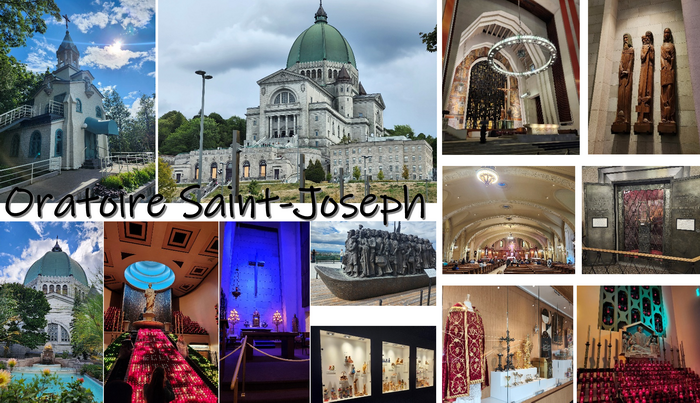
The Oratory is a vast and complex site spread over nearly eight levels along the mountainside. Its terraced, multi-level design reflects its gradual growth over time. Each level offers its own space: gardens, chapels, a museum, the crypt, the basilica, and a panoramic terrace.
Visitors discover the site progressively from bottom to top, creating a journey akin to a pilgrimage.
Elevators and escalators are available to facilitate access.
What to See at the Oratory
• The Original Chapel
Still preserved near the main site, this wooden chapel marks the sanctuary’s humble beginnings. Simple and intimate, it holds the memory of Brother André’s devotion. Both levels can be visited, including Brother André’s former room.
• The Basilica and Its Dome
Built between 1924 and 1967, the monumental dome rises 97 meters (318 ft) high—making it the third largest in the world, after Saint Peter’s in Rome and Saint Paul’s in London.
The interior is intentionally sober, reflecting a modern, minimalist aesthetic with concrete and granite construction. Light and space create a spiritual atmosphere free of excessive decoration.
Highlights include:
- An interior vault rising nearly 60 meters (197 ft) from the ground
- Modern stained-glass windows illustrating the life of Saint Joseph
- Decorative medallions depicting biblical scenes and spiritual symbols
- Monumental wooden sculptures in the choir and chapels
- Liturgical furnishings in marble and wood, combining simplicity and nobility
• The Votive Chapel
The true spiritual heart of the sanctuary. Thousands of candles illuminate this unique space, creating a contemplative atmosphere. The walls are lined with crutches, canes, and ex-votos left by grateful pilgrims.
Prayer intentions are arranged by theme: health and healing, family, work and studies, prosperity.
This chapel is striking for its popular devotion and the power of the testimonies it contains.
• The Crypt
The first stone church built on the site (1917–1924). It occupies two superimposed levels and provides essential insight into the Oratory’s architectural evolution.
• The Tomb of Saint Brother André
Located within the basilica, it is a major place of prayer and remembrance for visitors.
• Brother André’s Heart
Kept in a separate chapel, it is venerated as a symbol of his devotion and spiritual legacy.
• The Panoramic Terrace
Offering one of the most spectacular views of Montréal, it features two monumental sculptures:
- A bronze statue of Saint Joseph holding the Child Jesus, created by Alfred Laliberté in 1937
- The monument to Saint Brother André by Émile Brunet (1986), showing the saint surrounded by people from various backgrounds, symbolizing his deep connection with the population
• The Gardens of the Way of the Cross
A vast green space where monumental sculptures depict the Passion of Christ.
• The Carillon
Composed of 62 bells, it can perform an extensive musical repertoire and enriches the sanctuary’s daily ambiance.
The Carillon and the Absence of a Traditional Bell Tower
Unlike most major churches, the basilica of Saint Joseph’s Oratory has no integrated bell tower. A first bell was installed in 1910 in a small wooden campanile, but removed for fear of damaging the chapel. Today, the Oratory’s 62 bells are housed in a separate modern campanile (2023), physically independent from the basilica.
Thus, the Oratory does possess a significant carillon — simply not in a traditional architectural bell tower.
• The Oratory Museum
The museum offers exhibitions of religious and historical art. One small gallery, accessible for a modest fee, presents a unique collection of Nativity scenes from around the world — a fascinating journey through global Christmas traditions.
• The 283 Steps Climbed on One’s Knees
The grand outdoor staircase of 283 steps leading to the Oratory is more than a path: for many pilgrims, it is an act of faith. A central section of wooden steps is reserved for those who wish to climb on their knees, in prayer, silence, or meditation.
This act symbolizes penance, supplication, or gratitude for a grace obtained.
Though demanding, it is experienced by many as a profoundly spiritual moment.
Saint Brother André: The Man Behind Saint Joseph’s Oratory
A Humble Doorkeeper With a Great Heart
Born in 1845 in Saint-Grégoire d’Iberville, Alfred Bessette entered the Congregation of Holy Cross at a young age. Frail and uneducated, he was not assigned to teaching but instead worked as a porter at Collège Notre-Dame.
Despite this humble role, his faith was unwavering. He held a deep devotion to Saint Joseph, whom he affectionately called his “special friend.”
A Man of Prayer and Healing
Soon, hundreds of people came to see him with illnesses and personal struggles. Brother André prayed with them, listened, comforted them, and often encouraged them to apply a small dab of olive oil as a sign of trust in Saint Joseph.
Many claimed to have been healed, and crowds grew steadily around him.
The Birth of a Sanctuary
In 1904, Brother André obtained permission to build a small wooden chapel dedicated to Saint Joseph on Mount Royal. It was tiny and could barely hold a handful of visitors — yet it quickly became too small as pilgrims flocked from everywhere.
Thanks to donations and popular support, the chapel expanded, and soon a stone crypt was constructed. Brother André was not an architect or wealthy patron, but he played an essential role: he inspired trust, mobilized the faithful, and infused the project with a soul.
The Man Behind the Basilica
Brother André never saw the basilica completed — he died in 1937, when only the crypt was finished and construction of the basilica was still underway. Yet his legacy lives on: without him, there would be no sanctuary.
In 2010, he was canonized by Pope Benedict XVI, becoming Saint André Bessette, the first modern Canadian saint.
A Living Legacy
Today, Brother André’s remains are preserved in the basilica, and his heart is kept in a separate chapel. Millions of visitors come each year to walk in his footsteps, in a place that honors both his faith and his extraordinary legacy of humility.
Practical Information for Visitors
- Hours: Open daily; specific schedules for the basilica, museum, and original chapel.
- Fees: Paid parking. Entrance free with a suggested voluntary contribution. Museum exhibits require a ticket (including the international Nativity scene gallery).
 Simple Travel and Recreation