
A Historic Landmark in the Heart of Marseille
From Canal to Square: A Legacy of Maritime Trade
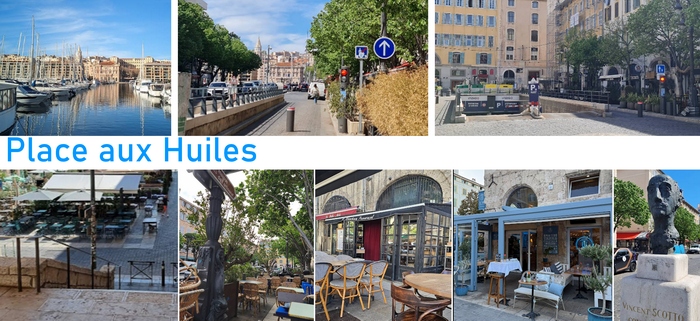
Just steps away from the Old Port, Place aux Huiles is today a lively and welcoming square, beloved by both locals and visitors. Yet behind its sunny terraces and bustling restaurants lies a fascinating history tied to Marseille’s maritime trade and its centuries-old olive oil industry.
Originally, this was not a square at all, but a canal — the Canal de la Douane — dug in the 17th century to allow galleys to reach the royal shipyards. It quickly became a vital hub for unloading barrels of olive oil, the essential ingredient for Marseille’s famous soap factories on nearby Rue Sainte. From this activity comes its name: “Place aux Huiles,” literally meaning “Oil Square.”
Small boats, known as barques à huile or barquettes marseillaises, carried the barrels from the Old Port up the canal, where they were unloaded. The oil came mainly from Provence’s olive groves, a region that had cultivated olives since their introduction by the Greek settlers of Phocaea over 2,600 years ago. Olive oil was one of Provence’s most prized exports — a cornerstone of local commerce and craftsmanship.
Urban Transformation and Modern Renewal
Between 1927 and 1929, the canal was filled in, marking the end of its port-related activity. Over time, the area was reshaped into a vibrant urban space. Initially occupied by a controversial elevated car park, it was completely redesigned in the 1980s, replaced by a large underground parking lot and transformed into a pedestrian-friendly plaza inspired by Italian piazzas — open, elegant, and ideal for social life.
The square connects directly to Cours Honoré d’Estienne d’Orves, another lively pedestrian zone lined with cafés, boutiques, and art galleries. Its location also provides easy access to Marseille’s City Hall (Hôtel de Ville) via the Vieux-Port ferry boat, making it both a practical passageway and a pleasant meeting point between the city’s historic and modern centers.
A Place of Life and Mediterranean Charm
Today, Place aux Huiles radiates a warm, southern atmosphere. Surrounded by 17th- and 18th-century façades, it is animated by bustling terraces, charming restaurants, and local shops. It’s a place where the echoes of Marseille’s working past blend seamlessly with the city’s modern, convivial spirit.
Although no visible historical markers recall its industrial and maritime origins, the square’s distinct character continues to evoke that heritage — subtly preserved in the rhythm of its streets and the brightness of its open space.
Vincent Scotto: Music in the Heart of the Square
At the heart of Place aux Huiles stands a discrete bronze bust of Vincent Scotto, one of Marseille’s most beloved composers. Created by André Arbus and inaugurated after the artist’s death, the sculpture portrays Scotto (1874–1952) with a serene and inspired expression, reflecting the warmth and creativity that defined his music.
Scotto composed more than 4,000 works, including many timeless songs celebrating Marseille and Provence.
 Simple Travel and Recreation