
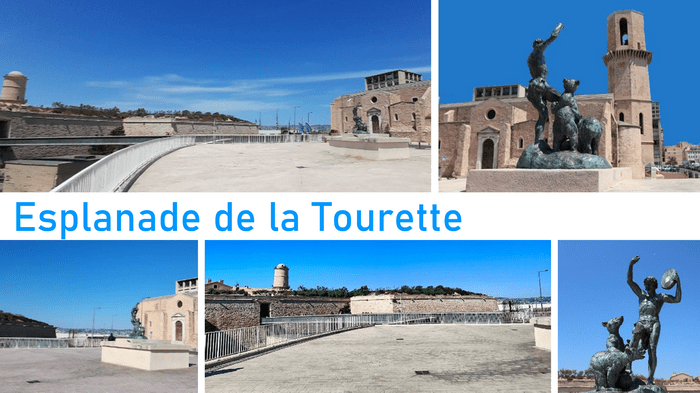
The Esplanade de la Tourette: between panorama, history, and memory in Marseille
Located in Marseille’s 2nd arrondissement, the Esplanade de la Tourette is much more than just a scenic viewpoint. This emblematic spot offers one of the city’s most striking panoramas, with a clear view of the Old Port and the famous Basilica of Notre-Dame de la Garde, affectionately called la Bonne Mère by the locals.
Location
Easily accessible from the city center, the esplanade sits just a few steps from Saint-Laurent Church, a gem of Provençal Romanesque architecture. It is also one of the main access points to the MuCEM, via the Fort Saint-Jean footbridge, which gracefully links ancient heritage with contemporary architecture.
At first glance, it may not be the most visually charming square, yet it takes on its full meaning through its rich history, breathtaking view, statues, and spiritual presence. Behind its apparent simplicity lies a place of deep, sometimes painful memory — one that deserves to be known.
A land marked by the plague of 1720
At the heart of one of Marseille’s darkest chapters — the Great Plague of 1720 — the Esplanade de la Tourette served as a temporary burial site, where corpses were gathered due to the lack of space in city cemeteries. Its peripheral, sun-exposed location made it a suitable, though tragic, site for this emergency use.
It was here that Nicolas Roze, a remarkable figure in local history, led a group of volunteers to collect and bury the bodies, notably in old fortifications repurposed as mass graves. His bravery left a lasting mark on Marseille’s collective memory.
The Statue of Chevalier Roze: a visible tribute
Positioned not far from Louis Botinelly’s “Bear Trainer” statue, in tribute to this heroic act, a bust of Nicolas Roze, known as Chevalier Roze, was installed in 1886. Created by sculptor Jean-Baptiste Hugues, this bronze statue has been relocated several times over the years. It finally returned to its historic location in March 2017, near Saint-Laurent Church — at the very site where Roze acted during the plague.
A site also marked by the Revolution
Little known to the general public, the “Affair of La Tourette”, also called the “Bournissac Affair”, took place here in 1789–1790, during the turbulence of the French Revolution. Clashes broke out between the bourgeois militia and the local population, once again highlighting the dynamic and rebellious spirit of this part of Marseille.
Not to miss during your visit:
- The panorama over the Old Port, Fort Saint-Jean, and Notre-Dame de la Garde (La Bonne Mère)
- The Saint-Laurent Church
- The MuCEM footbridge
- The statues of Chevalier Roze and The Bear Trainer
The Esplanade de la Tourette is a corner of reflection and history in the very heart of Marseille.
The Bear Trainer by Louis Botinelly
During your walk around Marseille’s Old Port, don’t miss the chance to look up and admire a work that is both original, poetic, and full of symbolism: The Bear Trainer, created by Louis Botinelly (1883–1962), a sculptor born in Digne-les-Bains who made Marseille his adopted home.
This is the artist’s first major public work, marking the beginning of a promising career. Later on, Botinelly would go on to create several of Marseille’s most famous monuments, including the monumental statues that flank the grand staircase of Saint-Charles train station.
The statue first received a medal at an art competition, after which the City of Marseille commissioned a bronze version to be installed in a public space.
Today, it stands proudly on the Esplanade de la Tourette, right next to Saint-Laurent Church, offering a beautiful view of Fort Saint-Jean and the Old Port. The bronze sculpture captures a charming and surprising scene: a young boy playing the tambourine, one foot resting on a ball, while two little bear cubs perform an acrobatic routine beside him.
Completed in 1911, this emblematic artwork combines grace, motion, and emotion, portraying the bond between humans and animals. Far from being a simple scene of entertainment, the statue symbolizes education, self-mastery, and the harmony that can exist between wild nature and human culture.
 Simple Travel and Recreation