La Major — Marseille’s Grand and Unmistakable Cathedral
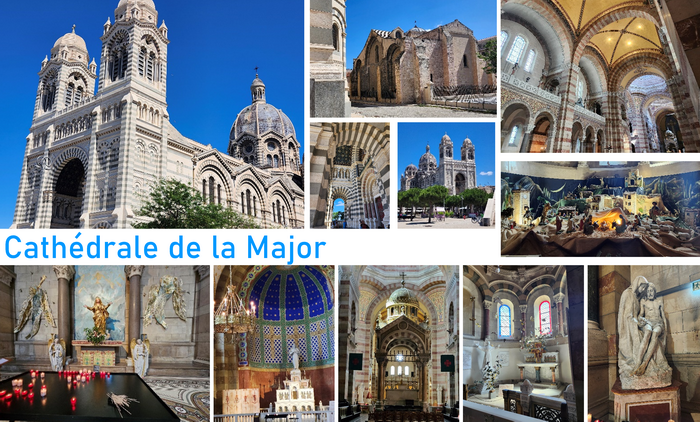
In Marseille, everyone simply calls it “La Major.” And indeed, it’s impossible to miss! Standing proudly between the Old Port and La Joliette, on the Esplanade Jean-Paul II, with the sea as a backdrop, the Sainte-Marie-Majeure Cathedral is one of the city’s most striking landmarks.
A Monument Born in the 19th Century
Construction began in 1852, when Prince-President Napoleon III himself laid the first stone on September 26 of that year. Architect Léon Vaudoyer designed the plans for this monumental building, blending Eastern and Western influences. After Vaudoyer’s death in 1872, the project was continued by Henri-Jacques Espérandieu (who also built Notre-Dame de la Garde) and completed in 1893 by Henri-Antoine Révoil, who oversaw much of the interior decoration.
A Site with Ancient Roots
The cathedral stands on a site steeped in history, where churches have succeeded one another since the 5th century. Remains of the “Vieille Major,” a Romanesque cathedral from the 12th century, can still be seen, alongside the foundations of a Paleochristian basilica and a vast baptistery.
A Blend of East and West in Stone and Marble
Architecturally, La Major is impossible to overlook. Its Byzantine-style domes, alternating stripes of green and white stone, and total length of 142 meters make it both imposing and original.
The materials used come from across the Mediterranean: green stone from Florence, white marble from Carrara, stone from Calissane and the Gard, onyx from Italy and Tunisia, and Venetian mosaics that add brilliance and refinement.
Inside, the decor is sumptuous — colored marbles, mosaics, stained glass, bronze work, and sculpture cover the walls and vaults. The central dome rises 70 meters high, and the cathedral can accommodate up to 3,000 worshippers.
The façade, flanked by two 60-meter towers crowned with domes, creates a harmonious balance between Western and Eastern aesthetics, making La Major a true architectural jewel visible from afar.
The Façade and the Main Portal
A Triumph of Sculpture and Ornamentation
The façade of La Major is a masterpiece of sculpture and architectural design, conceived as a monumental triumphal arch. The entrance porch impresses with its rich decorative and symbolic program.
Architecture and Decoration:
- Triple-arched portico (one main entrance and two secondary).
- Vault adorned with blue and gold mosaics.
- Central tympanum featuring a rose window and mosaics depicting Jerusalem and Bethlehem.
- Sculpted marble tympana: Coronation of the Virgin (central door), Resurrection (east door), and Mystic Lamb and Fountain of Life (west door).
- Alternating Cassis stone and green marble from Florence for the exterior.
The Sculptures
Fronton of the porch: seven statues representing Christ at the center, surrounded by Peter, Paul, and the Bethany group (Lazarus, Maximin, Mary Magdalene, and Martha).
Inside the porch: monumental statues of the first bishops and saints associated with Marseille (Saint Cannat, Pope Urban V, Saint Victor, Saint Mauront, Saint Serenus, Saint Theodore, and others).
The portal of La Major is not just an entrance — it’s a spiritual and artistic manifesto, combining Romano-Byzantine style, Ravenna-inspired mosaics, and statuary illustrating Marseille’s Christian history.
On the esplanade, a statue of Monseigneur de Belsunce honors the bishop who helped save the city during the plague of 1720, reinforcing the link between faith, history, and collective memory.
The richly decorated blue and gold mosaics complete this majestic entrance, inviting visitors into a space filled with symbols and beauty.
The Sculptures – How to distinguish them
At the center stands Christ, majestic and serene. To his sides are Saint Peter (with the keys of Heaven) and Saint Paul (with the sword of martyrdom).
Around them, the Bethany saints of Provence — Saint Lazarus (first bishop of Marseille, with a quill or staff), Saint Mary Magdalene (with her ointment jar), Saint Martha (with her apron or a dragon), and Saint Maximin (in episcopal attire).
These figures represent both the legendary evangelists of Provence and the great pillars of early Christianity.
Inside the porch, monumental statues of the early bishops and saints of Marseille are arranged in three symbolic groups.
- First group: Saint Cannat, bishop with mitre and crosier; Pope Urban V, wearing the papal tiara; and Saint Victor, monastic abbot holding a crosier, symbol of the abbey that bears his name.
- Second group: Saint Mauront, monk and bishop; Saint Serenus, youthful bishop with a crosier; and Saint Theodore, bishop depicted with a crosier and a book.
- Third group: Saint Cassian, monk and bishop, often shown with a quill symbolizing spiritual writing; Saint Lazarus, again evoked as evangelizer with quill and staff; and Saint Eucher, bishop of Lyon from the fifth century, holding a book and crosier.
Inside the Cathedral
Chapels, Art, and Devotion
The interior of La Major unfolds around a spacious ambulatory lined with radiant chapels. Each has its own atmosphere, featuring richly decorated altars, statues, mosaics, and votive offerings.
Among them, the Chapel of the Virgin Mary holds special significance as the protector of the city. Other notable spaces include the Chapel of the Sacred Heart, and the Chapel of Saint Eugène de Mazenod, where his tomb rests.
The meticulous attention to architectural and decorative detail in each chapel contributes to the cathedral’s solemn grandeur, while also offering intimate spaces for prayer and contemplation.
A Living Symbol of Marseille
A symbol of Marseille’s industrial and maritime strength in the 19th century, La Major was designed to be visible from the entrance to the port. Declared a minor basilica in 1896, consecrated in 1897, and listed as a Historic Monument in 1906, it remains one of the city’s defining landmarks.
Every August 15, the procession of the Virgin Mary gathers residents of the Panier district in a moving celebration that is both spiritual and deeply local.
More than just a historical monument, La Major is still a living place of worship.
The Old Major: Marseille’s Former Cathedral
Origins and Early Constructions
The Old Major, located right next to the new Sainte-Marie-Majeure Cathedral, is the former cathedral of Marseille. Its origins date back to the 5th century, when the first church was built alongside a large baptistery. From the 12th century, the Romanesque structure took shape and became the seat of the Diocese of Marseille. Simple and austere, its architecture perfectly embodies the Provençal Romanesque style, characterized by clean lines and monumental proportions.
Transformations and Alterations
Over the centuries, the cathedral underwent several transformations, particularly in the 11th century, which still define its current appearance. It was later expanded with the addition of a “great chapel,” completed in 1644 and dedicated to the Virgin a century later.
The Threat of Destruction in the 19th Century
In 1852, the construction of the new Sainte-Marie-Majeure Cathedral, in a grand Romano-Byzantine style, posed a serious threat to the Old Major, which once extended down to the waterfront. Thanks to the protests of the French Society for the Preservation of Monuments and the devotion of the people of Marseille, part of the old cathedral was saved—only the choir and one bay escaped demolition.
Downgrading and Closure
When the new cathedral was completed, the Old Major was downgraded to a parish church, though it continued to host services until the 1950s. The church has been closed to the public for nearly 30 years, but in 2015, it underwent conservation work accompanied by archaeological supervision by Inrap, underlining its historical and cultural importance.
A Precious Witness of Provençal Romanesque Art
Today, although partially destroyed and often overshadowed by its 19th-century successor, the Old Major remains a rare example of Romanesque architecture in Provence. Modest yet steeped in history, it stands as a reminder of Marseille’s long Christian tradition and the evolution of its religious landscape over the centuries.
Virtual visit (in French): https://www.la-grange-numerique.net/VV-vieillemajor/index.html
For an overview of what to see in Marseille click here.
What to See Around the Cathédrale de la Major
Le MuCEM & Fort Saint-Jean
A short walk away, the Mucem’s striking architecture connects to the historic Fort Saint-Jean via a footbridge. Both offer panoramic views and exhibitions on Mediterranean culture.
Le Panier District
Behind the cathedral lies Marseille’s oldest quarter — a maze of colorful streets, street art, and small restaurants. Don’t miss La Vieille Charité, a cultural and historical landmark.
L’Évêché (Bishop’s Palace)
Located right beside the cathedral, this elegant 18th-century building serves as the seat of the Archbishop of Marseille. It forms part of the historic ensemble of La Major.
Mairie des 2e et 3e arrondissements
Facing the sea, a modern administrative building with a classical façade, symbolizing the city’s commitment to maintaining an institutional presence in its historic heart.
Les Docks & La Joliette
A few steps north, the Docks Village and La Joliette district blend 19th-century port architecture with trendy shops, restaurants, and seaside terraces.
Esplanade de la Major
The open square between the cathedral and the sea offers wide views of the harbor, Mucem, and Frioul Islands — perfect for photos at sunset.
 Simple Travel and Recreation