
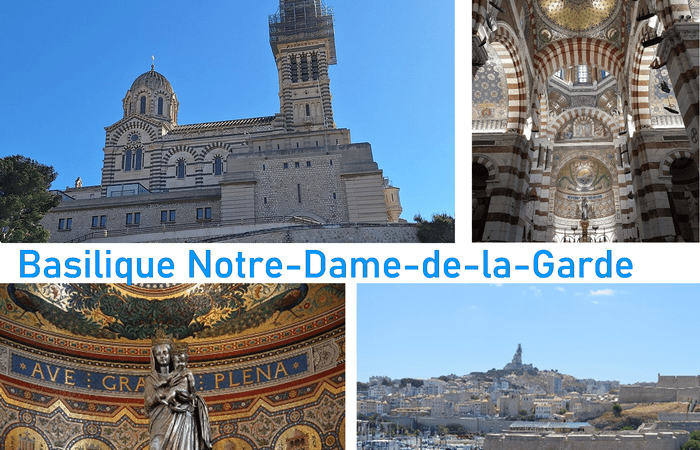
Affectionately known as “La Bonne Mère” (“the Good Mother”), the Basilica of Notre-Dame de la Garde is the undisputed symbol of Marseille.
Standing proudly atop the Hill of La Garde, 154 meters above sea level, it offers a breathtaking 360° panoramic view over the city and the Mediterranean Sea.
History
The religious history of the site began in 1214, when a priest named Pierre obtained permission from the Abbey of Saint-Victor to build a small chapel dedicated to the Virgin Mary on the hill.
This simple act of devotion coincided with the end of the Battle of Bouvines and soon became the foundation of a major pilgrimage site, especially for sailors seeking protection from the dangers of the sea.
Over the centuries, several chapels succeeded one another, each expanding the site’s spiritual influence as popular devotion continued to grow.
The Hill of La Garde also served a strategic military role as an observation post since the Middle Ages. In 1524, King Francis I built a fort there to defend the city. During the French Revolution, the chapel was desecrated and the site used as a prison. It was not until the 19th century (after 1807) that the hill regained its religious purpose, marked by the construction of the present basilica.
The growing influx of pilgrims prompted Bishop de Mazenod to launch the construction of a larger church in 1853, designed by Henri-Jacques Espérandieu and completed in 1864. The new basilica quickly became one of the most visited sanctuaries in southern France.
Its Roman-Byzantine style combines majesty and refinement, with domes, mosaics, colorful marbles, and symbolic motifs.
Origin of the Name
The name “Notre-Dame de la Garde” combines two symbolic elements:
- “Notre-Dame” (“Our Lady”) refers to the Virgin Mary, representing spiritual protection.
- “de la Garde” (“of the Guard”) refers to the hill’s long-standing use as a lookout post.
Together, they express a dual protection — both spiritual and military — over the city of Marseille.
“La Bonne Mère” – Name and Meaning
Although not its official title, the name “La Bonne Mère” (the good mother) comes from the Provençal dialect and has become a deeply rooted popular expression of faith, gratitude, and affection, often represented through the countless ex-votos offered by the faithful.
While thousands of churches worldwide are dedicated to “Our Lady,” none has acquired a nickname as intimate and enduring as “La Bonne Mère”, inseparable from the golden statue that watches over Marseille.
A Two-Level Architectural Masterpiece
The basilica consists of two superimposed churches:
- The lower church (crypt), simple and vaulted, invites quiet reflection.
- The upper church, dedicated to the Virgin, dazzles with golden mosaics and richly colored marble.
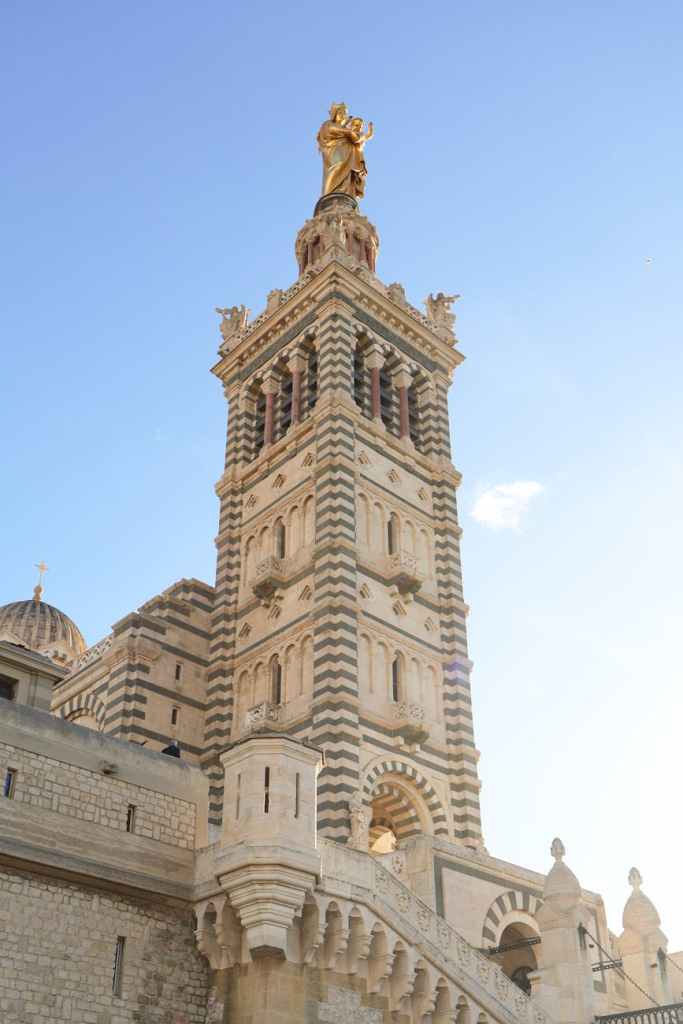
Its 41-meter square bell tower, topped by a graceful turret, serves as the pedestal for a monumental 11.2-meter statue of the Virgin and Child, sculpted by Eugène Lequesne in 1869, crafted in gilded copper by the Christofle workshops.
Visible from nearly every part of Marseille, this statue stands as a spiritual and emotional landmark, a shining protector over the city and sea.
The Bells – A Celestial Symphony Above Marseille
The tower houses three remarkable bells:
- Marie-Joséphine, cast in Lyon in 1845 by Gédéon Morel, weighs 8,234 kg and measures 2.4 m in diameter. It rings solemnly during major celebrations.
- Françoise, cast in Nancy in 1920 by Jules Robert, measures 92 cm in diameter and marks the passing hours.
- The smallest bell, cast in Marseille in 1885 by Toussaint Maurel, measures 71 cm and rings for the Angelus, the Roman Catholic prayer commemorating the Annunciation, traditionally recited three times daily — morning, noon, and evening.
Ex-Votos – The Living Memory of Marseille’s Devotion
Upon entering the basilica, visitors are immediately struck by the hundreds of ex-votos adorning the walls: engraved plaques, ship models, paintings, buoys, letters, crutches, and personal objects.
Each is a token of gratitude to the Virgin for protection, healing, or deliverance.
These humble yet powerful testimonies tell the story of sailors saved from storms, soldiers returned from war, and families spared from tragedy.
Unlike offerings made to ask for favors, an ex-voto is an act of thanks, a tangible reminder of faith fulfilled.
As one walks among these objects, one feels the emotional bond between Marseille and its protector — a silent witness to centuries of trials and rebirths.
A Sanctuary of Art and Popular Faith
The interior of the basilica displays more than 1,200 m² of neo-Byzantine mosaics, crafted between 1886 and 1892 by Venetian artisans.
These mosaics depict religious scenes, doves, stylized flowers, and a ship sailing toward a star — symbols both Marian and Marseillean.
The high altar, created by Cantini, combines marble, lapis lazuli, and mosaic, reflecting both reverence and artistry.
The Silver Statue of the Virgin
The basilica houses a magnificent silver statue of the Virgin, not the original one destroyed during the French Revolution.
The first statue, known as the “Virgin with the Monstrance” (1661), was melted down at the Marseille Mint in 1794 along with other sacred treasures of the time.
The current statue, created between 1829 and 1834 by silversmith Jean-Baptiste Chanuel, weighs about 80 kilograms and now presides over the main altar.
Its delicate craftsmanship reflects both 19th-century artistry and the Marseillais desire to restore their “Good Mother” after the upheavals of history.
A Spectacular View – An Exceptional Site
From the panoramic terrace, visitors enjoy one of the most stunning vistas in southern France:
- the Old Port, the Frioul Islands, the Calanques, and the shimmering Mediterranean Sea stretching to the horizon.
- the hill of La Garde is a natural lookout, chosen for centuries for its defensive position — today offering a view of unmatched beauty.
Swept by the Mistral wind, the hill gives a refreshing sense of freedom. At sunset, the golden light bathes the basilica and city in an almost mystical glow — the stones turn amber, the sea reflects copper and gold, and Marseille seems to sparkle like an offering to its “Bonne Mère.”
A Symbolic and Visible Landmark
Wherever you stand in Marseille — from the Old Port to Le Panier, from the Prado beaches to the hills of l’Estaque — the golden silhouette of the Good Mother remains visible.
She represents the unity, protection, and identity of the people of Marseille.
During the Feast of the Assumption, the basilica becomes a focal point for pilgrims and visitors alike, drawing millions each year who come to admire both its spiritual aura and its breathtaking panorama.
Restoration Works – 2025
Since February 2025, major restoration work has been underway at the basilica. Scheduled for completion in December 2025, just in time for the Feast of the Immaculate Conception, the project includes:
- complete re-gilding of the monumental Virgin and Child statue,
- anti-corrosion treatment of its internal metal structure,
- meticulous cleaning of the façades, and
- full restoration of terraces and railings for safety and brilliance.
The site remains open to visitors throughout, though some areas are temporarily restricted for safety reasons and the statue hidden when we were there.
A Must-See Site
Accessible on foot from the Old Port (a 20-minute uphill walk), by bus, tourist train, or car, the basilica offers an unforgettable view of Marseille, the sea, and the Frioul Islands.
While the original chapel could hold only about 60 people, the current basilica grounds can host up to 20,000 visitors for major events.
Notre-Dame de la Garde remains a spiritual, historical, and panoramic treasure.
 Simple Travel and Recreation