
Promenade Robert Laffont, Esp. J4
In Marseille, a Prehistoric Cave… Under the Sea!
While France’s decorated caves are famous around the world, most of them are completely closed to the public — too fragile, too remote. Fortunately, some have been faithfully recreated, allowing visitors to enjoy their beauty without damaging the originals.
Such is the case of the Cosquer Cave, one of the most extraordinary prehistoric sites, now reproduced at Cosquer Méditerranée in Marseille.
This Paleolithic cave was discovered almost by accident in 1985 by a Marseille diver named Henri Cosquer. He only made his discovery public in 1991, once it had been officially confirmed.
When prehistoric humans first entered the cave, between 33,000 and 19,000 years ago, the Mediterranean Sea was 120 meters lower, and the cave lay several kilometers inland!
Today, its entrance is completely submerged, located 37 meters below sea level at the foot of the Calanques cliffs, and accessible only through a 175-meter-long underwater tunnel. Needless to say, it is closed to the public. Yet it remains an exceptional site, containing over 500 drawings, engravings, and paintings of both land animals (horses, bison, deer…) and marine species (seals, penguins, fish) — an absolute rarity in prehistoric art!
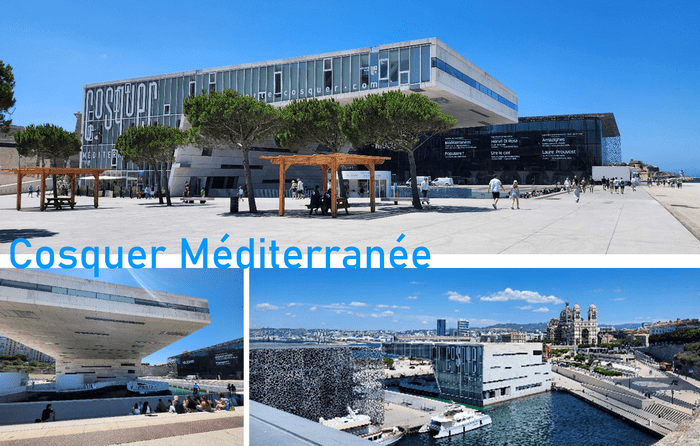
Fortunately, you don’t need diving gear to experience this marvel. A realistic replica opened in June 2022 inside the Villa Méditerranée, on the J4 esplanade in Marseille, right next to the MuCEM. Named Cosquer Méditerranée, the site offers an immersive and astonishing journey into an exceptional prehistoric heritage — without getting wet.
A Bit More About the Villa Méditerranée
The Villa Méditerranée, inaugurated in 2013 in Marseille, was designed by Italian architect Stefano Boeri. With its spectacular 40-meter cantilever suspended above an artificial pool, the building was meant to symbolize dialogue between Mediterranean cultures.
Originally intended to host exhibitions, conferences, and meetings, the Villa quickly faced criticism due to its high operating costs (over €5 million per year) and its modest attendance of around 100,000 visitors annually. Its spectacular but impractical design also limited its capacity, with interior spaces poorly suited to large exhibitions or heavy visitor flow.
In 2018, just five years after its opening, the site was closed to the public due to a lack of a clear project and financial sustainability. Considered an emblematic yet underused landmark, the Villa remained vacant until its conversion into a museum — now home to Cosquer Méditerranée, which has given it a vibrant new life.
 Simple Travel and Recreation