
Quai du Port
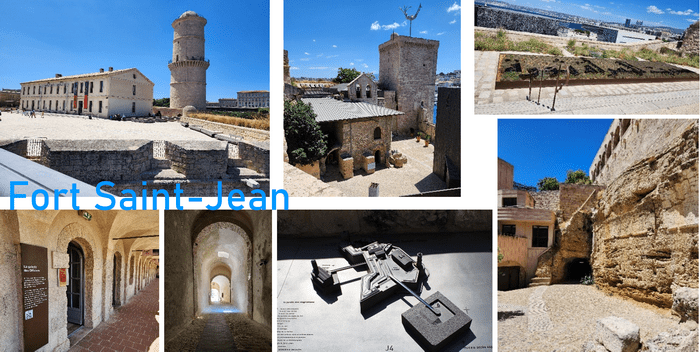
Located at the northern entrance of the Old Port, Fort Saint-Jean is one of Marseille’s most emblematic monuments, bearing witness to over ten centuries of history. The site was first occupied in Antiquity by the Greek settlers of Massalia, then became, in the 12th century, a commandery of the Knights Hospitaller of Saint John of Jerusalem. Several major buildings were later added: the Square Tower, built by King René in the 15th century, and the Fanal Tower, a lighthouse constructed in 1644 by Marseille’s shipowners.
Fort Saint-Jean – History at the Heart of the Old Port
A fortress with many faces
Overlooking the northern entrance of the Old Port, Fort Saint-Jean embodies more than a thousand years of Marseille’s history. First occupied by the Greeks of Massalia, the site was transformed in the 12th century into a commandery of the Knights Hospitaller of Saint John of Jerusalem, complete with a chapel, church, hospital, and palace completed in 1365.
In the 15th century, King René ordered the construction of the Square Tower between 1447 and 1453. Later, in 1644, shipowners built the round Fanal Tower—a watchtower that also served as a lighthouse.
In 1668, following a local rebellion, Louis XIV ordered the construction of the present-day fortress. The first stone was laid by the Chevalier de Clerville, and Vauban later oversaw the creation of a ditch isolating the promontory. Its cannons were pointed toward the city—a clear symbol of royal control over the people of Marseille.
From Prison to Museum
Until the French Revolution, the fort served strictly military purposes before being converted into a state prison. During the Reign of Terror, it held notable prisoners such as Philippe Égalité and other Jacobin figures; some inmates were massacred there in 1795.
During World War II, the Germans stored munitions in the fort, and an explosion in August 1944 destroyed part of the complex.
Listed as a historic monument in 1964, Fort Saint-Jean was integrated into the MuCEM (Museum of European and Mediterranean Civilisations) in 2013 and connected to it by a striking modern footbridge.
What You’ll Discover
The site brings together centuries of military power, maritime vigilance, and collective memory.
The fort features two distinct architectural levels.
The lower section preserves traces of the Middle Ages, with King René’s Square Tower and the chapel of the commandery, reminders of the Knights Hospitaller who once occupied the site. Their presence evokes Marseille’s long-standing role as a crossroads of faith, trade, and defense.
The upper section, in contrast, reflects the modern military architecture of the 17th century. It includes the Fanal Tower, a round lighthouse built in 1644 to guide ships safely into the harbor, along with barracks and bastions added under Louis XIV. These fortifications, linked to Fort Saint-Nicolas across the port, once formed a powerful defensive system controlling Marseille’s maritime gateway.
Today, the site is part of the MuCEM complex (Museum of European and Mediterranean Civilizations) and has been beautifully redeveloped to connect history with modern public space. The Galerie des Officiers, within the fort, presents an interactive exhibition trail retracing the site’s evolution through models, archival films, and reconstructions of the Square and Fanal Towers.
Nestled among the ramparts, the Jardin des Migrations offers a poetic interlude—a Mediterranean garden filled with plants symbolizing the cultural exchanges that have shaped Marseille. From its terraces, visitors enjoy panoramic views over the sea, the port, and the city’s skyline.
Beyond the fort, the Esplanade de la Tourette extends the visit toward a contemplative space overlooking the harbor. Here stands the Mémorial des Déportations, a solemn underground monument dedicated to the victims of Nazi deportations during World War II. Hidden beneath the esplanade and accessible through a narrow passage, the memorial contrasts sharply with the brightness of the port, offering a moment of silence and reflection.
Together, Fort Saint-Jean, the Esplanade de la Tourette, and the Mémorial des Déportations form a powerful ensemble—a place where military heritage, natural beauty, and remembrance meet. This historic site, once a fortress of control, now stands as a symbol of openness and peace, bridging Marseille’s past and present across the waters of its legendary harbor.
Admission to the outdoor spaces and gardens is free.
The MuCEM offers a combined ticket granting access to all paid exhibitions, including those inside the Galerie des Officiers.
Opening hours: Open daily except Tuesdays.
Summer: 10 a.m. – 8 p.m. (last entry 45 minutes before closing — so don’t expect to catch the sunset in summer!).
Fort Saint-Nicolas – Its Counterpart
Facing Fort Saint-Jean, on the opposite side of the Old Port, stands Fort Saint-Nicolas, built during the same period under the orders of Louis XIV. Erected between 1660 and 1664, just after the revolt of the Marseillais against royal authority, this impressive fort was not designed to defend the city from external attacks—but rather to keep an eye on its own inhabitants.
Its strategic position on the heights of the Pharo district, and the orientation of its cannons toward the city instead of the sea, clearly reveal this intent. Built according to the plans of engineer Chevalier de Clerville—like Fort Saint-Jean—it completed the system established by the Sun King to assert his power.
Today, its ramparts and bastions tower over the port, offering a spectacular view of Marseille. Classified as a historic monument, the fort was long closed to the public but is now undergoing rehabilitation projects aimed at hosting cultural events and opening its spaces for public visits and walks.
 Simple Travel and Recreation