
Mnt du Souvenir Français
Origins and Royal Intentions
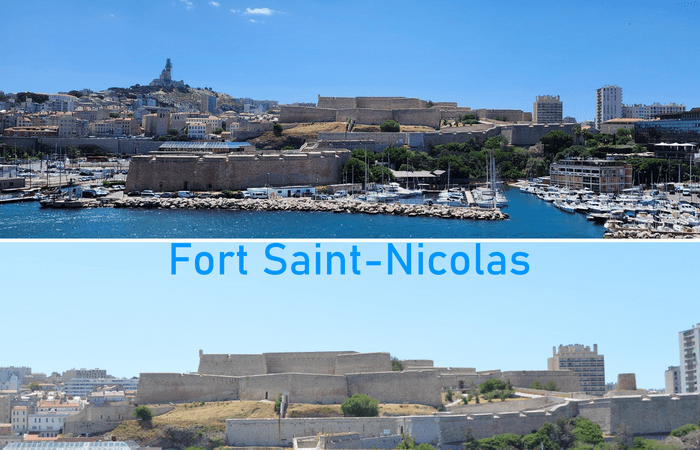
Built in 1660 on the orders of Louis XIV, Fort Saint-Nicolas proudly overlooks the entrance to the Old Port, directly facing Fort Saint-Jean. Officially designed to defend the city, it also had another less avowed purpose: to keep a close watch on the people of Marseille, who were known for their rebellious spirit. The king’s engineer, Louis Nicolas de Clerville, chose its strategic location—close to the sea and dominating the city. Construction began in March 1660 and lasted four years, an impressive feat for such an ambitious project.
A Dual Role: Defense and Surveillance
Located in Marseille’s 7th district, the fort occupies a prime position on the southern shore of the Old Port. Built between 1660 and 1664, its star-shaped plan was designed by Clerville and later reinforced by Vauban, whose defensive additions remain visible today. From the outset, the fort served a dual role: to protect the city against potential maritime attacks and, above all, to keep an eye on a population often deemed rebellious.
Revolutionary Destruction and 19th Century Restoration
Over the centuries, the fort witnessed turbulent times. During the French Revolution (1789-1799), it was partially destroyed by the people of Marseille, who saw it as a symbol of absolute power. Some of its stones were even reused to build houses in the Panier district! In 1834, the fort was restored, though with materials different from the original ones, giving it a contrasting appearance.
A City Divided: The Boulevard and Its Legacy
Under Napoleon III, the site was profoundly transformed. In 1860, to facilitate access to the Imperial Residence at the Pharo, a boulevard was cut straight through the citadel, dividing it into two. Over time, this boulevard bore several names—Boulevard de l’Empereur, Victor Hugo, du Pharo—before becoming Boulevard Charles Livon in 1922.
This separation created two distinct entities:
- above, on the landward side, Fort Entrecasteaux, named after a great French navigator;
- below, by the sea, Fort Ganteaume, named after a former vice admiral and maritime prefect of Toulon.
Today, Fort Ganteaume remains under military use, housing a military club and officers’ mess.
From Fortress to Prison
Fort Saint-Nicolas also served for centuries as a prison. As early as 1696, it held soldiers sentenced to short terms, then became a state prison in 1823. That year, following the Duke of Angoulême’s expedition in Spain, 569 prisoners were locked up there. Other historical figures would pass through its cells, including Jean Giono, Jean Zay, and Habib Bourguiba, the future president of Tunisia. The fort retained its prison role until the end of the Second World War, and then remained occupied by the army until 2011.
A New Life for the Citadel
Classified as a Historic Monument since 1969, Fort Entrecasteaux—also known as the Citadel of Marseille—has begun a new chapter. Since May 2024, it has been gradually opened to the public as part of the Citadelle project, which aims to restore, preserve, and transform it into a cultural and community space. Its gardens are now accessible, offering spectacular views of Marseille and its harbor.
The Return of a Monument to Its People
Some 360 years after its construction, the fort is finally opening to the people of Marseille and curious visitors alike—a striking reversal for a citadel long closed off, bearing witness to struggles, tensions, and the maritime grandeur of the city.
 Simple Travel and Recreation