
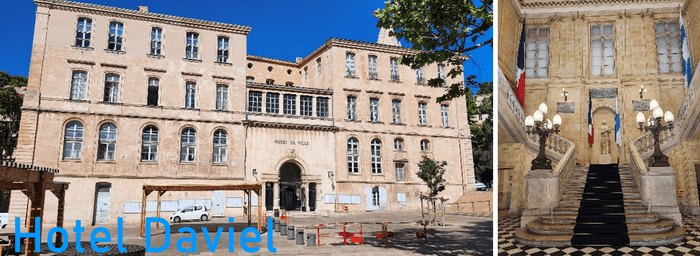
10 Pl. Daviel
Just a stone’s throw from the Old Port, in the heart of Marseille’s historic center, stands an elegant building steeped in history: the Hôtel Daviel, also known as the Pavillon Daviel. Built between 1743 and 1747 by architects François and Esprit-Joseph Gérard, this building served as the city’s courthouse until the 19th century.
A courthouse at the heart of Old Marseille
The site has not always looked as it does today. It replaced an earlier courthouse dating back to 1576, renovated in 1618, which had become increasingly cramped for a rapidly growing city. A royal decree ordered the construction of a new tribunal on the same site, with the purchase of several neighboring houses to enlarge the space.
The result was a pink-stone building with a symmetrical façade, a central balcony, and sculpted decorations—an elegance that earned it the nickname “pavilion.” The name Hôtel Daviel follows the French tradition of designating notable public buildings as “hôtels,” like city halls. It also pays tribute to Jacques Daviel, the renowned 18th-century Marseille surgeon and pioneer in cataract treatment.
From 1747 to 1862, the Hôtel Daviel was the seat of justice in Marseille. It is also tied to darker chapters: during the French Revolution, numerous public executions were carried out in the square that today bears its name.
The transfer to the Palais Montyon
By the early 19th century, the Hôtel Daviel had also become too small. In 1839, a new project was launched to relocate the courts to Place Montyon, in the 6th arrondissement.
Construction finally began in 1856 under architect Auguste Martin. This neoclassical building was inaugurated on November 4, 1862, officially transferring judicial authority to the new site.
A historic landmark to admire from the outside
Today, the Hôtel Daviel is an annex of the City Hall and is not open to the public, but its façade—classified as a historic monument—can be admired from the square between the central Town Hall and the Church of Les Accoules, in the Panier district. Its architecture and history make it a key stop for anyone interested in Marseille’s judicial and administrative past.
 Simple Travel and Recreation