
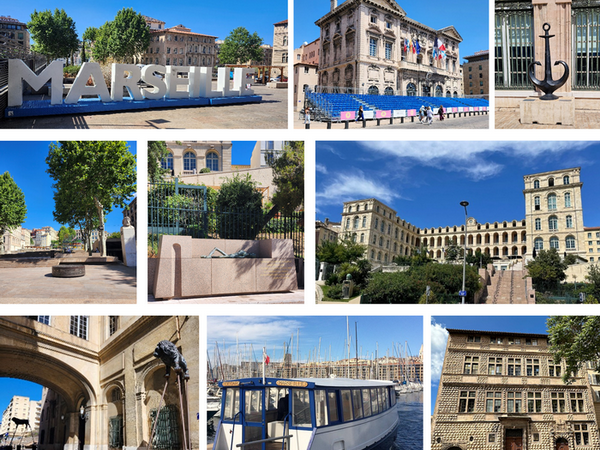
Located at the heart of the Old Port, Marseille’s City Hall is surrounded by historic landmarks, cultural sites, and lively public spaces. From centuries-old architecture to modern squares, small museums, and symbolic monuments, the area offers a fascinating blend of past and present, making it an essential stop for any visitor exploring the city.
Marseille’s City Hall (Hôtel de Ville)
Standing proudly on the Vieux-Port since the 17th century, Marseille’s City Hall is a rare example of Provençal baroque architecture. Commissioned by Louis XIV’s engineers in 1653 and completed in 1673, the building features a richly decorated façade with pilasters, garlands, and the city’s coat of arms. Unlike many French town halls, it has no grand staircase: instead, an ingenious internal bridge connects the ceremonial rooms on the upper floor with the rear building, a design meant to keep the façade intact. Today, the Hôtel de Ville remains the political heart of the city, welcoming official receptions and civic ceremonies.
Anchor-Heart of Odessa
The Anchor-Heart, a monumental sculpture gifted by Odessa in 2017, symbolizes the bond between the two twin cities. Originally placed on the Prado beaches, it was moved in March 2022 to stand before Marseille’s City Hall as a gesture of solidarity with Ukraine. Today, it serves as a powerful symbol of friendship, peace, and resistance.
The Lion and Bull Statues
Next to the Pavillon Bargemon, two imposing statues of a lion and a bull gaze out over the square from tall metal platforms. Originally placed at the entrance of City Hall in the 19th century, they were later moved to their current elevated position. The lion, symbol of strength and vigilance, and the bull, emblem of power and endurance, both come from Marseille’s coat of arms. Perched high above passersby, they embody the city’s resilience and authority while adding a monumental touch to the square.
Pavillon Bargemon
This 18th-century pavilion, built in 1783 for the Marquis de Bargemon, once served as a barracks and later as administrative offices. Today it has been transformed into a modern annex of the City Hall, housing meeting rooms and exhibition spaces. Its classical architecture, with simple lines and elegant proportions, provides a refined contrast to the ornate Hôtel de Ville beside it.
Place Villeneuve-Bargemon
Opened in 2006 as part of the City Hall’s underground expansion, Place Villeneuve-Bargemon is a vast pedestrian esplanade planted with plane trees and olive trees. Beneath the square lies a modern architectural complex designed by Franck Hammoutène, including the municipal council chamber and cultural exhibition halls. Archaeological excavations carried out here revealed traces of ancient Greek baths and early fortifications, linking Marseille’s 26 centuries of history with its contemporary urban design.
Statue of Pythéas and Euthymènes
At the heart of Place Villeneuve-Bargemon stands the striking Janus-like statue of Pythéas and Euthymènes, two explorers born in ancient Massalia. Pythéas ventured north to the edges of Europe, describing tides and the mythical island of Thule, while Euthymènes sailed south to study African coasts and the Senegal River. The back-to-back busts symbolize Marseille’s double identity as a maritime and scientific city, forever turned toward new horizons.
Maison Diamantée
Just a short walk away, the Maison Diamantée (Diamond House) is one of Marseille’s oldest Renaissance mansions. Built in the late 16th century by wealthy merchants of Spanish and Italian origin, its façade is covered in diamond-shaped stone projections, a rare Italianate style in Provence. Inside, a grand Renaissance staircase with sculpted balusters reflects the wealth and prestige of its former owners. Today, the house is reserved for cultural uses, reminding visitors of Marseille’s patrician past and Renaissance prosperity.
Hôtel-Dieu
Overlooking the Old Port, the Hôtel-Dieu was originally a hospital founded in the Middle Ages and rebuilt in the 18th century in majestic classical style. Its monumental façade, long arcades, and symmetrical design embody the grandeur of public architecture under Louis XV. After serving for centuries as the city’s main hospital, it was converted into a luxury hotel in 2013, blending history with modern hospitality while preserving its architectural splendor.
Hôtel Daviel
Located just behind City Hall, the Hôtel Daviel was built in the 18th century in a refined classical style to house Marseille’s courthouse. Its elegant façade, with tall windows and balanced proportions, reflects the dignity of justice during the Enlightenment era. Though no longer used as a tribunal, it remains an important landmark, symbolizing Marseille’s civic and judicial heritage.
Deportation and Resistance Memorial
In front of the Hôtel-Dieu, a discreet stele commemorates the Vieux-Port roundup of January 22–24, 1943. More than 30,000 residents were expelled, 1,500 buildings destroyed, and over 4,000 Jews arrested, many of whom were deported to death camps. Inaugurated in 1983, Louis Amaud’s work invites reflection and remembrance of this tragedy.
Musée des Docks Romains
A few steps from the Hôtel de Ville, this small but fascinating museum is built directly over the remains of ancient Roman warehouses. Discovered during construction in the 20th century, the site preserves huge dolia—giant ceramic jars once used to store oil, wine, and grain. The museum offers a glimpse into Marseille’s role as a bustling trading port 2,000 years ago, highlighting its strategic importance in the Mediterranean.
The Ferry Boat
From the quay right in front of City Hall, visitors can board Marseille’s iconic Ferry Boat, a small shuttle that has crossed the Vieux-Port since 1880. Linking the Hôtel de Ville to the opposite side of the port, this short but historic ride offers one of the most charming perspectives of the harbor. Immortalized by poet Alphonse Daudet and beloved by locals, it remains a symbol of daily life in Marseille.
 Simple Travel and Recreation