
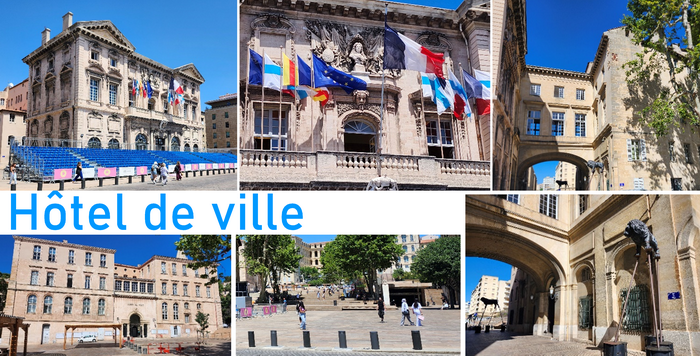
66 Quai du Port
The City Hall of Marseille: a Baroque witness to municipal power
In the heart of the Old Port, in a maritime landscape steeped in history, stands one of the rare buildings that survived the massive destruction carried out by the German occupier in 1943: the City Hall of Marseille. A true jewel of Provençal Baroque architecture, it reflects both the prestige of Marseille as a thriving merchant city in the 17th century and its adaptation to the royal authority imposed by Louis XIV.
Origins and Construction
Since the 13th century, this site had already been dedicated to public affairs: the “Maison de Ville” gathered the city’s consuls and merchants. In 1653, at the proposal of the first consul Gaspard de Villages, the decision was made to build a City Hall worthy of a major Mediterranean metropolis. The project, designed by architect Mathieu Portal in collaboration with Gaspard Puget (brother of the renowned sculptor Pierre Puget), was strongly inspiration by the style of Genoese loggias. Hence, Marseillais nicknamed the building La Loge. Pierre Puget himself only created the coat of arms that once adorned the main entrance (now preserved in the Musée des Beaux-Arts).
The architectural ambition was clear: to create a spectacular façade facing the port, symbolically affirming municipal power opposite the Arsenal des Galères—the military institution representing royal authority on the other bank. Construction, slowed by political unrest and intermittent funding, extended until 1673. The building was later enlarged in the 18th century by acquiring and aligning neighboring houses, which allowed the creation of the rear pavilion.
A Building that Withstood the Test of Time
Miraculously spared during the French Revolution—despite suspicions of having sheltered federalists—the City Hall also survived the wartime destructions of 1943. It was officially listed as a Historic Monument on April 30, 1948. Today, it stands as an exceptional landmark in the urban landscape, both for its turbulent history and its unique architecture.
A Unique Architectural Design
The City Hall consists of two distinct wings: the Pavillon Puget, facing the port, and the Pavillon Bargemon, facing the square. These two sections are connected by a suspended arcade, an architectural bridge above the Rue de la Loge.
The Pavillon Puget, with its refined Baroque façade, displays two symmetrical wings, a vast balcony supported by Corinthian columns, and triangular pediments above the windows. This balcony overlooks the port and houses the mayor’s office, offering a majestic view of Notre-Dame de la Garde. The vaulted ground floor once served to store wheat, complete with an oven and two small shops known as the loges.
A particularly unusual feature is the absence of any staircase connecting the ground floor to the first floor. This layout was intended to distinguish the merchants, who worked on the ground floor, from the municipal aldermen, who sat upstairs. Access to the upper floor was (and still is) via the Pavillon Bargemon through a covered stone bridge, a stereotomic masterpiece built by architect Joseph-Esprit Brun between 1782 and 1786. Within the Pavillon Bargemon, Brun also designed a monumental stone staircase, with an elegant railing, harmonious proportions, and natural overhead light that confer a striking nobility to the space.
Contemporary Functions
Since 2006, part of the City Hall’s administrative and political functions have been relocated to a modern extension beneath Place Villeneuve-Bargemon: the Espace Villeneuve-Bargemon, designed by architect Franck Hammoutène. Awarded the Équerre d’Argent prize, this underground complex houses the municipal council chamber, public reception areas, and a temporary exhibition gallery.
Nearby, the Pavillon Daviel complements the ensemble. Built between 1743 and 1747, it successively housed the courthouse, the Revolutionary Tribunal, and later the medical school. Today, it is attached to City Hall for administrative use. It also witnessed darker episodes during the Revolution, when its balconies were used to announce death sentences. It has been listed as a historic monument since 1945.
An Unmissable Stop
Although modest in height, the Hôtel de Ville impresses with its Baroque elegance and historical weight. As the political and symbolic heart of the city for centuries, it remains both a seat of power and a witness to the urban history of Marseille. Its architectural richness, monumental staircase hidden from outside view, and central location on the Old Port make it an essential stop for any visitor eager to discover the soul of the Phocaean city.
Special note: the ferry boat is nearby and connects to the opposite side of the harbor at Place aux Huiles.
Statue of the Bull and the Lion
The Lion and the Bull: Guardians of Marseille’s City Hall
Positioned beside the Pavillon Bargemon entrance, the lion and bull statues—symbols taken from Marseille’s coat of arms—stand on raised platforms. Perched atop metal pillars, they command attention, as if silently watching over the city. More than decorative features, these figures represent enduring symbols of Marseille.
19th-Century Sculptures and Municipal History Dating from the mid-to-late 19th century, likely between 1860 and 1870, the statues were created during a period of major urban transformation in Marseille. Across Europe, cities were adorning public squares with monumental sculptures to express civic pride and identity. The lion, symbolizing strength and vigilance, and the bull, representing power and endurance, are closely tied to Marseille’s character. In front of City Hall, they convey the city’s authority and vitality through a distinctly classical style.

Anchor-Heart of Odessa
A symbol of friendship and resistance in the heart of Marseille
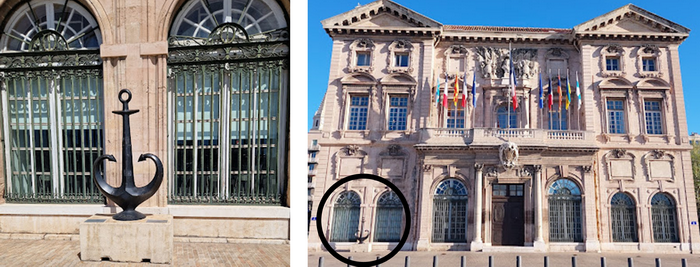
In 2017, the mayor of Odessa in Ukraine presented Marseille with a monumental sculpture called the Anchor-Heart, as a tribute to the deep bond between the two twin cities. Created in copper alloy by Ukrainian artist O.M. Shevchenko, the work symbolizes the sea, human connection, and solidarity between peoples. It was officially inaugurated on November 27, 2019, on the Prado beaches.
Shortly after Russia’s invasion of Ukraine in February 2022, the sculpture was relocated to stand in front of Marseille’s City Hall, on March 2, as a powerful act of support for the Ukrainian people. This symbolic gesture, initiated by Mayor Benoît Payan, carries a message of friendship, peace, and resistance. “It was by the sea, and I wanted to bring it closer to the heart of the city. It will remain here as a symbol of our unwavering support for Ukraine and Odessa until a definitive ceasefire,” he declared.
What to See Around Marseille’s City Hall
- Maison Diamantée – A Renaissance gem with its distinctive diamond-point façade, one of the oldest surviving buildings in the city.
- Hôtel-Dieu – Once Marseille’s main hospital, rebuilt in the 18th century and now transformed into a luxury hotel while preserving its grand classical architecture.
- Hôtel Daviel: built in the 18th century in refined classical style, once served as Marseille’s courthouse and today stands as a graceful reminder of the city’s judicial and civic history.
- Place Villeneuve-Bargemon – A modern square adjacent to City Hall, home to the Pavillon Bargemon, exhibitions, and city archives.
- Musée des Docks Romains – A small but fascinating museum built on the ruins of Roman warehouses, showcasing Marseille’s ancient trading past. (2025- currently closed)
- Place de Lenche – A lively square with cafés, historically the site of the Roman forum, offering a fine view of the Old Port.
- Church of Les Accoules – Recognizable by its bell tower, a reminder of Marseille’s medieval religious heritage.
- The Ferry Boat – A short, iconic crossing of the Old Port, connecting City Hall to the Place aux Huiles, celebrated in Marcel Pagnol’s writings.
- The Old Port (Vieux-Port) – The beating heart of Marseille since antiquity, perfect for a stroll along the quays.
- La Vieille Charité – A 17th-century architectural masterpiece in the Panier, now a cultural hub housing museums and exhibitions.
 Simple Travel and Recreation