
Quai des Belges
A church in the heart of the Old Port
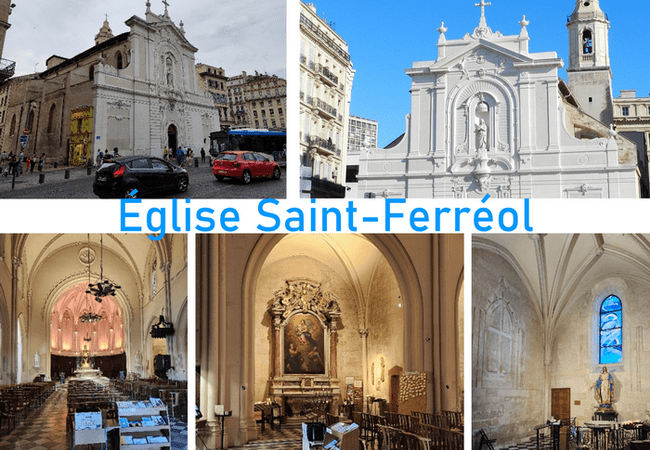
Strolling along Marseille’s Old Port, it is impossible to miss Saint-Ferréol-les-Augustins Church. Its white façade clearly stands out from the neighboring buildings at the corner of Rue de la République, Quai du Port, and Quai des Belges. This discreet yet historic place of prayer has been part of Marseille’s landscape for centuries.
From the Templars to the Augustinians
Originally, the land belonged to the Templars in the 13th century. After the dissolution of their order, the site passed to the Hospitallers of Saint John, who eventually sold it in 1367 to the Augustinian monks. From then on, the true history of the church began.
Construction started in 1447 with modest resources — including wood salvaged from a galley. The church was consecrated in 1542, though the vaults were not completed until 1588.
A place of memory… and history
A major historical event took place here on October 28, 1533, when Pope Clement VII came to Marseille to officiate the marriage of his niece, Catherine de’ Medici, to the future King Henry II of France. The ceremony was held in this very church, still under construction at the time.
Over the centuries, Saint-Ferréol also became home to many trade guilds. As early as 1390, the dockworkers had their own altar here, followed by the bakers, blacksmiths, saddlers, carpenters, and more. Each guild had its patron saint and its own celebrations.
Revolution, reconstruction, and a new beginning
During the French Revolution, like many other religious buildings, the church faced the threat of destruction. It was saved at the last moment by being converted into a warehouse. In 1803, it was renamed Saint-Ferréol, in memory of another Marseille church that had been destroyed at the time.
The current façade dates from 1874–1875, rebuilt after part of the church was demolished to make way for Rue de la République. The bell tower was heightened in a neoclassical style and remains a visible landmark on the port.
An interior rich in art and spirituality
Inside, visitors will discover a beautiful polychrome marble altar designed by Dominique Fossaty, crowned by an elegant ciborium. Several side chapels contain works of art and historic tombs, such as those of the Mazenod family (1564) and the Montolieu family (1695).
Remarkable works on display include three paintings by Michel Serre, the great 17th-century painter of Marseille. More recent statues can also be admired: Saint Joan of Arc (1930) by Louis Botinelly, Saint Augustine (1950) by Raymond Servian, and Saint Thérèse of the Child Jesus (1940) by Élie-Jean Vézien.
Organ enthusiasts will appreciate the neo-Gothic instrument built in 1844 by Augustin Zieger.
A living, open church
Since 2017, the church has been entrusted to the Jesuits. While it no longer has the status of a parish church, it remains a vibrant and welcoming place. People can come here to pray, to speak with a priest, or simply to enjoy a moment of calm in the heart of the city.
The Jesuits have developed a mission of hospitality and listening, in the spirit of Saint Ignatius of Loyola, centered on values such as justice, ecology, reconciliation, and social engagement. It is an open church, turned toward the world, where everyone can find a moment of peace.
For an overview of Marseille click here.
For all my posts on Marseille click here.
 Simple Travel and Recreation