
17 Cr Belsunce
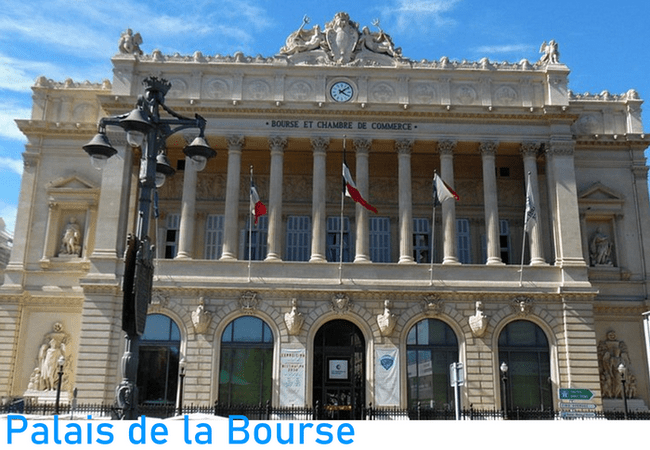
In the very heart of Marseille, at the foot of La Canebière, stands one of the city’s most iconic landmarks: the Palais de la Bourse. Overlooking the square that bears its name, this majestic building embodies the economic prestige of the Phocaean city in the 19th century.
The idea of building a new seat for the Marseille Chamber of Commerce—the oldest in France, founded in 1599—emerged as early as 1834. The previous space had become too small, and a structure worthy of the Mediterranean port’s ambitions was required. The choice of site—at the entrance of the bustling Canebière—and the scale of the project reflected Marseille’s determination to assert itself as a major commercial power.
Construction, entrusted to architect Pascal Coste, began in 1852 after the expropriation of 65 buildings. Twenty years were needed to complete this Second Empire masterpiece, inaugurated with great pomp by Napoleon III and Empress Eugénie in September 1860. With its dimensions (47 meters long, 68 deep, and 30 high), the building even surpassed the Paris Bourse de Commerce, further confirming Marseille’s stature.
The façade is a true architectural manifesto. Monumental and perfectly symmetrical, its central projection is adorned with five doors topped by ten Corinthian columns, each 12 meters high. Above them, medallions display the names of eight great explorers—Columbus, Magellan, Cook, Tasman, La Pérouse, Vespucci, da Gama, and d’Urville. At the center sits the clock, crafted by the renowned horologist Henry Lepaute, while allegorical sculptures personify the Mediterranean and the Ocean.
Two statues by Auguste Ottin depict the ancient navigators Pytheas and Euthymenes, symbolic founders of Marseille’s maritime influence. Around them, allegories of Commerce and Navigation, sculpted by Eugène Guillaume, highlight the city’s economic foundations.
The interior is equally impressive, though not freely accessible without prior reservation. Daily visits are not available, but access to the Grand Hall may be granted upon request and availability. For a more complete experience—exploring the interiors, architecture, and history—the European Heritage Days in September remain the best opportunity to fully discover the site.
During World War II, the Palais suffered damage, and in August 1944 a fire destroyed part of the archives as well as the clock’s mechanism, which was restored in 1946.
Today, it continues to serve as the active headquarters of the Marseille-Provence Chamber of Commerce and Industry (CCI), carrying on its mission within this exceptional heritage setting. At nightfall, the building’s illumination highlights its majestic silhouette, a lasting symbol of Marseille’s economic legacy.
For an overview of Marseille click here
For all my posts on Marseille click here
 Simple Travel and Recreation