
2 Rue de la Charité
A Stop at the Vieille Charité, Between Pink Stone and Living Memory
A Marseille landmark like no other
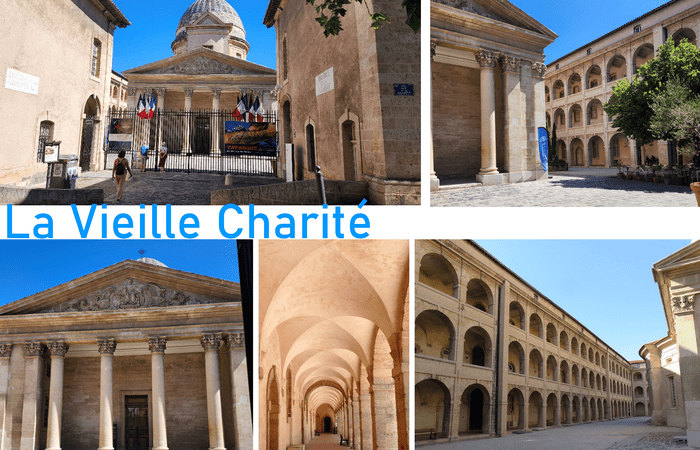
Behind a discreet, almost austere façade, the Vieille Charité reveals a peaceful courtyard, enclosed by three levels of arcaded galleries, dominated at its center by a baroque chapel topped with an ovoid dome—both surprising and elegant. It is not merely a beautiful building: it is a place that vibrates, that resonates with the passing of time, the wear of centuries, the crossing of lives, and the southern light.
Originally, a project of social control
The Vieille Charité was conceived in the 17th century in a very different context. In 1640, the City Council of Marseille, following King Louis XIV’s directives, decided to create a hospice for “the confinement of the poor and beggars.” According to the policies of the time, indigents had to be isolated in enclosed institutions. The project only took real shape in 1670, when a child of the neighborhood, Pierre Puget, was entrusted with designing a vast General Hospital.
Pierre Puget, the multi-talented architect
Sculptor, painter, draftsman, and architect, Pierre Puget (1620–1694) is a major figure of Provençal baroque. Little known outside Marseille, he is a local legend here. And for good reason: the Vieille Charité is one of his masterpieces.
The first stone was laid in 1671. Puget envisioned a light-stone building structured around an interior courtyard, with four wings closed to the outside but open to the light within—a kind of architectural hospitality. He designed a central chapel with lines inspired by Italian baroque, crowned with an ovoid dome made of stone from La Couronne. It was a technical feat for its time. After Puget’s death, his son François continued the work, which was completed in 1749.
A building with a thousand lives
The history of the Vieille Charité hardly ends there. After housing beggars, the elderly, and abandoned children, the hospice became, in turn, a military barracks, an anchovy cannery, a banana-ripening warehouse, and even a shelter for disaster victims after World War II. In the 1940s and 1950s, over 150 families were still living there in precarious conditions.
Facing the building’s severe deterioration, it was Le Corbusier who, in 1951, alerted the authorities. Thanks to him, the Vieille Charité was listed as a Historic Monument and then restored over the course of twenty-five years—a rebirth for a place once thought lost.
A missed visit, with a slight pang of regret
Like many travelers who don’t plan with military precision, we showed up at the Vieille Charité… on a Monday morning. And like all of Marseille’s municipal museums, it was closed. The locked gate, the silent arcades, the inaccessible courtyard—everything was there, just behind, but out of reach. A small pang of regret settled in, that feeling of missing out on a place we had looked forward to.
I would have loved to explore the Museum of Mediterranean Archaeology.
So we will have to come back. .
The Vieille Charité today: a living soul
Today, the Vieille Charité is far more than a restored former hospice. It has become a vibrant cultural center, housing:
- The Museum of Mediterranean Archaeology
- The Museum of African, Oceanian, and Amerindian Arts
- An international poetry center, a bookstore, a cinema, conferences, and temporary exhibitions
- Even research institutions such as the CNRS and the EHESS
But beyond these institutions, it is the link between past and present that makes the place so unique. You can feel the memory of the site, but also the fierce will not to freeze history—to keep transmitting, creating, and renewing.
On leaving…
If you pass through Marseille, do not miss this unique site. It tells you much about the city: proud, popular, unruly, yet always animated by a living memory.
For an overview on Marseille click here.
For all posts on Marseille click here.
 Simple Travel and Recreation