
Discovering Marseille: Between Heritage, Sea, and Culture
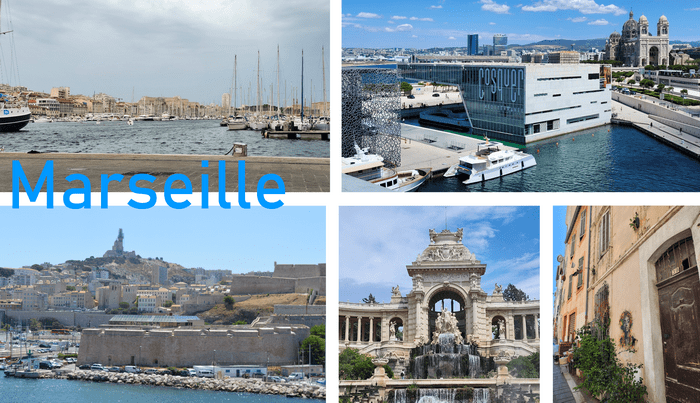
France’s second-largest city and its oldest settlement, Marseille offers a unique blend of history, Mediterranean landscapes, and cultural diversity. Founded more than 2,600 years ago by Greek sailors from Phocaea, the city grew around its emblematic Old Port, still the beating heart of Marseille today. Nestled between spectacular calanques, authentic neighborhoods, and cultural landmarks, Marseille attracts millions of visitors each year eager to discover its many facets.
But be warned: one or two days are not enough to grasp the soul of this city of a thousand contrasts. Behind its sunlit façades, Marseille hides an incredible wealth of cultural and natural treasures that require time to be appreciated. From strolling through the narrow streets of Le Panier, hiking in the Calanques, visiting museums such as the MuCEM or the Musée Cantini, to enjoying a local meal in a small restaurant, every moment reveals a different side of the city. To truly appreciate Marseille, you need to take your time: wander, step off the beaten path, and let the city slowly unveil itself.
This is the historic and symbolic heart of Marseille. Always lively, it brings together restaurants, terraces, and the traditional fish market. It is also the departure point for boats to Château d’If, the Frioul Islands, and the Calanques. With its renovated quays, its wide esplanade, and the striking Ombrière — a modern mirrored canopy reflecting the life of the port — the Old Port is an unmissable place to stroll, day or night.
Here you will also find the City Hall, an elegant 17th-century Provençal Baroque building on the Quai du Port. This historic monument, still home to the central town hall, stands between the Old Port and the Panier district, serving as one of the city’s architectural and civic landmarks.
The Old Port also features emblematic touches of tradition and modernity, such as the Ferry Boat, and it is here that the Petit Train of Marseille begins its route, offering a picturesque way to explore the city and its monuments.
- Le Panier
Historic heart of Marseille, Le Panier is today also a district of art and creativity. Its narrow, colorful streets, such as Rue du Panier, have become a canvas for street art, where murals and graffiti mingle with artists’ studios, shops, and cafés. Highlights include La Vieille Charité, a remarkable 17th-century building now housing museums and cultural spaces. At the edge of the Old Port, the former Hôtel-Dieu, transformed into a prestigious hotel, marks the entrance to the district. The Maison Diamantée, the Hôtel de Cabre, and the Montée des Accoules with its church recall Marseille’s ancient history, while the quirky Maison de la Boule pays homage to pétanque, the quintessential Provençal sport.
At the gateway to the Panier, Place Sadi-Carnot opens onto the elegant Church of Saint-Cannat, built in the 17th century for the Dominican friars. Its Baroque façade and richly decorated interior make it one of the district’s major religious landmarks, linking the Old Port with the Panier’s historic streets.
- Facing the Sea – North Side
On the northern shore of the Old Port entrance stands Fort Saint-Jean, built in the 17th century, still proudly guarding the city. Linked by a footbridge to the MuCEM, the national museum dedicated to Mediterranean civilizations, it forms a cultural and architectural landmark not to be missed. Both sites also offer stunning views over the sea and the harbor.
Nearby, the Musée Regards de Provence, housed in the former maritime health station, adds to this cultural hub with its exhibitions of modern and contemporary art. Its terrace also provides a fine view of the bay.
Overlooking the harbor from the Saint-Laurent hill, the Church of Saint-Laurent is a simple Romanesque building from the 12th century, once frequented by fishermen. Built in pink limestone from the coastal quarries of La Couronne, west of Marseille, it is now an emblematic site offering one of the best viewpoints over the Old Port and the Mediterranean. Not far away lies the Police Headquarters, known as l’Évêché, housed in the former episcopal palace. This imposing building, located between the Old Port and the Panier district, now serves as the seat of Marseille’s judicial police.
- Facing the Sea – South side
On the southern shore of the Old Port, Fort Saint-Nicolas recalls the city’s military past. Higher up, the Palais du Pharo, built by Napoleon III, offers from its gardens one of the most beautiful panoramas of Marseille. Nearby, the Abbey of Saint-Victor, founded in the 5th century, bears witness to the ancient roots of Christianity in Marseille and remains an important spiritual landmark.
Towering above it all, the Basilica of Notre-Dame de la Garde, affectionately called la Bonne Mère (“the Good Mother”), is the city’s most iconic symbol. From its hilltop, it watches over both the city and the sea, with its esplanade providing an exceptional 360° view.
- The South of the Port
Walking along the Corniche Kennedy offers a panoramic promenade above the sea. Further south, the Prado beaches and Borély Park are popular spots for families and sports enthusiasts. Beyond them, Pointe Rouge and the village of Les Goudes mark the gateway to the Calanques National Park, a true natural jewel of Marseille.
- The North of the Port
This area is home to some of Marseille’s most iconic landmarks. The Cathedrale de la Major, with its striking neo-Byzantine style, dominates the waterfront. Nearby, the modern Euroméditerranée district and the Docks illustrate the city’s ongoing transformation. The Joliette Port remains a vital hub for trade and ferry connections, linking Marseille to Corsica and North Africa. At the same time, cultural venues such as the Docks du Sud bring a vibrant, festive energy to the neighborhood.
- La Canebière
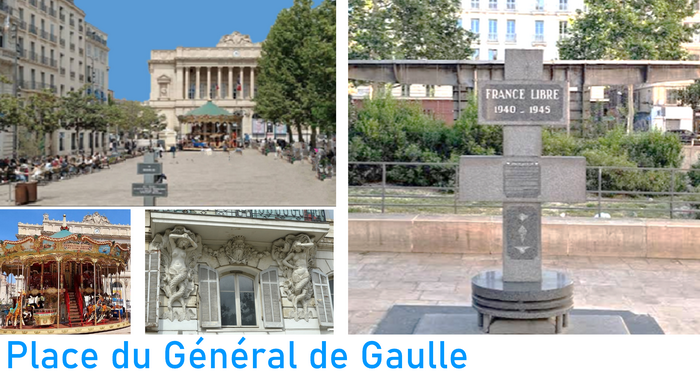
Marseille’s emblematic avenue, La Canebière, stretches from the Old Port up to the Église des Réformés at its far end. At its beginning, it is flanked by the Palais de la Bourse, the World Trade Center, and the grand Colbert post office, reflecting its historic economic role. Further along stands the Marseille Opera House, while Place du Général-de-Gaulle, with its fountains, forms a lively central crossroads. Once the city’s commercial and social heart, La Canebière remains a symbolic artery where cafés, shops, and historic buildings embody Marseille’s urban life.
Around the Bourse and Toward the Porte d’Aix
Close by, the Marseille History Museum, located next to the Centre Bourse, traces the city’s evolution since its Greek foundation. Its Jardin des Vestiges preserves the archaeological remains of the ancient harbor. Further north, the Porte d’Aix and its 19th-century triumphal arch mark the entrance to the city and open toward the modern districts.
Around the Opera and the Shopping Streets
Near the Opera House, lively streets such as Rue Saint-Ferréol and Rue Paradis are among Marseille’s main shopping areas. Just a short walk away, the Musée Cantini, housed in a 17th-century mansion, is dedicated to modern and contemporary art, with a rich collection of 20th-century paintings.
- Further from the Center
Palais Longchamp
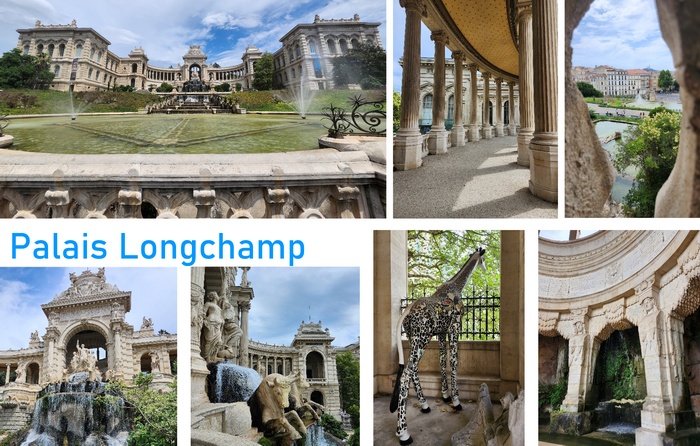
Located in the Cinq-Avenues district, the Palais Longchamp is one of Marseille’s most iconic monuments. Built in the 19th century to celebrate the arrival of water from the Durance River, it is renowned for its monumental architecture and spectacular central fountain. The site houses two major cultural institutions: the Museum of Fine Arts and the Natural History Museum. Surrounding the palace, Longchamp Park offers wide pathways and green spaces ideal for strolling, popular with both families and visitors.
The Fountains of Marseille
Symbols of Water, Art, and Memory
In Marseille, water has always been central — first as a vital resource, then as artistic inspiration. Since the 18th century, fountains have dotted the city, celebrating its connection to the sea, the Durance River, and daily life. Whether grand or modest, they form a poetic and historical journey through the Phocean city.
Wallace Fountains
The Wallace fountains are cast-iron public drinking fountains created in the late 19th century thanks to the generosity of British philanthropist Sir Richard Wallace. Designed by sculptor Charles-Auguste Lebourg, they are easily recognized by their dark green color and elegant architecture featuring four female figures supporting a domed canopy.
In Marseille, eight Wallace fountains remain scattered across various districts, serving as symbols of heritage and public access to water that spread throughout France from their origins in Paris. Originally designed to provide free drinking water after the hardships of the 1870 war, these fountains combine functionality and artistry, blending public service with urban beauty.
8 Wallace Fountains in Marseille
- Near palais Longchamp : golden color
- Rue des Trois-Rois : brown
- Allées Gambetta
- Place du Terrail
- Place Jean-Jaurès
- Place Bernard Cadenat
- Place Louis Goudard
- Place Edmond Rostand (2014)
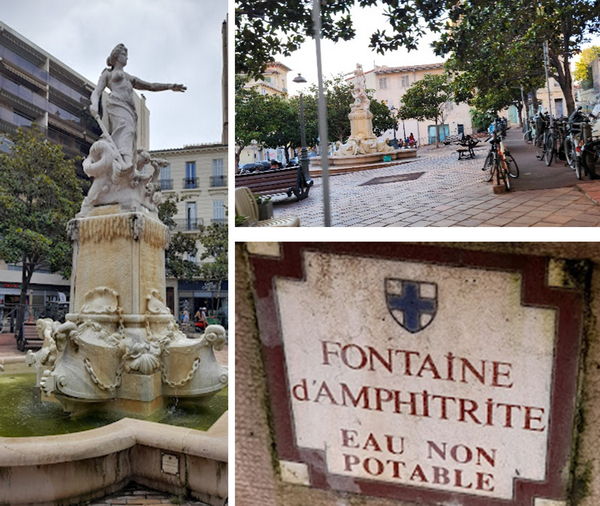
Fontaine d’Amphitrite (place Joseph Étienne)
Sculpted in 1908 by Auguste Carli, it depicts Amphitrite, wife of Poseidon, rising gracefully from the waves.
Fontaine Le Bateau (Place du Général-de-Gaulle)
Le Bateau—a monumental fountain with a boat-shaped structure, designed by architect Stéphane Hanrot and installed in 1995 during the redevelopment of the square.
Fontaine Cantini (Place Castellane)
Created in 1913 by André-Joseph Allar, it depicts Marseille surrounded by allegories of the Rhône, the sea, and the mountain streams.
Fontaine Coste (Place de la Joliette)
The Coste Fountain is an iconic neo-classical fountain built in 1846 by architect Pascal-Xavier Coste, featuring elegant sculptures and representing the city’s industrial heritage.
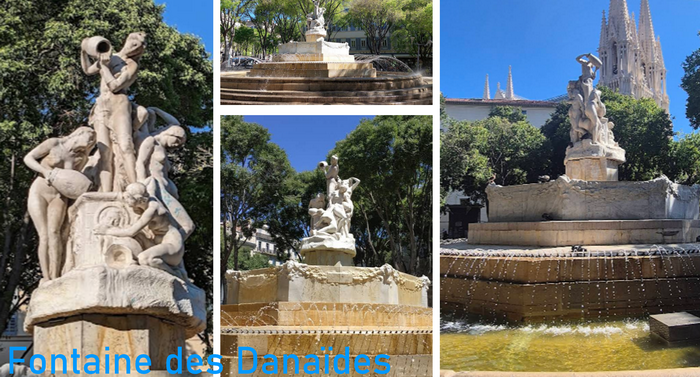
Fontaine des Danaïdes (Square Stalingrad)
Created in 1893, it portrays the daughters of Danaus endlessly pouring water — a metaphor for Marseille’s tireless energy.
Fontaine Estrangin (Place Estrangin)
This monumental fountain was donated to the city by the Estrangin family in 1890 and created by architect Joseph Letz together with sculptors André-Joseph and Gaudensi Allar. It features allegorical figures representing the four continents and celebrates Marseille’s maritime and commercial power.
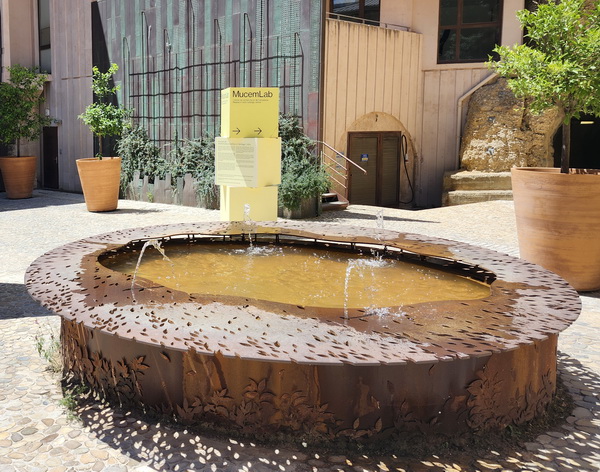
Fontaine du Fort Saint-Jean
The fountain features a circular metal basin with perforated floral patterns, and it’s part of the artistic and landscaping redesign integrated into the museum’s outdoor spaces.
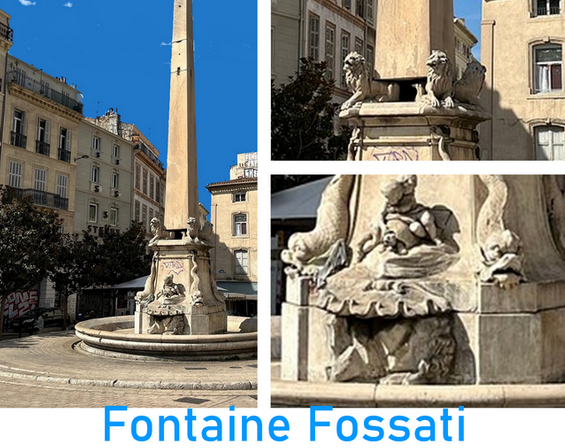
Fontaine Fossati (Place des Capucines)
Built in 1778, it is Marseille’s oldest fountain, adorned with lions, turtles, and dolphins sculpted in elegant 18th-century style.
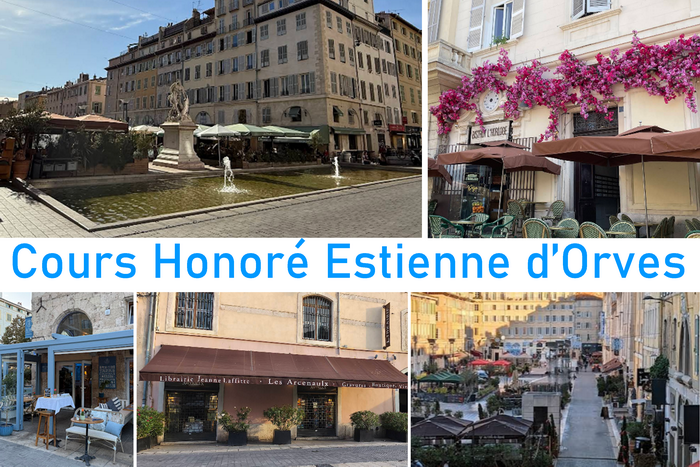
Fontaine d’Honoré-d’Estienne-d’Orves
Simple and modern, this fountain pays tribute to Admiral Honoré d’Estienne d’Orves, hero of the French Resistance.
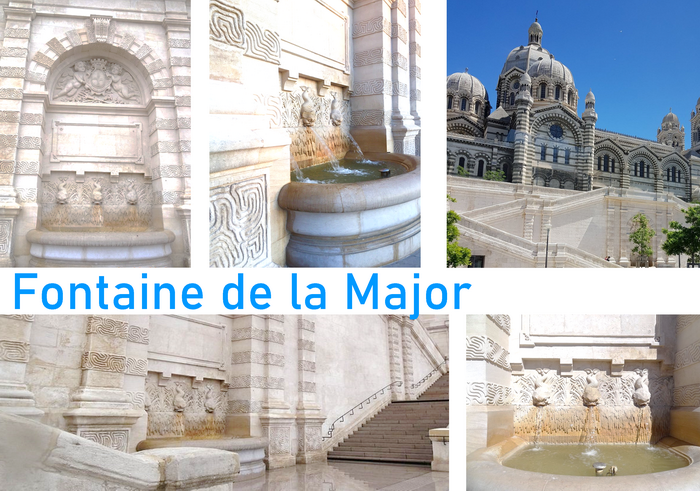
In 2015, restoration work on the Marchetti Street staircase and the central stairway of the Voûtes de la Major led to a surprising discovery — a beautiful fountain dating from 1852. Adorned with three fish at its base and two cherubs holding the coats of arms of Marseille at the top, this long-forgotten fountain had been buried under layers of reinforced concrete poured around 1950.
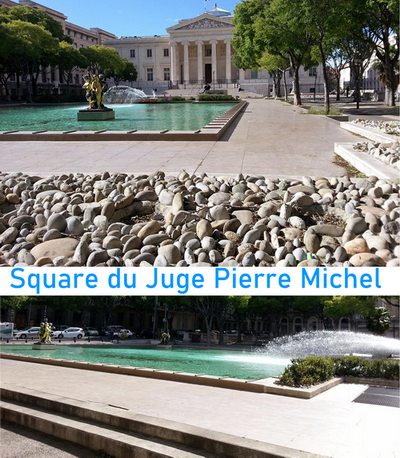
Fontaine du Palais de Justice (Square du juge Pierre Michel)
The fountain in Square du juge Pierre Michel (now Place Monthyon), near the Palais de Justice in Marseille, is a large decorative basin created in 1976, featuring golden cherubs
The central fountain at Palais Longchamp in Marseille is a magnificent monument celebrating the arrival of water from the Durance River; it features a grand waterfall and sculptures depicting the Durance as a young woman standing on a chariot pulled by four bulls, accompanied by Ceres and Pomona, symbolizing abundance and fertility brought by the canal. Water cascades from the fountain into a large basin, creating a spectacular centerpiece that highlights the vital role of water in Marseille’s history and prosperity.
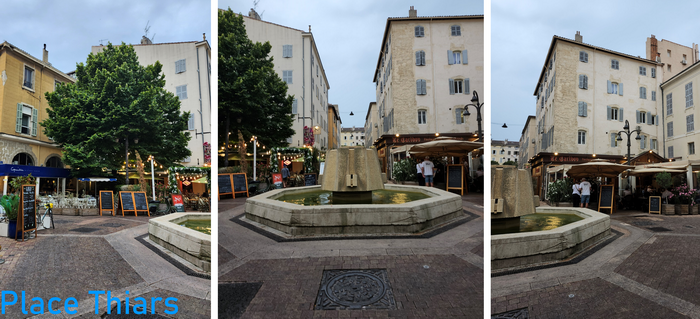
Fontaine Thiars (Place Thiars)
A modern fountain built in 1978 by Yvan-Pierre Gouirand, marking the centre of Place Thiars.
The Churches of Marseille – Witnesses of History and Faith
Marseille, a city shaped by centuries of faith and exchange, holds a collection of churches that mirror its long and diverse history. From Romanesque simplicity to Baroque and Byzantine grandeur, each church reveals a different chapter of the city’s spiritual and cultural evolution.
Highlights include:
- Notre-Dame de la Garde Basilica, overlooking the city as its symbolic guardian.
- La Major Cathedral, a magnificent Romano-Byzantine monument by the sea.
- Saint-Victor Abbey, one of France’s oldest Christian sanctuaries, founded in the 5th century.
- Saint-Ferréol Church, blending Gothic and Baroque on the Old Port.
- The Church of the Réformés, with its impressive neo-Gothic towers marking the top of La Canebière.
- Saint-Laurent Church, a Romanesque church dedicated to fishermen, facing the harbor.
- Saint-Cannat Church, built in the 17th century, known for its Baroque façade, frescoes, and ornate altarpieces — a gem of Marseille’s historic center.
Together, these monuments form a living mosaic of art, faith, and heritage, offering a journey through fifteen centuries of devotion at the heart of Marseille.
 Simple Travel and Recreation