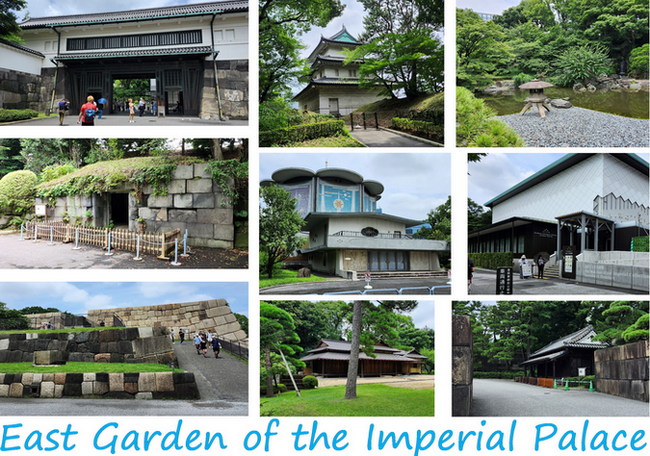

The site of the Tokyo Imperial Palace was once that of Edo Castle. Originally occupied by Ota Dokan in 1457, it was when the place became the official residence of the Tokugawa shoguns in 1590 that it was turned into a fortress.
Between 1593 and 1636, a massive defense work was undertaken by digging moats, erecting walls and limiting access by adding imposing gates with strategic watchpoints to discourage and repel the enemy.
The angled walls with perfectly cut stones came from several regions of Japan. You can see for yourself on the site that the lines are straight and perfect. The walls are impressive and demonstrate remarkable robustness after so many years. The geometry of the moat is not peripheral and allows it to better trap a potential adversary.
The water flow engineering was reflected since the creation of the moat. The water is fed from the Sumida River.
To access the protected site, bridges and massive gates were installed. Today, there are still a few left. Some have disappeared over time either by a natural disaster, by choice, or following the bombings of 1945. One thing is certain, the site of the emperor’s residence must remain a safe place.
In the following text notice that the terms ending with “bashi” mean bridge and those with “mon” mean gate.
Here are 12 sites related to the accesses of Edo Castle:
- Ōte-mon (大手門)
- Kikyō-mon (桔梗門)
- Sakashita-mon (坂下門)
- Nishinomaru-mon(西の丸門)
- Sakurada-mon (桜田門)
- Hanzō-mon(半蔵門)
- Inui-mon (乾門)
- Tayasu-mon (田安門)
- Shimizu-mon (清水門)
- Kita-hanebashi-mon (北桔橋門)
- Hirakawa-mon (平川門)
- Wadakura-mon (和田倉門)
- Tsubonemon and other gates
It is difficult to confirm but at the time of Edo Castle, there were about 36 major gates with a total of 92 if you consider restricted accesses inside the walls. Only a few still exist.
There are only two original gates from the Edo Castle period:
- Tayasu-mon (田安門)
- Shimizu-mon (清水門)
- Ōte-mon (大手門)
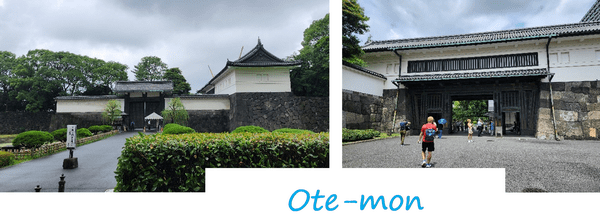
Ote-mon seems to have always been an important entry point to the site. While it was the main gate of the castle to welcome the regional lords (daimyos), it is today the main gate for access to the East Garden of the Imperial Palace and the ruins of Edo Castle.
The entrance via Ote-mon shows interesting architectural features. It was for a time one of the few to have a drawbridge, just like the Kitahanebashi-mon gate. Although there is now an approach path, the anchors are still visible. To enter, one must pass through a “double entrance”. Just like the Hirakawa-mon, Kikyo-mon, Hanzo-mon and Tayasu-mon gates, once the first gate is passed, another passage must be crossed at 90 degrees (Masugata style) to arrive at the site, which once again is walled and thus limits the general view of the site. A defensive strategy.
History states that this gate was destroyed by fire in 1657, but replaced the following year. Earthquakes in 1703 and 1855 also caused significant damage, and the gate was repaired again.
A major event occurred in 1868, when the Tokugawa Shogunate handed over the site to the imperial forces through this gate, marking the end of the Edo period and the beginning of the Meiji period.
Another terrible earthquake occurred in September 1923 (Kanto) and was again disastrous and led to the reconstruction of the stone walls on both sides of the gate. Even the Watari-yagura had to undergo major metamorphoses and about twenty years later, it completely burned down on April 30, 1945, during World War II. Given the severity of the damage throughout the city, restoration activities did not resume until 1965.
Despite its scars and some revamping, this access maintains a historical importance.
2. Kikyō-mon (桔梗門) / Inner Sakurada-mon Gate
This fortified entrance, built in 1614, is massive and surrounded by thick stone walls, built in 1620. To monitor the site, a guard tower was built to protect Edo Castle. Since the gate provides access to the Imperial Palace complex, entrances like these are controlled and only visitors registered for a guided tour are allowed in unless they are a special guest, such as a dignitary. To access the public garden, go through the nearby Ote-mon Gate.
Kikyo-mon Gate (sometimes called Kiyomon) is the one you will use if you are planning a guided tour of the palace grounds. There are only two tours per day and the meeting point is at Kikyo-mon Gate.
If you are looking to know a little more about the history of Kikyo-mon, it can get confusing because during the Edo period (1603-1868) the gate was called Inner Sakurada-mon (Uchi-Sakurada-mon), but another entrance already bears the name Sakurada-mon, except that the other one was the Outer Sakurada-mon (Soto-Sakurada-mon). We will come back to this later.
This Masugata-style gate consists of two entrances placed at right angles and a rectangular central part ready to create an ambush to stop the enemy. If you are lucky enough to go through the first gate, notice the architectural detail. The Koraimon style (Korean gate) of the first and the Watariyagura style of the second gate which is more imposing, because it has a second floor that serves as a watchtower with narrow gaps allowing a weapon to be placed there.
Despite their heavy appearance, there is a softness in the detail of the decorative motifs found on the roofs, proof that aesthetics and strength can be combined.
The gate has changed its name to Kikyo-mon, the reason for which is not verifiable. One possibility is that the name comes from the coat of arms of the Ōta Dōkan family, the first occupants of the site, that had the Chinese bellflower flower (kikyo) in it and that can be found in the detail of the site.
The guards control access before the bridge because cars can enter the enclosure via this entrance.

3. Sakashita-mon (坂下門)
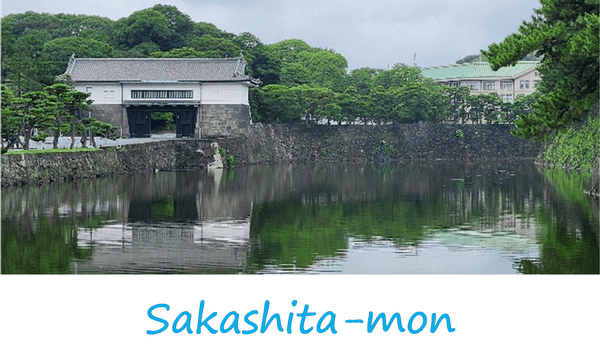
Sakashita-mon is one of the fortified entrances of the Edo Castle period that is now part of the Imperial Palace complex.
The entrance no longer has the same defensive role as it did in the time of Tokugawa Ieyasu, but access remains controlled and limited. The difference from the original version is that the orientation of the gate was changed to face east, after the appointment of Emperor Meiji, instead of north.
Like Sakuradamon Gate, this entrance was the scene of an assassination attempt. In 1862, a member of the former shogunate, Ando Nabumasa, survived from a group of samurai rebels opposing political change.
During special annual events when access to the imperial palace complex is open to the public, visitors pass through the Sakashita-mon entrance and the route can lead to the Inui-mon Gate.
4. Nishinomaru-mon Gate (西の丸門) (Main Gate) / Nishinomaru Otemon Gate
This controlled access to the Imperial Palace site, near the Kokyo Garden Plaza, appears in several iconic images of the city without however being the center of attention.
Indeed, one mainly marvels at the two historic bridges and the Fushimi-yagura in the distance without really noticing the access gate to the imperial site just to the left which is used mainly by the emperor himself and sometimes by special ambassadors or authorized state guests.
The two bridges that are so popular are the stone bridge Meganebashi (Seimon Ishibashi) and the one iron bridge, Nijubashi (Seimon-tetsubashi) in the background, a little hidden, because it is parallel to Meganebashi.
The palace buildings are hidden by the trees to the right of the Nijubashi bridge (iron bridge) in the background, to access the imperial palace, all visitors must cross both bridges.
The main gate is accessed via Meganebashi Bridge, the stone bridge with decorative lights that is also nicknamed “glasses bridge” because the reflection of the double arches on the water forms a spectacle frame. The public can only cross Meganebashi Bridge and the gate twice a year, on January 2 and the Emperor’s birthday. Surprisingly, on January 2, 1954, during a public opening day, a stampede broke out on the bridge, resulting in 16 deaths.
The main gate was originally named Nishinomaru when the bridge was made of a wooden frame (1614). It was in 1888 that the construction of the bridge was replaced by a stone structure. That was after the rise to power of Emperor Meiji and his European influence.
The gate of the Meganebashi Bridge is close enough to admire the style. The gate seems to be the same height as the side stone walls. At the level of the roof an additional floor serves as a watchtower (yagura) which exceeds the height of the walls.
Before being an iron structure (1888), the Nijubashi Bridge was also made of wood and had a structural reinforcement suggesting a two-level bridge hence the name Nijubashi which means double bridge.
A beautiful bronze balustrade with floral inserts and caps nicely frames the access to Meganebashi Bridge and prevents people from walking beyond the pedestrian areas. As you get closer to the stone bridge, you will have a better view of the iron bridge.
This gate was built in 1620 during the Edo period when the Edo Castle grounds were being fortified. Because there were several enclosures, each of them had levels of control. There was the Uchi-Sakurada-mon (inner Sakurada-mon) entrance which is now called Kikyo-mon and there was the Soto-Sakurada-mon (outer Sakurada-mon) entrance which is now called Sakurada-mon.

5. Sakuradamon Gate (桜田門)/ Soto-Sakurada-mon
The gate is sadly associated with a crime scene. The assassination of Ii Naosuke, a minister of the Tokugawa shogunate, occurred on March 24, 1860, by opponents of Japan’s opening border policies. In addition, in 1932, an assassination attempt on Emperor Hirohito by a Korean activist also created moments of torment.
6. Hanzo-mon Gate (半蔵門)
Hanzo Gate has retained its original name, but it no longer has the same structure or style after being heavily damaged during World War II.
Defensively, this access had several strategic advantages. The original gate (1620) was of the Masugata style whose entrance angle to the site could trap an opponent between its walls. The gate was guarded by an elite team of samurai and the location of the gate made it possible to escape an attack via a secondary road controlled by the shogunate.
Today, these elements are no longer applicable, but the facts remain for its highly defensive character. The gate was named in honor of Mr. Hattori Hanzo (1542–1597) who was the leader of the Ninja clan until his death. Hanzo served in defense for 40 years and was nicknamed the demon for his intimidating tactical approach. This ability to fight is said to have saved the life of Tokugawa Leyasu and to have supported him until his ascension to leader.
The redevelopment of the Imperial Palace grounds after World War II led to the relocation of the Wadakura Gate to the Hanzo-mon entrance.
Today, the gate is closed and not accessible to the public.
7. Inui-mon (乾門)
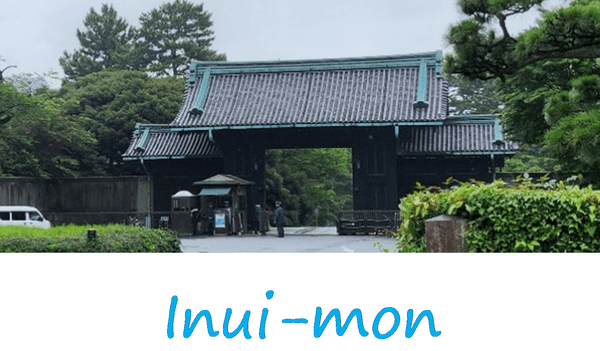
The Inui-mon is an entrance to the Imperial Residence grounds of the Fukiage section. During the rare annual events that give the public access to the Imperial Palace grounds, the tour can end by exiting through the Inui-mon entrance.
The gate is between the Kitanomaru and Fukiage gardens. Inui refers to it as northwest of the Imperial Palace complex position.
8. Tayasu-mon (田安門)
Of the original main gates of Edo Castle, only a few have survived over the years, and two of them are on the Kitanomaru Garden side: Tayasu-mon and Shimizu-mon. These two entrances are no longer controlled by an active guard.
According to the inscription, this access dates back to the early 17th century, but the Tayasu-mon gate is engraved with the year 1636, making it the oldest entrance gate to the fortified site.
When you pass through the first gate, you will face a second entrance, Tayasu-mon, located at 90 degrees to access the park. This style of access, which is found at several other gates of the castle, is strategically designed to slow down the troops arriving on the site. It is therefore a simple defense mechanism known as the Masugata style.
The space between the two entrances is rectangular and surrounded by high stone walls, thus helping to trap potential invaders. The Tayasu-Tokugawa family lived on the site of the Kitanomaru garden, and the name of the gate seems to be related.
The space between the two entrances is rectangular and surrounded by high stone walls, thus helping to trap potential invaders.
Another historic gate gives access to the Shimizu-mon garden.
The Tayasu-Tokugawa family lived on the site of the Kitanomaru garden, and the name of the gate seems to be related.
The area around the gate is particularly popular during the cherry blossom season.

9. Shimizu-mon (清水門)
Shimizu-moi is one of the few gates that have remained standing since the Edo period. This gate is rarely mentioned and is part of the Kitanomaru Garden, just like the Tayasu-mon gate.
Designated as an Important Cultural Property since 1961, this gate was rebuilt in 1658, making it one of the oldest from the shogunate period.
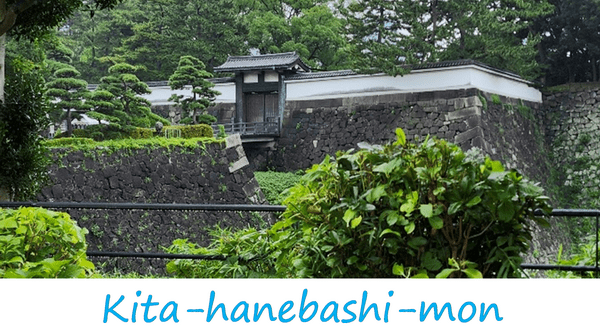
10. Kitahanebashi-mon (北桔橋門)
To access the East Garden of the Imperial Palace, there are three entrances: Ote-mon, Hirakawa-mon and Kitahanebashi-mon.
Kitahanebashi is one of the few entrances that had a drawbridge, just as the Ote-mon and Hirakawa-mon bridges did. Although there is no longer a drawbridge, the attachments to the roof of the gate are still visible.
11. Hirakawa-mon (平川門) / Otsubone-mon / Fujyou-mon
One of the entrances to the East garden of the Imperial Palace, Hirakawa-mon has a similar style to other entrances to the site with its double 90-degree entrance, but its location gave it a unique role as the entrance and exit dedicated to the reception of maids because, during the time of the shoguns, there was a harem (Ooku) on the site of Edo Castle. For this reason, it is nicknamed the Otsubone-mon gate.
But that’s not all, access to it also has another name, Fujyou-mon, which can be translated as “gate of the impurity”. It took this name when criminals had to be expelled or corpses evacuated from the site.
The access bridge to the entrance is embellished with a decorated balustrade.

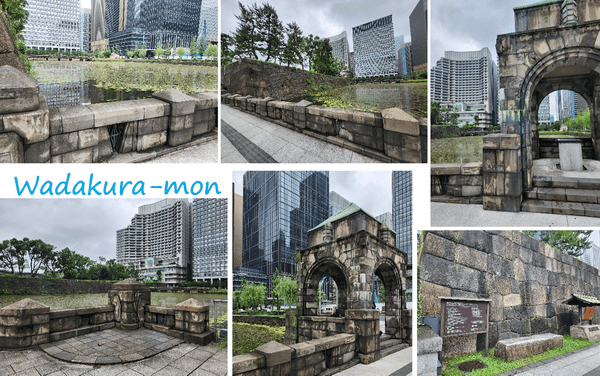
12. Wadakuramon(和田倉門) and the guardhouses
Wadakuramon is no longer part of the direct Imperial Palace grounds, but I wanted to add it to the list for its accessibility, the opportunity to get a glimpse of the impressive fortification, and its contribution to the current Imperial Palace site.
The size of the palace ground was significantly altered with the arrival of Emperor Meiji and the shock of the destruction of much of Tokyo during World War II. The site is smaller than it was during the Shogunate era, and some historical elements have been incorporated into the metropolitan landscape. This is the case with the Wadakura-mon gate. The sturdy reinforced gatehouse was salvaged to be used to renew the protective role of the Hanzo-mon entrance to the Imperial palace site.
The Wadakura-mon gate was, therefore, removed to replace the Hanzo-mon gate destroyed by the bombings. Wadakura-mon no longer exists, but the walls, the bridge and the guard post are next to those who pass by when traveling between the Wadakura fountain and Tokyo station.
This proximity allows the curious to see up close the ingenuity and precision of the work of the walls.
With the skyscrapers nearby, it is a beautiful setting that combines the past with modernity.
13. Tsubonemon and the other gates
Since the site had a larger area than today, different enclosures within the fortified walls existed. Thus, the number of accesses were surely more numerous.
Information on Tsubonemon Gate exists but is limited. This access was for the women’s quarters (Ōoku (harem)) during the Edo period. Since this area was very discreet and isolated, accesses were limited in an area that occupied a fairly large space of the east garden. However, we could not see it.
 Simple Travel and Recreation