
Taito
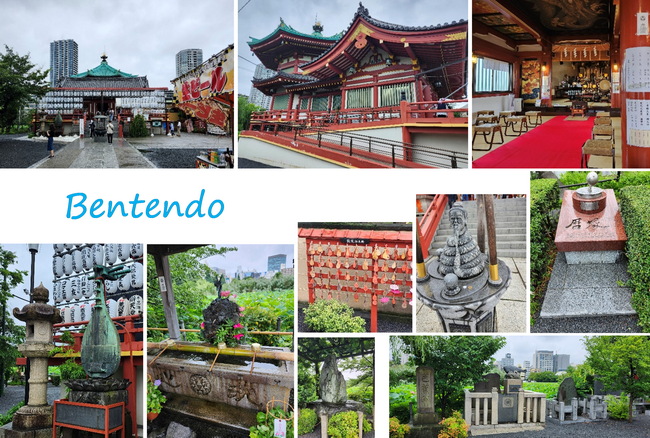
Bentendo is a Buddhist temple that doesn’t go unnoticed when you’re around Shinbazu Pond in Ueno Park. Its location and colors stand out remarkably in this setting.
Inspired by the Hogonji Temple on Chikubushima Island on the Lake Biwa, Bentendo Temple was originally located on a manmade island (Bentenjia) accessible only by boat. In 1672, a stone bridge was built to allow access on foot.
Initially, the temple was part of a very large complex of over 30 structures that was known as Kan’ei-ji. Major events changed the face of the 17th-century complex, including the Great Fire of Meireki (1657) and the Boshin War, which were so destructive that many sites were not rebuilt.
Benten is a diminutive of Benzaiten, a Japanese goddess worshipped in both Buddhist and Shinto cultures. Temples dedicated to her in Japan are mostly located near water and are associated with the sea dragon.
Her virtues are those of good fortune, knowledge, and being the patron saint of music. On this site, the biwa (Japanese lute), a four-stringed musical instrument is honored. At least two monuments depict this musical instrument. A bronze biwa on a pedestal is located to the left of the temple entrance, and another is set back to the left, where the instrument lies in front of a stone. In addition, wooden plaques (amulets) in the shape of a biwa are also offered.
Lotus-shaped lucky charms are also available. This flower has great significance on the site, it is associated with art, poetry, lightness, and purity. The Shinbazu Pond is covered with lotuses during the summer.
As you walk toward the temple, you can smell the scent of incense. Incense is a form of offering to pay homage, just like candles, flowers, or food found at shrines. Incense is used in several religions. The smoke rises like a prayer reaching for the heavens.
Two places are marked by the dragon: the welcoming purifying fountain, and inside the temple, a beautiful painting depicts a dragon on the ceiling.
Before reaching the temple steps, you will be greeted by an Ugaijin. This is a statue of a coiled white snake with the head of a bearded man and is worshipped for crops and fertility.
The white snake is said to represent female freedom. Benzaiten is, in fact, the only female of the seven deities associated with good luck in Japan. Furthermore, white snakes are associated with Benzaiten’s messengers, bringers of prosperity, and water deities.
The front of the temple is partially covered by a series of lanterns bearing the names of associations. The lanterns protect the temple, where prayers are inscribed.
The temple’s octagonal geometric shape and colors will become more striking as you move toward the back of the temple.
Take the time to approach and see the interior of the main hall, rebuilt in 1958. There, you can see a small but highly respected eight-armed statue called Happi-Benzaiten, surrounded by superb wall and ceiling paintings, as well as a drum. In each of the goddess’s hands there is a weapon to fight evil.
The dragon painting on the ceiling of the main hall was done by Kibo Kodama in 1966. Like the serpent, the dragon is associated with water spirits.
All around the temple, you can see a series of stones, sculptures, and monuments. These monuments have even taken unusual and revealing forms. As mentioned earlier, there are monuments related to the biwa, but also to fish, knives, glasses, and the calendar. After all, each one plays a role in our daily lives. One of them, the Torizuka, was erected by the Chicken and Egg Association as a token of gratitude and prosperity. Another was created by the Tokyo Automobile Association to mark its 30th anniversary, and another pays tribute to the pioneers who made it all possible. There is also the Shinobazu Pond Monument, which stands at the temple entrance.
So when you visit Benten-dō, you’ll be at the center of a historic site, whose architecture illuminates the enchanting natural setting.
Daikokutendo
Near Benten-do is a pavilion honoring Daikokuten, a deity associated with wealth, trade, and prosperity.
 Simple Travel and Recreation