
Taito
In the vast Ueno Park lies the Hanazono Inari Shrine, a Shinto shrine that can be viewed from variable depths. Indeed, one part of the site, the most mysterious side, is accessible via a gated passageway and restricted to worshippers. We respected this warning and were content to admire the more general aspect.
From what I understand, the hidden part features a small Inari statue nestled in an enclosed space: symbolizing the mountain. Originally, the statue was at the top of a cave and was known as Ana Inari. It was renamed after its relocation. Since photography is prohibited, it is difficult to learn more about the statue.
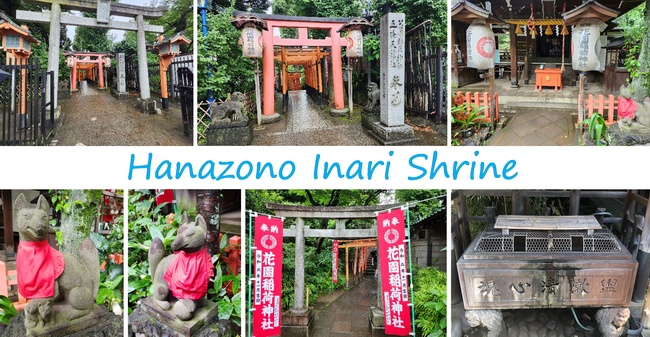
You’ll notice that the site here is protected by white foxes. This isn’t the only Shinto site linking Inari with foxes, but the information available on the links is conflicting.
It is said that the construction of the great pilgrimage site, the date of which is unknown, expanded to eliminate the foxes’ habitat and thus it was vital to commemorate the foxes at this location, but according to Japanese mythology, Inari Ōkami arrived on the back of a white fox to save the country from a rice famine. Hence its association with agriculture. In addition, the fox is known to be the messenger of the goddess Inari.
Still today, Inari has been depicted both as a female and as a male figures.
People come here to pray for abundance and successful harvests, whether commercial or financial, as well as for fertility and marital union.
The site has been known by several names associated with its surroundings. But over time, with wars, the Great Kanto Earthquake, the current name of Hanazono, dating back to 1873, translates to “flower garden” which represented the place at the time of its restoration during the Meiji period when the site was that of the Kan’eiji temple.
Note the chozubachi (stone basin) used for Temizu (purification ritual before entering a sacred site) rests on four demons at the four corners of the basin.
One of the entrances to the shrine is a series of torii gates painted in the distinctive vermillion orange of Shinto sites, donated by various businesses or families as a token of gratitude for their prosperity. A few steps lead down to the shrine.
A large plaque incorporating sculptures leans against a wall and lists the names of the donors. Although the site is not grandiose, its power seems to bring good luck to many.
The courtyard of the site is shared with the Gojoten Shrine.
For all my posts on Tokyo, click here.
 Simple Travel and Recreation